Quick answer
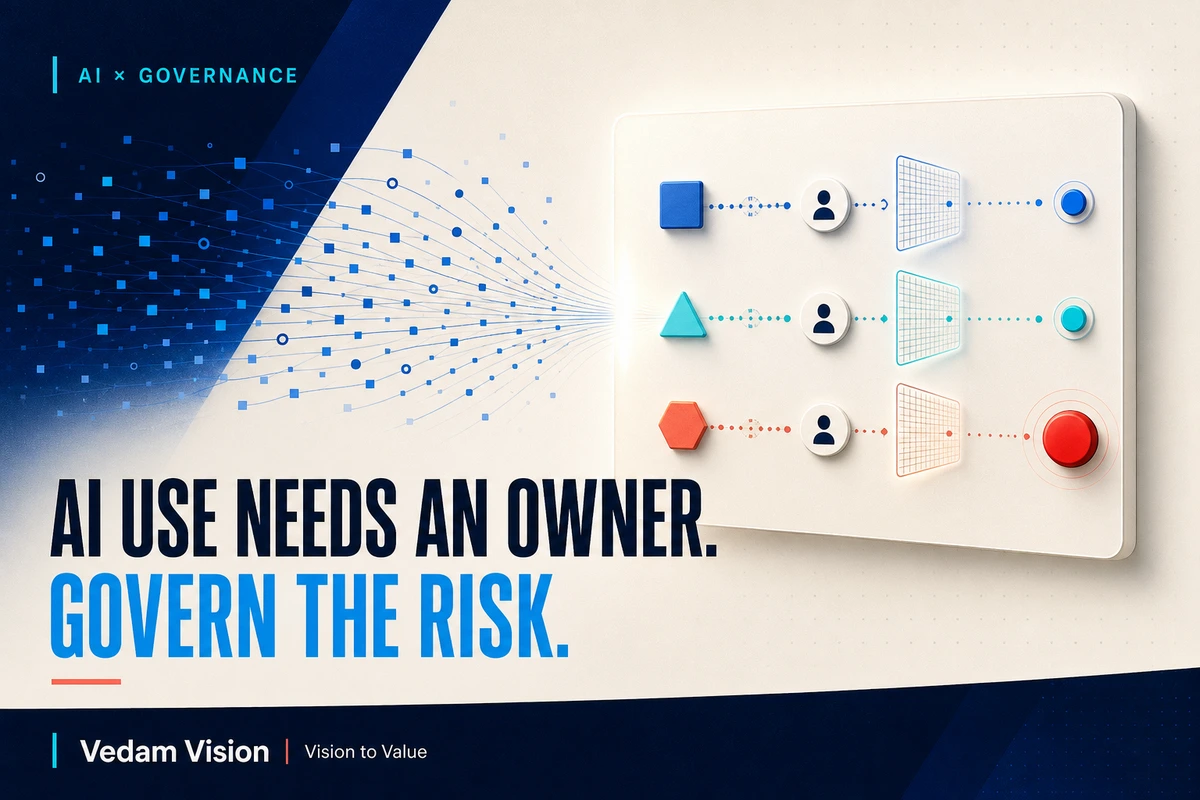
AI governance for small business does not require a large policy department. Start with an AI use register, named owners, simple data rules, risk levels, human review requirements, vendor checks, incident reporting, and scheduled review. Apply the strongest controls to decisions involving people, money, sensitive data, contracts, safety, or public claims. Keep low-risk experimentation easy, but never ownerless.
Small businesses are adopting AI through many doors.
A marketing executive uses a writing assistant. Sales uploads meeting notes into a summariser. HR tests a screening tool. Finance experiments with invoice classification. A founder connects an agent to email or a CRM.
Each use may look small. Together they create business risk that nobody owns.
Governance is the operating discipline that makes those uses visible and manageable. It is not a ban on experimentation. It is a way to decide which AI use is acceptable, what evidence is needed, who reviews the output, and what happens when something goes wrong.
NIST's AI Risk Management Framework is voluntary, sector-neutral, and designed for organisations of different sizes. Its core functions are often summarised as Govern, Map, Measure, and Manage. A small business can use the same logic without copying an enterprise compliance programme.
Start with visibility, not a fifty-page policy
You cannot govern an AI use you do not know exists.
Create a simple register with one row for each recurring use. Record:
- business task
- team and owner
- AI product or model
- input data
- output and audience
- whether the system takes an action
- possible harm if wrong
- human reviewer
- vendor and contract link
- approval status
- next review date
The register may be a spreadsheet. The important thing is that someone maintains it and leadership reviews material changes.
Do not attempt to list every casual brainstorming question. Focus first on repeatable uses, customer-facing output, automated actions, sensitive information, and decisions that affect people or money.
Use three practical risk levels
A smaller business needs a classification that employees can apply without specialist language.
Low risk
The AI assists with reversible internal work using non-sensitive information.
Examples include brainstorming headings, reformatting public material, drafting an internal checklist, or summarising a non-confidential article.
Controls may include basic fact checking, approved tools, and a reminder not to enter restricted data.
Managed risk
The output influences a customer, process, or business decision but a person reviews it before use.
Examples include sales email drafts, product descriptions, customer-service suggestions, meeting summaries, proposal analysis, and internal forecasting support.
Controls should include a named owner, approved sources, human review, documented prompt or workflow, sample testing, and a clear escalation path.
High risk
The use affects rights, employment, credit, pricing, safety, regulated activity, sensitive data, contracts, or autonomous actions.
Examples include candidate ranking, medical guidance, legal interpretation, payment release, dynamic price changes, or an agent that can send external messages and update records.
High-risk use may require legal, security, privacy, or domain review. Some uses may be inappropriate for the business to deploy at all.
Risk depends on context, not just the model. The same summariser may be low risk for a public article and high risk for confidential health records.
Set six minimum controls
1. A named business owner
Every recurring use needs one person accountable for its purpose, inputs, review standard, and continued operation.
The owner does not need to build the technology. The owner must understand why the business is using it and decide whether the result is acceptable.
2. Clear data rules
Create three data categories employees can remember:
- public or approved
- internal
- restricted
Restricted data may include personal information, payment information, health details, credentials, confidential contracts, unreleased financial information, customer databases, or trade secrets.
State which tools may receive each category. Use masking or synthetic examples when the task does not require real data. Check provider terms, retention controls, access settings, and the business's legal obligations.
3. Human review at the right point
"Human in the loop" is useful only when the person has authority, context, and time to challenge the output.
Define what the reviewer checks. For a marketing claim, that may be evidence, accuracy, tone, and approval rights. For a sales summary, it may be commitments, dates, pricing, and customer identity. For an automated action, review may need to happen before execution rather than after.
Never let familiarity turn review into a rubber stamp.
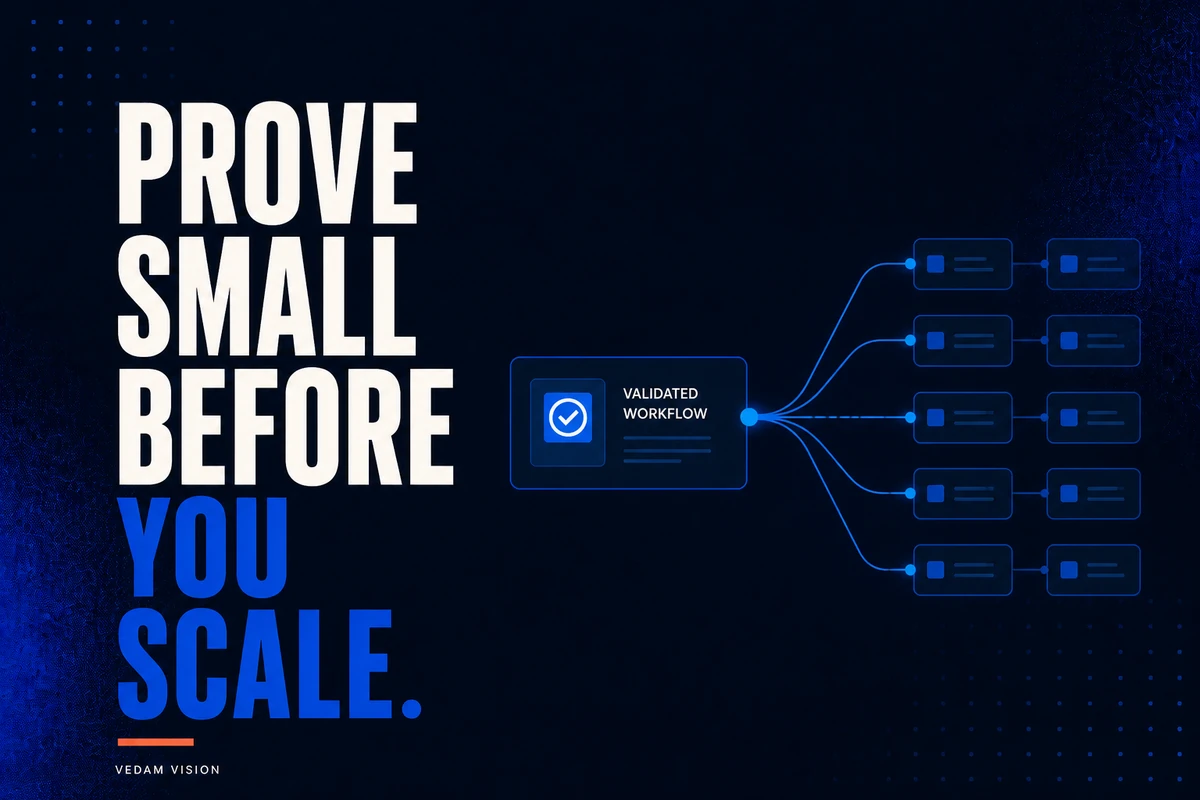
4. Testing before scale
Test normal cases, missing information, unusual inputs, sensitive inputs, and likely misuse.
Record failures. Decide which failures are tolerable, which require a warning, and which should stop the workflow.
NIST's Generative AI Profile expands the AI RMF for generative systems and emphasises risk management across design, use, evaluation, and monitoring. For a small team, the practical lesson is to test the workflow, not just admire one successful output.
5. Vendor checks
Before approving a tool, record:
- legal entity and contract owner
- data use and retention terms
- access controls
- export and deletion options
- model or service change policy
- security documentation
- incident notification process
- availability of audit logs
- cost controls
- exit plan
Do not treat a familiar brand as a complete risk assessment. The configuration and plan you use can change the data treatment.
6. Incident and correction process
Employees should know how to report an AI problem without hiding it.
An incident may include a false public claim, leaked information, biased recommendation, incorrect customer action, unauthorised tool, unexpected cost, or repeated workflow failure.
The response should identify the owner, contain the issue, preserve evidence, correct affected records or communication, notify appropriate people, and decide whether the use can resume.
A starter governance table
| AI use | Risk | Required owner | Human review | Minimum evidence |
|---|---|---|---|---|
| Public content draft | Managed | Marketing lead | Before publication | Sources and brand check |
| Meeting summary | Managed | Sales or project lead | Before CRM update | Transcript comparison |
| Internal idea generation | Low | Team user | Before action | Common-sense review |
| Candidate ranking | High | HR leader | Before any decision | Legal, fairness, and process review |
| Agent sending customer messages | High | Operations owner | Before or tightly bounded execution | Test set, logs, limits, rollback |
This table is a starting point. Add requirements relevant to the industry and use.
Make governance part of the workflow
Policies fail when they live away from the work.
Add approved-tool guidance to onboarding. Place data warnings near the AI interface. Put the reviewer field inside the content or automation checklist. Link the incident form where employees can find it. Review the AI register during an existing operations meeting.
Use short templates:
AI use request
What problem are we solving? What data enters? What output leaves? Who is affected? Who owns the result? What could go wrong? How will we test and stop it?
Output review
Are facts supported? Is restricted information absent? Are customer commitments correct? Is the result fair and appropriate? Does a person need to approve the next action?
Change review
Did the model, provider, data source, integration, prompt, audience, or level of autonomy change? If yes, reclassify the risk.
Vedam Vision's article on AI governance for Indian enterprises provides a broader governance view. A smaller business can keep the same principles while reducing paperwork.
Governance for agents needs stronger boundaries
An AI assistant that drafts text is different from an agent that can search records, send messages, create invoices, or modify a CRM.
For action-taking systems, define:
- allowed tools
- allowed records
- transaction or action limits
- prohibited actions
- approval thresholds
- identity and access rules
- complete logs
- rate and budget limits
- rollback or correction steps
- emergency stop owner
Give the system the least authority needed. Separate drafting from approval. Test with safe data before connecting production systems.
Teams exploring these workflows can review Vedam Vision's AI solutions and automation services. The sensible first deployment is a bounded workflow with a visible owner, not an agent with broad access.
A 30-day governance starter
Week 1: discover
List recurring AI uses and approved tools. Ask team leads where customer, employee, financial, or confidential data may enter.
Week 2: classify
Assign low, managed, or high risk. Name owners and human review points. Pause uses with unclear authority or unacceptable data handling.
Week 3: control
Publish data rules, approved tools, incident reporting, and two short checklists. Test the highest-value managed-risk workflow with normal and failure cases.
Week 4: review
Leadership reviews the register, exceptions, incidents, costs, and next approvals. Set quarterly reviews and immediate review triggers for material changes.
The aim is not perfect documentation. It is reliable visibility and ownership.
Governance should protect useful experimentation
A blanket ban pushes employees toward hidden use. No rules leave the business exposed.
The practical middle is clear permission.
Employees should know which tools are approved, what data is allowed, which outputs require review, and when to ask for help. Founders should know which uses are creating value and which carry material risk.
That is AI governance for small business at the right scale: simple enough to use, strong enough to matter, and ready to grow with the company.
Frequently asked questions
What is AI governance for a small business?
It is the set of roles, rules, records, reviews, and controls used to manage how the business selects, uses, monitors, and changes AI systems.
Do we need an AI governance committee?
Not always. A small company may use one accountable leader plus relevant operations, legal, security, HR, or domain reviewers when the risk requires them.
Which AI uses should be reviewed first?
Prioritise uses involving personal or confidential data, customer-facing claims, employment, money, contracts, regulated activity, safety, or autonomous actions.
How often should an AI use be reviewed?
Review important uses on a schedule and whenever the model, provider, data, prompt, integration, audience, purpose, or autonomy changes materially.
Can governance guarantee that AI will be safe?
No. Governance reduces and manages risk through ownership, controls, testing, monitoring, and response. It cannot eliminate uncertainty or replace suitable legal and domain advice.