Quick answer
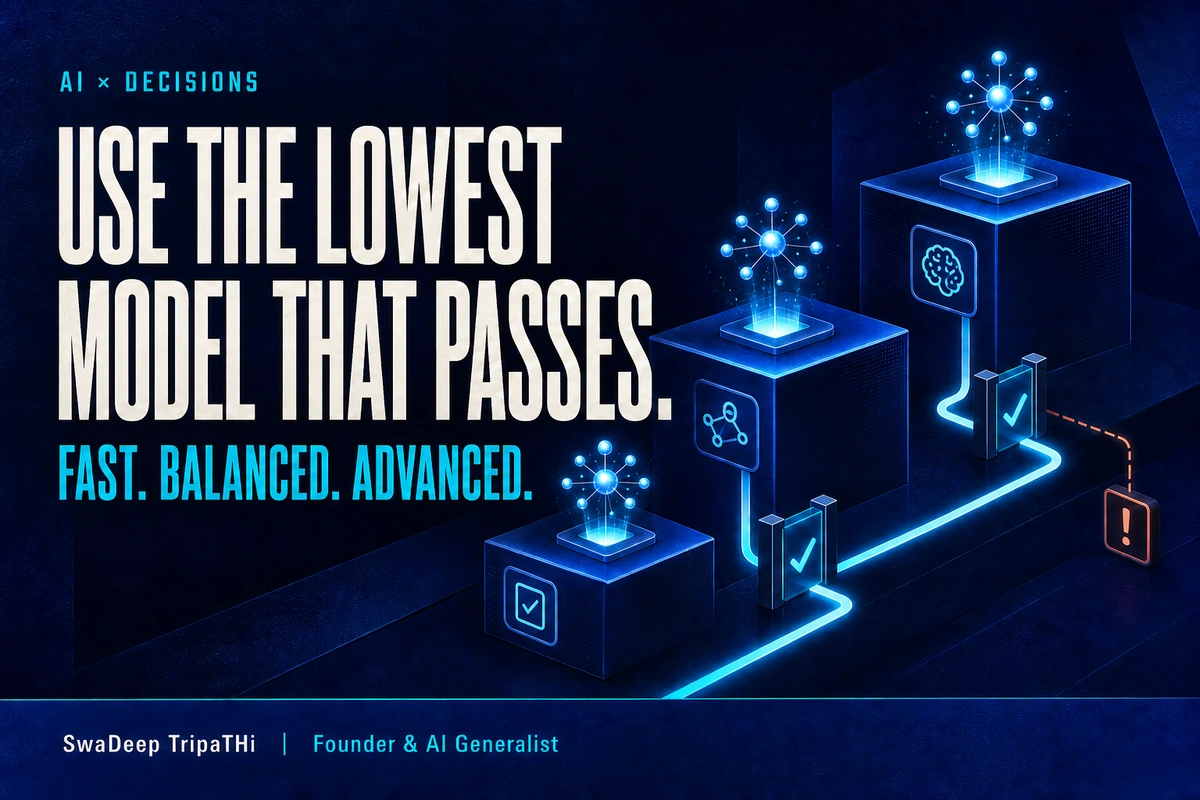
Use a three-level AI model selection ladder: start with a fast economical model for narrow, repeatable tasks; move to a balanced general model when context and output quality require it; reserve the most capable reasoning model for genuinely complex work where the value justifies higher cost and latency. Test every level on the same realistic cases, include human review and error cost, and choose the lowest level that reliably meets the business standard.
AI model selection often starts at the wrong end.
A team hears that a new flagship model is the smartest available and makes it the default for every prompt. The results may be strong. The bill, response time, and review process grow with them.
Another team chooses the cheapest model and spends hours correcting work it cannot handle.
Both mistakes come from treating model choice as a ranking contest.
Business teams need a routing decision. Which level of capability is enough for this task, with this data, at this volume, under this risk?
The ladder creates a disciplined default: begin lower, evaluate honestly, and move up only when the evidence requires it.
Why one model should not run every workflow
Business tasks vary more than model marketing pages suggest.
Classifying an enquiry into five categories is different from drafting a response. Drafting a response is different from comparing three contracts. Comparing contracts is different from recommending a financial or medical action.
The input length, ambiguity, reasoning depth, output format, error consequence, and speed requirement all change.
Official provider catalogues reflect these tradeoffs. OpenAI's model documentation separates models by capability, price, speed, context, and tools, while its comparison view makes those differences visible.
The catalogue helps create candidates. Your own evaluation chooses the model.
The three-level ladder
Level 1: fast and economical
Use Level 1 for narrow, frequent tasks with clear instructions, structured outputs, and recoverable errors.
Good candidates include:
- Classifying support tickets
- Extracting known fields from standard documents
- Reformatting approved content
- Tagging leads by defined criteria
- Summarising short routine notes
- Checking whether required fields are present
These tasks benefit from volume, speed, and predictable structure. They do not usually require broad reasoning.
Level 1 still needs testing. A small model may fail when a document is noisy, a customer mixes languages, or the input falls outside the expected format. Define confidence and fallback rules.
For example, an invoice extraction workflow can use Level 1 when required fields are readable. If the invoice layout is unknown or values conflict, route the case to Level 2 or a person.
Level 2: balanced general capability
Use Level 2 when the task needs more context, nuance, writing quality, or multi-step understanding, but still follows a repeatable workflow.
Candidates include:
- Drafting a customer response from approved policy
- Summarising a long sales call with actions and objections
- Comparing proposals against a standard checklist
- Producing first-pass campaign variations
- Answering internal questions from a curated knowledge base
- Reviewing a document for inconsistencies
This level is often the practical default for business applications. It can handle variation without paying for maximum capability on every request.
The output should still be bounded. Give the model source material, required structure, decision rules, and a clear instruction to identify uncertainty rather than invent an answer.
Level 3: advanced reasoning and complex synthesis
Use Level 3 when the task involves several interacting constraints, ambiguous evidence, long-range reasoning, tool use, or a high value per successful result.
Candidates might include:
- Analysing a complex operational problem across several documents
- Planning a migration with dependencies and risk tradeoffs
- Investigating a difficult code or data issue
- Comparing strategic options with explicit assumptions
- Coordinating a multi-step research workflow
High capability does not make the output automatically safe. For legal, financial, medical, employment, safety, or other consequential decisions, a qualified person must own the judgment. The model can support analysis without becoming the accountable decision-maker.
Level 3 should be the exception earned by the task, not a prestige default.
Choose the lowest level that passes
The ladder works only when the pass standard is defined before the comparison.
Create a realistic evaluation set. Include normal cases, hard cases, mixed-language inputs, missing information, and examples where the correct response is to decline or escalate.
Then score each candidate on the same dimensions:
| Measure | What to check |
|---|---|
| Task success | Did the output complete the requested job? |
| Factual grounding | Is the answer supported by the supplied source? |
| Format reliability | Did required fields and structure remain valid? |
| Review effort | How many human minutes were needed? |
| Error severity | What could the failure cost or harm? |
| Latency | Is response time acceptable for the workflow? |
| Full unit cost | What is the cost per accepted output? |
Start with Level 1. If it passes the required threshold, stop. If it fails in a way that matters, test Level 2. Move to Level 3 only when Level 2 cannot meet the standard and the expected value justifies the step.
This prevents a team from choosing higher capability because the prose feels more impressive.
Build the evaluation from real work
Provider benchmarks are useful for orientation. They rarely match your exact process.
Google Cloud's official generative AI evaluation guidance describes evaluation as a data-based process that can support model migration and comparison. Its documentation also discusses custom rubrics and evaluation datasets.
For a small business, the first evaluation can be a spreadsheet.
Collect 30 to 100 representative cases, depending on the task. Remove personal or sensitive data unless it is truly required and permitted. Have a knowledgeable person define the expected qualities or reference answer.
Do not let the model that is being tested write the only scoring rule.
For subjective work, use a rubric. A sales summary might be scored for factual accuracy, captured actions, objections, owners, and unsupported claims. For structured extraction, compare exact fields and record exception types.
Add routing instead of forcing one default
Many workflows work best as a ladder in production, not only during selection.
Use Level 1 for the normal path. Route difficult cases upward when a rule identifies uncertainty, missing data, unusual length, conflicting evidence, or a failed validation.
A simple pattern is:
- Level 1 attempts the task.
- Automated checks validate format and required fields.
- Low-confidence or failed cases move to Level 2.
- Complex exceptions move to Level 3 or a human specialist.
- High-impact decisions always receive the required human review.
Routing can improve economics because expensive capability is used where it adds value.
It also makes failures visible. A system that silently asks the same model to retry five times is not a ladder. It is a hidden cost loop.
Vedam Vision's guide to AI tools that actually save small businesses time and money explains why workflow design matters more than a long tool list.
Include review time in the cost
The lowest API price is not always the lowest workflow cost.
Suppose Level 1 costs less per request but requires six minutes of correction. Level 2 costs more per request and requires one minute. The labour difference may make Level 2 cheaper per accepted output.
Use this formula:
Full unit cost = provider and platform cost + human preparation + review + rework + maintenance, divided by accepted outputs
Record the currency used by the provider and the company's own labour assumption. Avoid hard-coding volatile model prices into a long-lived business case. Pull current figures from the provider and date the comparison.
Vedam Vision's article on calculating AI ROI for Indian SMBs can help connect full unit cost with time, error, revenue, and capacity effects.
Match the level to the consequence
Capability and risk are separate axes.
A powerful model can still invent information. A small model can still expose sensitive data if the workflow is poorly designed. Model choice does not replace governance.
The NIST AI Risk Management Framework Core calls for measurement before deployment and during operation, including performance and risk. It also emphasises that risk management continues across the system lifecycle.
For each workflow, record:
- Business owner
- Allowed inputs and prohibited data
- Model level and version
- Test set and pass threshold
- Human review rule
- Escalation path
- Monitoring metrics
- Re-evaluation date
Vedam Vision's guide to AI governance for Indian enterprises provides a wider control structure for ownership and review.
Avoid three common selection mistakes
Comparing outputs with different prompts
Use the same instructions, source material, tools, and scoring rule where possible. If a model needs a different prompt, document the difference and include prompt maintenance in the decision.
Testing only easy cases
Easy cases make every model look acceptable. Include the exceptions that drive review cost and customer risk.
Selecting once and forgetting
Models, prices, limits, and business tasks change. Re-run the evaluation when the provider changes a model version, the workflow changes materially, or monitoring shows quality drift.
Vedam Vision's article on choosing AI vendors in Indian markets is helpful when model selection also changes the commercial and operational relationship.
A one-week model selection sprint
On day one, name the workflow, owner, baseline, risk level, and pass threshold. On day two, build the evaluation set and scoring rubric.
On day three, test Level 1 and record failures. On day four, test Level 2 only where needed. On day five, test Level 3 on the unresolved complex cases.
During day six, calculate full unit cost and review the operating fit, including language, latency, integration, and provider conditions. On day seven, document the selected level, routing rules, controls, and re-evaluation date.
The output is not a declaration that one model is best. It is a reasoned choice for one workflow.
Frequently asked questions
What are the three levels in an AI model selection ladder?
Level 1 is fast and economical for narrow repeatable tasks. Level 2 balances capability, context, and cost for varied workflows. Level 3 is reserved for complex reasoning and high-value synthesis.
Should a business always start with the cheapest AI model?
Start with the lowest capability level that might fit, not blindly with the lowest price. The model must meet quality, review, latency, format, and risk requirements.
How many examples are needed to compare AI models?
Use enough representative cases to include common work and meaningful edge cases. A small workflow may begin with 30 to 100 curated examples and expand the set as failures appear.
Can different models be used in one workflow?
Yes. Routing normal cases to a lower level and difficult cases upward can improve cost and quality, provided the triggers, validation, monitoring, and human review are clear.
How often should AI model selection be reviewed?
Review it when the model or price changes, the workflow changes, quality drifts, incidents occur, or at a scheduled interval appropriate to the task's volume and risk.
Capability should be earned by the task
The best model is not the most capable model in the catalogue. It is the lowest level that reliably meets the standard for a specific workflow.
Start with the task. Build the evaluation. Count review effort. Route exceptions. Keep risk ownership human. Then document why the chosen level deserves its place.
If your team needs a measurable model selection and routing process, Vedam Vision's AI solutions and automation service can help connect model capability to workflow economics, controls, and ongoing evaluation.