Quick answer
Adobe Firefly creative workflows are moving beyond one prompt and one asset. Adobe's June 2026 update introduced agentic capabilities and an upgraded studio designed to connect ideation, creation, production, variation, and feedback. For Indian creative teams, the opportunity is not simply faster image generation. It is reducing avoidable handoff friction while keeping the brief, brand rules, cultural judgment, rights review, and final approval with people.
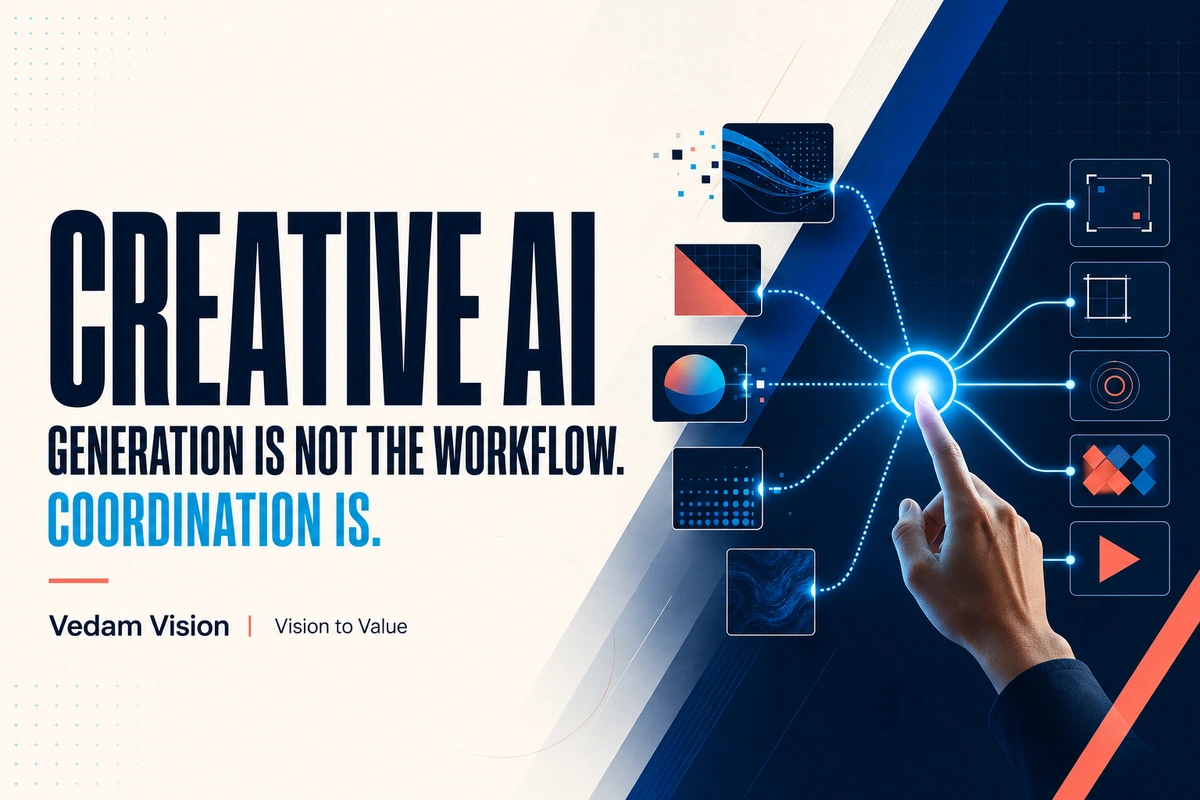
Creative AI is moving from generating assets to coordinating work.
Adobe's official June 2026 Firefly announcement describes a creative agent, AI Assistant capabilities, and a studio intended to bring more stages of the creative process together. Adobe frames the problem around tab switching, tool switching, model switching, and the interruptions that make momentum disappear.
That is a more useful problem than asking whether another image model can produce an attractive picture.
Most professional creative work is a chain. A campaign moves from brief to references, exploration, selection, copy, design, resizing, review, revision, legal checks, and delivery. Generation is one part of that chain.
When AI begins coordinating the chain, the valuable human work moves upward. Someone still needs to define the idea, protect the brand, reject weak directions, and decide what is ready to publish.
What Adobe announced in June 2026
Adobe said Firefly AI Assistant in beta includes new creative skills, tools, and personalisation capabilities. The company also previewed an upgraded Firefly creative AI studio that connects work from ideation through production.
Adobe's Firefly what's new page lists a redesigned experience with quicker access to image, video, audio, and design workflows. Product access, beta status, credit use, and pricing can change, so teams should verify current details before planning production around a feature.
The durable shift is coordination.
An AI assistant may help interpret a direction, prepare variations, move work between formats, or reduce repeated setup. That can save time, but it also raises questions about brand context, approvals, file ownership, and quality control.
Map the real creative workflow first
Before adding another tool, write down how a typical asset reaches the market.
For an Indian D2C campaign, the path may look like this:
- marketing writes the offer and target audience
- the creative lead defines the campaign idea
- a team gathers references and product information
- designers explore key visuals
- copy is adapted for English and regional language use
- approved work becomes web, marketplace, social, and WhatsApp formats
- stakeholders review prices, dates, claims, and legal details
- files are delivered and publication is logged
The slowest stage may not be visual generation. It may be a missing product photo, unclear offer, late feedback, unsupported claim, or repeated resizing request.
Vedam Vision's guide to AI content creation for Indian brands explains why AI output still needs research, brand context, cultural review, and editorial control.
Where coordinated AI can remove friction
Turning a brief into structured starting points
AI can extract the audience, offer, required formats, mandatory text, proof, restrictions, and deadlines from a brief. It can flag what is missing before design begins.
This is useful when briefs arrive through email, WhatsApp, or a document with mixed comments. The system should not invent the missing facts. It should ask for them.
Keeping reference material together
A coordinated workspace can keep the approved logo, palette, type choices, product images, packaging rules, and example assets close to the task.
Context should be selected rather than dumped. Old campaigns, outdated prices, and draft logos can create confident mistakes. Give someone responsibility for the current source of truth.
Creating deliberate variations
More variations are not automatically more useful.
Ask for contrasting strategic directions rather than twenty cosmetic changes. One direction might emphasise product proof, another customer situation, and a third a distinctive brand idea. The creative lead can then judge real tradeoffs.
Adapting approved work across formats
Once the core idea is approved, AI can assist with crops, aspect ratios, background extensions, subtitle preparation, version naming, and platform checklists.
Every adaptation still needs inspection. A crop can remove a product, disclaimer, or cultural cue. A translated line can overflow. A mobile layout can bury the offer.
Consolidating feedback
AI can group comments, identify conflicts, and create a revision list. It should preserve who requested what and should not decide which stakeholder has authority.
A useful feedback summary separates mandatory corrections from preferences, legal issues, and new scope.
What must stay human
The idea
An idea is more than a visual style. It connects the business objective with something the audience can notice, understand, and remember.
AI can broaden exploration and challenge a familiar direction. A creative lead still needs to decide whether the concept is distinctive, appropriate, and worth the brand's attention.
Brand judgment
Brand rules are not only colour values and logo clearance. They include tone, promises, exclusions, customer expectations, and the standard the company wants to protect.
For an Indian brand, judgment may include regional language nuance, festival symbolism, clothing, family roles, food practices, or category-specific sensitivity. A technically clean output can still feel culturally careless.
Truth and rights review
Someone must verify prices, dates, product claims, testimonials, certifications, and performance statements. The team must also review rights, licenses, releases, and platform terms appropriate to the asset.
Do not treat a polished generated image as proof that its content is accurate or safe to use.
Final approval
Approval should sit with a named person who understands the objective and consequence. A campaign should not publish because every automated step completed successfully.
The final reviewer needs the brief, source material, mandatory text, restrictions, and a view of all important formats.
A coordinated workflow for an Indian SME team
Consider a five-person marketing team preparing a festive offer for a regional retail brand.
The team begins with a structured brief containing the offer, dates, stores, target customers, approved product information, language requirements, and mandatory conditions.
AI helps organise the brief and proposes three creative territories. The creative lead selects one and records why it fits.
Designers develop the main visual using real product material and approved brand assets. AI assists with background exploration and version preparation.
The chosen design is adapted for Instagram, a website banner, marketplace images, WhatsApp, email, and in-store screens. Each output uses a checklist for text, crop, product, price, date, and disclaimer.
A marketing owner checks the offer. A language reviewer checks local copy. A creative lead checks brand and craft. Publication happens only after the named approvals are logged.
This workflow uses AI in several places without asking it to own the campaign.
Vedam Vision's content and creative production service covers photography, video, copy, motion, and campaign production. Coordination matters because these outputs often depend on the same brief and approval chain.
Set up a useful creative source of truth
A coordinated system is only as good as its context.
Keep a compact, maintained set of assets:
- current logo files and usage rules
- approved colours and typefaces
- product names, descriptions, and claims
- current prices and offer conditions
- real product and team photography
- language and tone examples
- restricted words and visual treatments
- standard disclaimers
- final approval owners
Do not add every old campaign. Archive is not context.
Version the important files and make expiry visible for time-sensitive information. A creative agent that reads last quarter's offer can produce a polished problem very quickly.
Measure workflow quality, not asset count
Generating more images is easy to count. It is not enough.
Track:
- time from approved brief to first review
- number of meaningful directions, not raw variations
- correction rounds caused by missing information
- errors in price, text, crop, or disclaimer
- time spent on resizing and file preparation
- percentage of assets approved without brand correction
- reuse of approved components and source material
Use a baseline from recent campaigns. A tool that produces more drafts but creates more review work may not improve the system.
Questions to ask before adopting a creative AI studio
- Which stages of our workflow does it actually connect?
- Can we control which brand assets and sources it uses?
- How are versions, comments, and approvals recorded?
- Which models or services process our files?
- What rights and commercial-use terms apply to each output?
- Can we prevent publication or export before approval?
- How does the system handle regional scripts and long text?
- Can our team retrieve editable source files and history?
Answers should be reviewed against the real campaign process, not a demonstration.
Vedam Vision's article on building AI-powered websites in 48 hours makes a related point: AI can compress drafting and production, but positioning, trust, conversion logic, and quality assurance still need people.
Frequently asked questions
What are Adobe Firefly creative workflows?
They are connected creative processes using Firefly capabilities across tasks such as ideation, generation, editing, variation, and production. Current feature access and beta terms should be checked with Adobe.
Does coordinated creative AI replace a creative team?
No. It can reduce setup, switching, adaptation, and preparation work. People still define the idea, brand judgment, cultural fit, truth, rights, and final approval.
Which creative task should an Indian SME coordinate first?
Start with a repeated, low-risk task such as brief extraction, format planning, feedback consolidation, or resizing approved work. Measure correction time before expanding.
How can a brand reduce inconsistent AI creative?
Maintain a current source of truth, provide selected approved examples, define restricted claims and visual treatments, and require review against a clear brief.
What should a team measure in a creative AI pilot?
Measure cycle time, meaningful directions, correction rounds, factual errors, adaptation effort, and approval quality. Raw asset volume is not a sufficient outcome.
Coordinate the friction, protect the judgment
Adobe's Firefly update signals a wider move from isolated generation toward connected creative work.
That can help teams spend less time moving files, rebuilding context, and repeating low-value preparation. It does not remove the need for a strong brief or a responsible final decision.
Map the workflow. Fix the handoffs. Give AI the repetitive coordination. Keep the idea, truth, brand, and approval with people.