Quick answer
An AI strategy for business should begin with a decision that needs to improve, not with a tool the company wants to buy. Define the business outcome, give the system the context it needs, decide what evidence makes an answer trustworthy, and assign a human owner. AI can then accelerate research, analysis, drafting, or routine execution without taking accountability away from the people running the business.
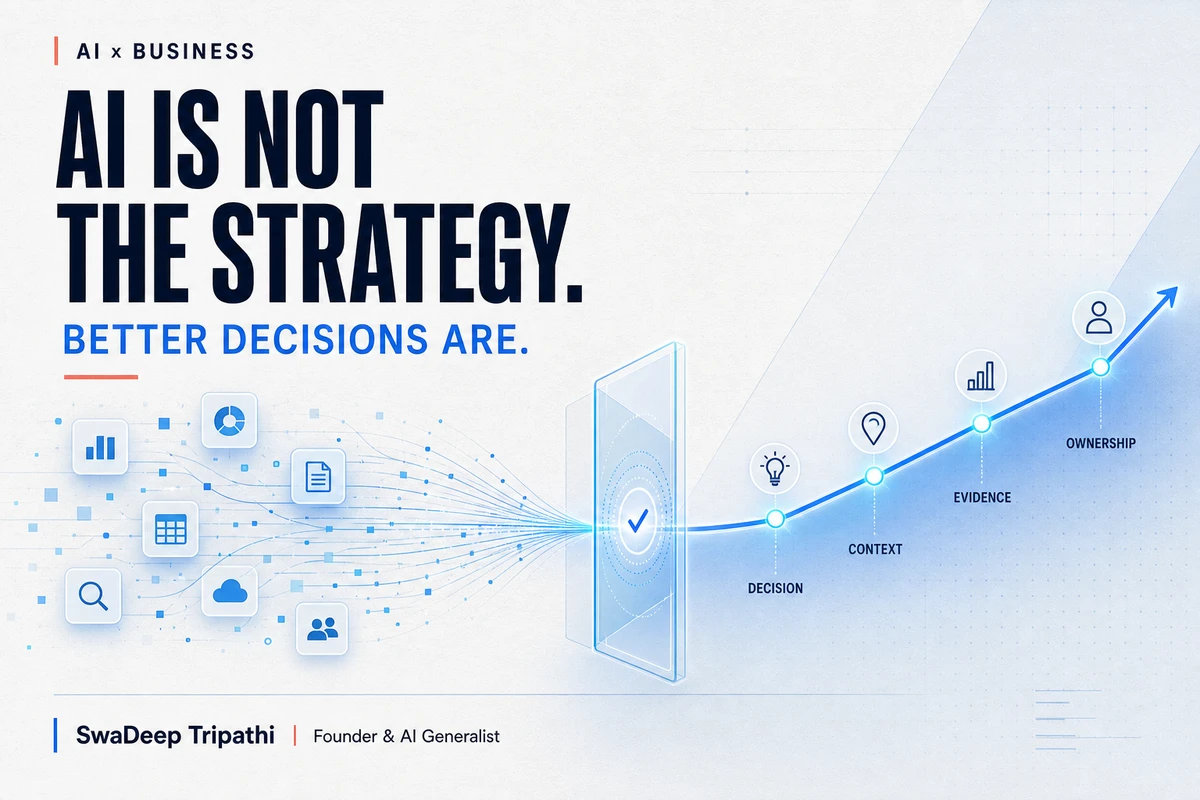
AI is not the strategy.
Better decisions are.
That distinction matters because it is easy to add AI to a workflow without improving the workflow itself. A team can generate reports faster, produce more campaign ideas, answer more customer questions, and still make the same weak calls. The output arrives sooner, but the thinking behind it has not changed.
This is especially relevant for Indian small and medium businesses. Most SMEs do not have spare time, unlimited budgets, or large transformation teams. A new subscription has to earn its place. It should help the business make a decision with more speed, better evidence, or greater consistency. If it cannot do that, it is probably adding activity rather than value.
The opportunity is real. Microsoft's 2025 Work Trend Index described an emerging model of work built around human-led teams using AI assistants and agents. The report also found that 82 percent of surveyed leaders considered that year pivotal for rethinking strategy and operations. The useful message for a business owner is not that every company needs an agent. It is that AI adoption should be connected to how work and decisions are designed.
Why a tool-first AI plan usually disappoints
A tool-first plan begins with a product name.
"We should use AI for marketing."
"We need a chatbot."
"Let us automate sales follow-up."
These statements sound active, but they leave the important questions unanswered. Which marketing decision needs to improve? What should the chatbot be allowed to say? Which sales leads deserve immediate attention? What happens when the system is uncertain or wrong?
Without those answers, the team usually finds one of three problems.
First, the output is generic because the AI does not have enough business context. It knows how to write a polite message, but it does not know the company's actual offer, target customer, pricing logic, service limits, or brand voice.
Second, nobody agrees on what good looks like. One person expects more leads, another expects faster content, and a third expects lower costs. The pilot may produce plenty of output while still being judged as a failure.
Third, responsibility becomes unclear. People may trust the result because it sounds confident, or reject every result because they do not know how it was produced. Both reactions are expensive.
NIST's AI Risk Management Framework offers a useful way to think about this problem. It organizes responsible AI work around four functions: govern, map, measure, and manage. The framework is voluntary and designed for organizations of different sizes. Its practical lesson is simple: context, measurement, roles, and ongoing management belong in the system from the beginning.
Start your AI strategy with one business decision
Do not begin by asking where AI can be used across the whole company. That question is too broad to produce a disciplined first project.
Choose one recurring decision that is important enough to matter and narrow enough to test.
For a service business, that decision might be which inbound enquiries need a call within ten minutes. For an ecommerce company, it might be which product questions can be answered automatically and which require a support specialist. For a marketing team, it might be which campaign concepts are strong enough to enter creative production.
A useful decision has an owner, inputs, a desired outcome, and a consequence when it goes wrong. Once those elements are visible, the role of AI becomes easier to define.
Before selecting a tool, ask four questions.
1. What decision should improve?
Describe the decision in operational language.
"Use AI for marketing" is too vague.
"Reduce research time for campaign planning while keeping every factual claim source checked" is much clearer.
The second version tells the team what should become faster and what quality control must remain. It also creates a testable outcome. The company can compare research time, the number of usable campaign angles, and the rate of unsupported claims before and after the pilot.
Good AI use cases often sit near frequent, repeatable decisions. They may involve classifying enquiries, summarising documents, finding patterns in feedback, drafting responses, or preparing options for a human reviewer. The final decision does not always need to be automated. In many cases, the greatest value comes from helping a person reach a better decision sooner.
2. What context should the system never have to guess?
AI output is shaped by the information available to it. A capable model with weak context can still produce a poor business answer.
List the facts, rules, and boundaries that the system needs. These may include:
- Current products, services, and prices
- The customer segments the business serves
- Approved claims and prohibited claims
- Delivery areas, timelines, and refund rules
- Brand voice and language preferences
- Examples of acceptable work
- Escalation rules for sensitive or unusual cases
An Indian SME may also need local context that a generic system will not reliably infer. That can include GST treatment, cash-on-delivery policies, WhatsApp-first customer behaviour, regional language needs, city-level service coverage, or festival-related demand patterns.
Context should be maintained, not pasted once and forgotten. Prices change. Offers change. Regulations change. A reliable workflow needs a clear source of truth and a person responsible for keeping it current.
Vedam Vision's guide to AI content creation for Indian brands makes the same practical point for content teams: AI works best as part of a human-led workflow, with research, cultural context, expert review, and brand editing around it.
3. What evidence makes the answer trustworthy?
Fluent writing is not evidence.
If an AI system recommends a campaign angle, qualifies a lead, summarises a contract, or produces a market claim, the user needs a way to inspect the basis of that output.
The right evidence depends on the decision. It could be a link to a primary source, a quotation from an approved knowledge base, a CRM field, a customer message, or a calculation that can be reproduced.
For content and research workflows, require source links for factual claims. For customer support, restrict the system to approved documentation and make uncertainty visible. For lead scoring, document which fields affect the score and test the logic against real cases. For financial or legal decisions, use qualified human review and the controls appropriate to that risk.
NIST recommends testing AI systems before deployment and monitoring them while they are in operation. That does not mean every SME needs a complex compliance programme. It means a business should decide how accuracy will be checked before customers or employees depend on the output.
4. Who owns the result when it goes wrong?
Every business workflow needs a named owner.
The owner is not the software vendor, the prompt, or the model. It is a person with the authority to review performance, correct errors, update rules, and stop the system if the risk becomes unacceptable.
Ownership should be matched to impact. A low-risk tool that groups internal notes may need occasional review. A customer-facing assistant that discusses prices, health information, credit, contracts, or refunds needs tighter approval and escalation rules.
This is where human judgment stays essential. People set direction, understand consequences, handle exceptions, and remain accountable. AI can prepare options or execute defined tasks, but the business still decides what outcome it is willing to accept.
What a decision-first AI workflow looks like
Consider a typical inbound lead process for an Indian service company.
The company receives enquiries from its website, WhatsApp, social media, and phone calls. The sales team responds in the order messages appear. Some high-intent leads wait too long, while the team spends time chasing enquiries that do not match the service.
A tool-first response would be to buy a chatbot.
A decision-first response is to define the decision: which enquiry should receive a human call first?
The team can then define the required context, such as service needed, location, budget range, timeline, and consent to be contacted. It can identify trustworthy evidence from the customer's own answers. It can assign sales leadership as the owner of the scoring rules and require a human to review uncertain or high-value cases.
AI may help summarise the enquiry, detect missing information, assign a provisional priority, and draft a reply. It should not invent a budget, promise availability, or reject a potential customer based on information the company never collected.
This design is less exciting than announcing a new bot. It is also far more likely to improve the business.
For companies that need help mapping practical workflows, Vedam Vision's AI solutions and automation service covers assistants, lead qualification, workflow automation, and content systems built around existing business processes.
Measure decisions, not output volume
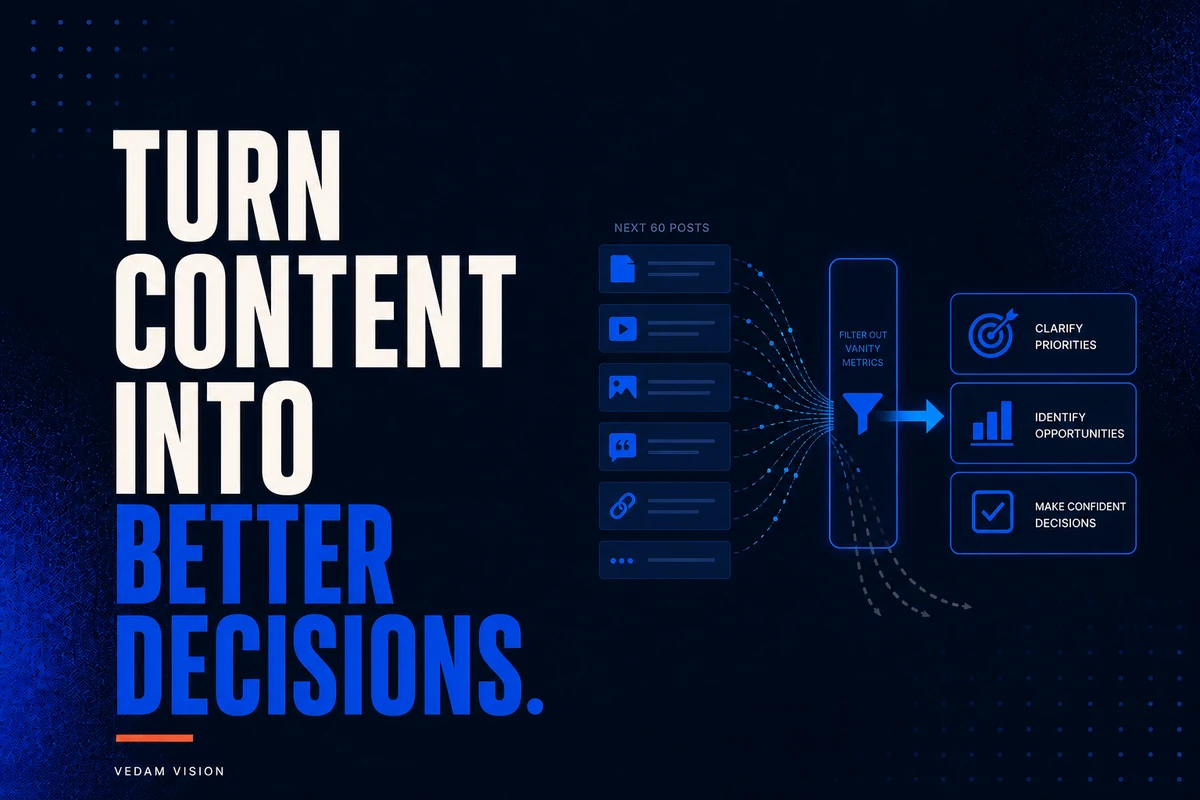
AI projects often report what is easiest to count: prompts sent, messages generated, articles drafted, or hours estimated. Those figures may describe usage, but they do not prove that the business is making better decisions.
Choose measures tied to the outcome.
For a research workflow, track time to a usable brief, source coverage, factual corrections, and the percentage of ideas approved for testing. For lead qualification, track response time, qualified appointments, false positives, and missed high-intent leads. For customer support, track resolution quality, escalation accuracy, repeat contacts, and customer satisfaction.
Include a baseline from the current process. Without a baseline, a faster workflow can feel impressive while delivering no meaningful improvement.
Keep the pilot small enough to review closely. Test with real examples, including difficult cases. Record why outputs were accepted, edited, or rejected. Those review notes are valuable because they expose missing context and weak rules.
Where human judgment should remain
There is no single boundary that fits every company. Risk, regulation, customer expectations, and the cost of an error all matter.
As a general principle, keep people close to decisions involving significant financial consequences, legal commitments, safety, employment, sensitive personal data, brand reputation, or unusual customer situations. Use AI to organise information and surface options, but require a qualified person to approve the final action.
Routine work can often move further toward automation once the inputs, rules, monitoring, and exception paths are stable. Even then, the system needs review because business conditions and model behaviour can change.
Microsoft's Work Trend Index describes a progression from a person using an assistant, to human-agent teams, and eventually to human-led processes where agents execute more of the workflow. The phrase "human-led" is the important part. Automation can expand, but direction and accountability do not disappear.
A practical next step for business leaders
Open a blank page and write down one decision your team makes repeatedly.
Then answer these questions in plain language:
- What should become faster, more accurate, or more consistent?
- Which information must the system use?
- What evidence must appear with its recommendation?
- Who reviews the result and owns the outcome?
- Which metric will show whether the decision improved?
Only after this exercise should you compare tools.
The tool matters, but it comes later. A modest model inside a well-designed process can create more value than an advanced model inside a confused one.
Frequently asked questions
What is an AI strategy for business?
An AI strategy for business is a plan for using AI to improve specific business outcomes while defining context, controls, measurement, ownership, and human oversight. It should connect technology choices to real decisions and workflows.
Should a small business automate an entire workflow at once?
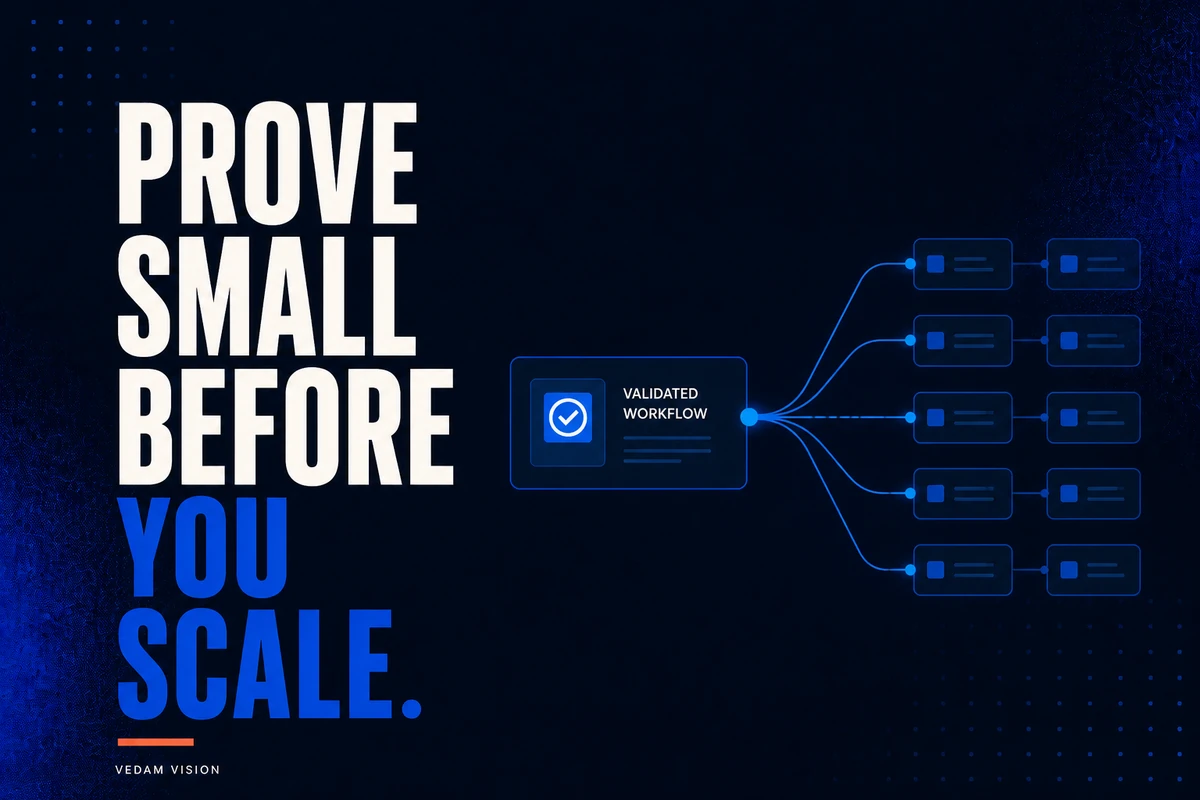
Usually, no. Start with one bounded decision or task that occurs frequently and can be reviewed. Establish a baseline, test with real cases, and expand only when quality and exception handling are reliable.
How do we choose the first AI use case?
Look for a recurring process with clear inputs, an identifiable owner, measurable delay or inconsistency, and manageable risk. Avoid beginning with a sensitive, poorly understood, or rarely performed decision.
How can a business reduce inaccurate AI output?
Provide approved context, require evidence for factual claims, restrict the system to reliable sources where possible, test it with difficult examples, and keep human review proportional to the risk. Monitor performance after launch rather than treating the first version as finished.
Does human review remove the benefit of AI?
No. AI can still reduce research, sorting, drafting, and preparation time. Human review protects the decision where context, consequences, or uncertainty require judgment. The goal is not to remove people from every step. It is to use their time where it matters most.
Better decisions create the advantage
Buying more AI does not create a strategy.
A strategy appears when a business knows which decision it wants to improve, which context the system needs, what evidence makes the output trustworthy, and who remains accountable.
That is how AI moves from an interesting tool to useful business infrastructure. It helps people think faster without asking them to surrender judgment. It reduces repetitive work without hiding responsibility. Most importantly, it gives the company a way to measure whether the technology is helping at all.
Start with the decision. The right tool will be much easier to choose after that.