Quick answer
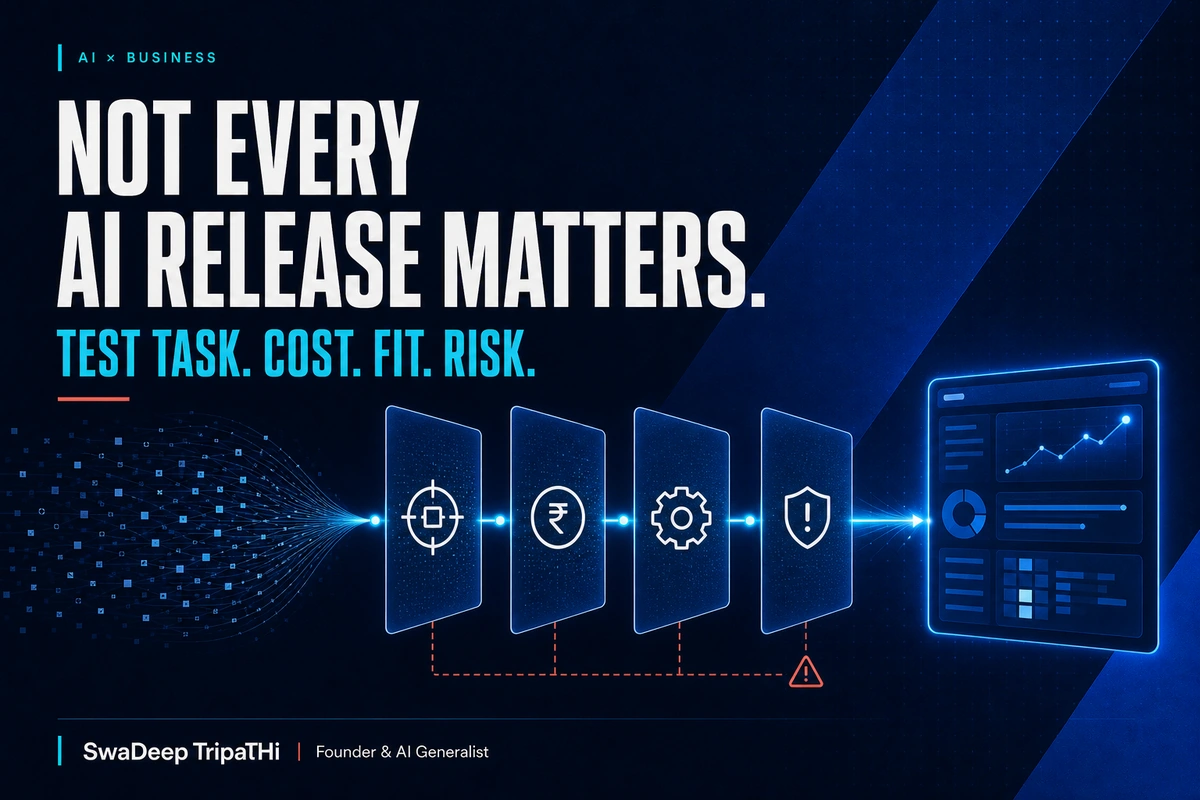
Judge global AI releases for Indian SMEs with four tests: task fit, economic fit, operating fit, and risk fit. A release matters when it improves a real workflow, produces better unit economics after human review, works with your languages, data, devices, vendors, and support conditions, and can be governed at the risk level of the task. If it fails one of those tests, the announcement may be interesting without being useful to the business.
AI announcements arrive with their own weather system.
Benchmarks rise. Context windows grow. Demos appear within hours. Every release is described as a new era for work.
An Indian SME does not need to react at the speed of the launch cycle.
The founder's job is not to identify the most exciting model. It is to decide whether a new capability improves a business process enough to justify change.
That decision needs more than a benchmark chart. It needs context about the task, cost, local operating environment, and risk.
Why global excitement can create local distraction
A product release is designed to explain what is newly possible. Your business decision has to explain what becomes better for your team or customer.
Those are different questions.
A model may perform well on coding tests but have no role in a distributor's invoice process. A new voice capability may sound impressive but struggle with the language mix, background noise, or support workflow your customers actually use. A lower token price may disappear once integration, review, and vendor charges are included.
The gap is especially important for small businesses because switching has a cost. People need training. Prompts and automations need retesting. Data handling may need review. Existing outputs may change.
Treat every release as a candidate, not an instruction.
Test 1: Does it improve a real task?
Start with one task that already exists.
Examples include summarising sales calls, classifying support requests, drafting product descriptions, extracting invoice fields, checking documents against a checklist, or answering staff questions from approved internal material.
Write the current baseline:
- Time per case
- Acceptable quality rate
- Human review required
- Error types
- Cost per useful result
- Customer or staff consequence
Then build a small test set from realistic cases. Include normal examples, difficult examples, long inputs, mixed-language content, incomplete information, and edge cases that previously caused trouble.
Do not test only the demo that suits the release.
OpenAI's official model catalogue separates models by capability, cost, context, and tools. Its comparison page makes the tradeoff visible. That is useful product information, but your own test set still decides whether the model is fit for the task.
Score the new release against the current method. It matters only if the improvement appears in the workflow you care about.
Vedam Vision's article on AI tools that actually save small businesses time and money uses the same practical principle: tool value is measured in a specific process, not in a general feature list.
What task fit is not
Task fit is not asking the model a clever question in a meeting. It is not comparing one attractive answer. It is not assuming that a larger model will always be better.
A useful test is repeatable. Two people should be able to apply the scoring rule and reach a similar decision.
Test 2: Do the unit economics work?
New AI releases often change pricing, speed, or both. Those numbers are only the first layer.
Calculate the full workflow cost:
Full cost = provider usage + platform and integration + staff preparation + human review + rework + maintenance
Then divide by useful outputs, not total outputs.
If a new model drafts 1,000 replies but 300 need major correction, the business did not receive 1,000 useful replies. Define a pass rule and count the work that meets it.
Also measure latency where it affects the experience. A slower model may be acceptable for an overnight report and unacceptable for a customer waiting on WhatsApp. A faster model may cost more but reduce abandonment in a live flow.
Use a simple comparison:
| Measure | Current method | New release | Decision question |
|---|---|---|---|
| Cost per useful output | Record baseline | Run pilot | Is the full unit cost better? |
| Review minutes | Record average | Measure again | Did hidden labour fall? |
| Pass rate | Use agreed standard | Same standard | Is quality stable or better? |
| Turnaround | End-to-end time | End-to-end time | Does speed matter here? |
| Incident severity | Known failure types | Pilot failures | Did new risk appear? |
Vedam Vision's guide to calculating AI ROI for Indian SMBs can help translate time, cost, error, and revenue effects into a decision.
Watch the migration cost
A release may be cheaper per request and expensive to adopt.
Count prompt changes, evaluation work, retraining, approval, integration updates, data migration, and parallel running. Spread that cost across the expected life and volume of the workflow.
If the current system already works, the new release needs to earn the disruption.
Test 3: Does it fit the Indian operating environment?
Global availability does not guarantee local fit.
Check six areas.
Language and communication
Test the Indian language mix the business uses, including Hinglish, names, addresses, product terminology, and code-switching. Do not infer performance from a provider's broad multilingual claim.
Data and privacy
Identify what information enters the system, where it is stored, which vendor terms apply, and whether customer consent or contractual restrictions matter. Mask personal or sensitive fields where the task does not require them.
Access and support
Verify country availability, account eligibility, payment method, service limits, documentation, support path, and whether a feature is preview, beta, or generally available.
Devices and networks
Test the customer and staff environment. A browser feature that performs well on a modern laptop may fail on an older Android phone or unreliable connection.
Integration reality
Check whether the release connects safely with the CRM, WhatsApp provider, website, document store, or internal system involved. Confirm who maintains the connection after launch.
Vendor continuity
Understand model identifiers, deprecation practices, export options, and fallback routes. A release is less useful when the business cannot manage change.
Vedam Vision's guide to choosing AI vendors in Indian markets provides a wider checklist for contracts, support, data handling, and implementation ownership.
Test 4: Can the risk be governed?
The same model can be suitable for one task and unsafe for another.
Drafting an internal meeting summary and approving a loan, medical instruction, or employment decision do not carry the same consequence. The level of review, evidence, monitoring, and escalation should follow the potential harm.
The NIST AI Risk Management Framework Core organises work around govern, map, measure, and manage. Its Measure function calls for testing before deployment and regularly during operation, using metrics that cover performance and risk.
IndiaAI's official Responsible AI self-assessment document includes practical prompts around goals, degree of harm, data relevance, privacy, error handling, and unintended consequences.
For an SME, turn those principles into a short control sheet:
- Named business owner
- Approved use and prohibited use
- Human review level
- Data allowed and data excluded
- Test set and pass threshold
- Incident and escalation route
- Vendor and model version
- Review date
The release matters only if the company can operate it responsibly.
Vedam Vision's article on AI governance for Indian enterprises shows how controls can scale with the impact of the use case rather than becoming a blanket paperwork exercise.
A simple release scorecard
Score each test from zero to two:
| Test | 0 | 1 | 2 |
|---|---|---|---|
| Task fit | No measured improvement | Promising but inconsistent | Clear improvement on realistic cases |
| Economic fit | Full cost is worse | Unclear or volume-dependent | Better unit economics with migration included |
| Operating fit | Important local barrier | Workaround required | Fits languages, access, systems, and support |
| Risk fit | Controls inadequate | Controls possible but unfinished | Risk is understood, owned, and monitored |
A total score is not an automatic decision. A zero in risk fit can stop the pilot even if the other scores are strong.
Use the scorecard to make assumptions visible. It helps a founder say, "We are testing this because it may reduce review time" instead of, "Everyone is talking about it."
Four possible decisions
Adopt now
Use this when the task improvement is clear, economics work, operating fit is confirmed, and controls are ready.
Pilot with a boundary
Limit the workflow, data, users, volume, or customer exposure while evidence is collected.
Watch and wait
Choose this when the capability is relevant but access, pricing, reliability, or integration is not mature enough.
Ignore for now
Use this when there is no current task fit. Ignoring a release is not falling behind. It is protecting focus.
A two-week evaluation routine
On day one, name the workflow, owner, baseline, and stop rule. On days two and three, build the realistic test set and scoring guide.
During days four to six, run the current method and the new release on the same cases. Record cost, time, quality, and failure types.
On days seven and eight, test the operating environment: languages, devices, integration, data handling, and support conditions.
On days nine and ten, review risk controls. During the final days, calculate migration effort and make one of the four decisions.
Document the reason. The next release should not restart the debate from zero.
Frequently asked questions
Should an Indian SME test every major AI release?
No. Test only releases that could improve an active workflow or remove a known constraint. Maintain a watch list for relevant capabilities and ignore announcements with no current task fit.
Are global AI benchmarks useful for business decisions?
They can help identify candidates, but they do not replace tests using the business's own tasks, languages, data patterns, quality rules, cost structure, and risk conditions.
How long should an AI release pilot run?
Run it long enough to cover realistic volume and difficult cases. A two-week bounded pilot can be enough for an early decision, while higher-impact workflows may need longer evaluation and specialist review.
What if the new model is cheaper but slightly less accurate?
Measure full unit cost and the consequence of errors. A lower price can be useful for low-risk, high-volume work, but expensive rework or harmful mistakes can erase the saving.
When should a business switch AI providers?
Switch when measured task performance, full economics, local operating fit, and risk controls justify the migration cost. Do not switch only because a launch is receiving attention.
Relevance is a business judgment
The release cycle will keep moving. Your operating priorities should not move with every announcement.
Use the four tests. Does it improve the task? Do the full economics work? Does it fit the Indian operating environment? Can the risk be governed?
When the answer is yes, move with evidence. When it is not, keep watching without surrendering focus.
If you need a controlled way to evaluate and implement a new capability, Vedam Vision's AI solutions and automation service can help connect model choice to a measurable workflow, local constraints, and ongoing ownership.