Quick answer
Write LinkedIn posts for people first, then make the idea easy for search systems to understand. Open with a specific statement or question, answer one professional problem clearly, use descriptive language instead of vague motivation, support factual claims, and finish with a useful prompt for discussion. The goal is not to impress an algorithm. It is to make your expertise understandable, quotable, and worth remembering.
LinkedIn content now has more than one route to a reader.
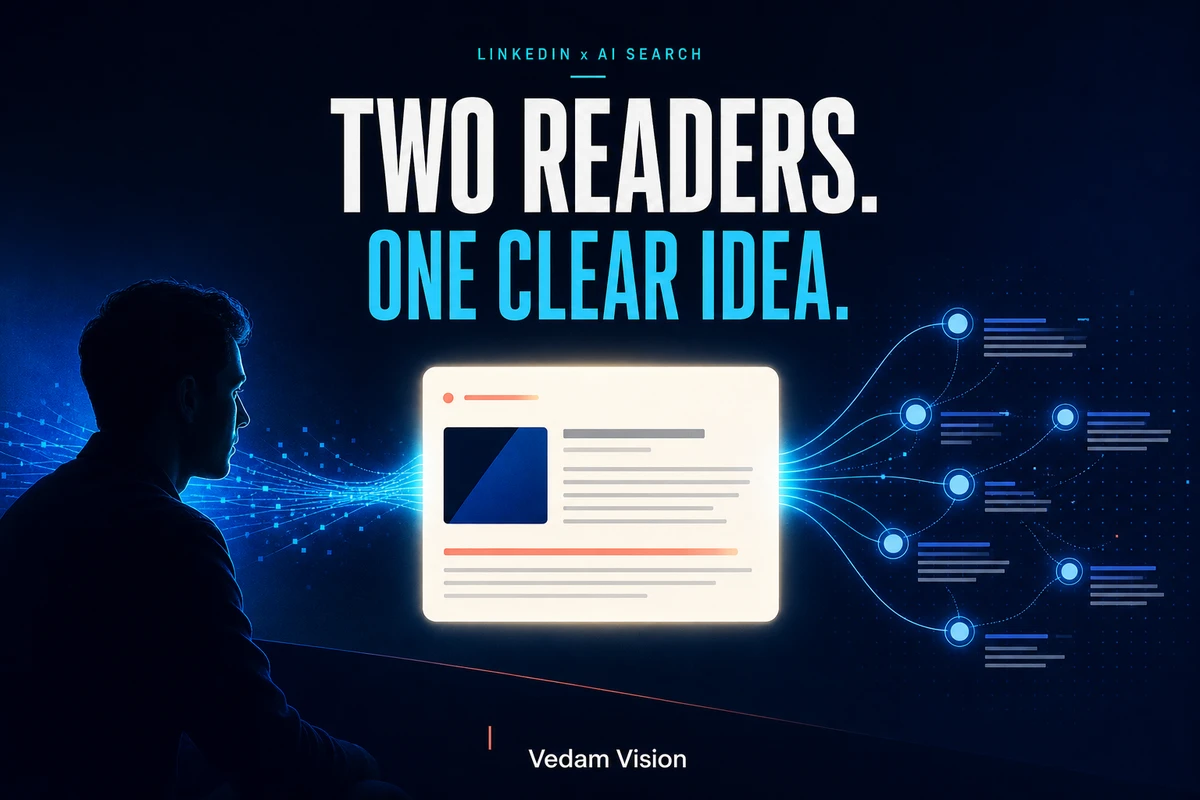
A post can appear in the feed, travel through comments and shares, surface in a conventional search result, or be referenced by an AI-generated answer. That changes how founders and business teams should think about clarity.
It does not mean writing for robots. It means removing the fog that often surrounds professional content.
LinkedIn's official article on maximising AI visibility for posts recommends a clean, keyword-rich opening line, clear questions with direct answers, educational value, and consistent publishing. It also says the opening line can shape the post URL, which makes the first sentence useful for both the reader and discovery.
Those recommendations point to a simple principle: a system cannot reliably identify your expertise if a person cannot explain what your post was about.
Why vague thought leadership is hard to discover
Consider an opening such as: "Growth begins when you believe in the process."
It sounds positive. It could apply to a founder, athlete, student, designer, or sales team. The reader does not know what process, what kind of growth, or what problem will be solved by reading further.
Now compare it with: "A small B2B service firm should measure LinkedIn by qualified conversations, not total impressions."
The second line names the audience, channel, business model, and decision. A founder can immediately decide whether the post is relevant. A search system also receives clearer information about the subject.
Vague posts often earn polite agreement because they ask little of the reader. But agreement is not the same as recall. If people cannot repeat your point, connect it to a problem, or use it in a decision, the content does little to build a professional reputation.
This matters for Indian founders who are using LinkedIn to reach buyers outside their immediate network. A profile may be reviewed before a sales call, partnership, interview, or vendor decision. Useful posts give a visitor evidence of how the person thinks. Generic inspiration gives them very little to evaluate.
Vedam Vision's guide to personal branding for Indian founders explains why a clear expertise intersection and a defined audience make a professional brand easier to understand. The same discipline should shape each post.
Start with one professional question
The strongest starting point is not a format. It is a question your intended reader already faces.
For example:
- Should a local manufacturer automate customer support?
- Why are qualified leads not replying after the proposal?
- What should a founder review before approving AI-generated content?
- How can a service business explain a premium price?
- Which website metric signals buying intent?
Each question creates a boundary. It stops the post from becoming a broad collection of observations.
Write the answer in one plain sentence before drafting the post. If the sentence needs several qualifications, keep them for the body. The opening should give the reader a useful direction, not hide the idea to manufacture suspense.
This is especially helpful when English is not the writer's first language or when the audience uses a mix of English, Hindi, and industry terms. Simple does not mean simplistic. It means the business point survives translation, skim reading, and a busy feed.
How to write an opening line that carries the topic
Your opening line has three jobs.
First, it should tell the right person that the post is for them. Second, it should create enough tension to earn the next sentence. Third, it should signal the subject accurately.
Here are four practical opening patterns.
State the decision
"Do not hire an AI tool until you know which decision it should improve."
This gives the reader an action and a reason to continue. It is stronger than "AI is changing everything" because it connects the topic to a business choice.
Name the mistake
"Most service firms lose LinkedIn leads after the post, not in the post."
The body can then explain profile clarity, response time, proof, and follow-up. The claim should be framed as an observation unless you have evidence for a broader statistic.
Answer a specific question
"What should an Indian SME automate first? Choose a frequent task with clear inputs and a human owner."
This question-and-answer structure is close to LinkedIn's own guidance for extractable, useful content.
Reveal a useful contrast
"High impressions create attention. Qualified replies create demand."
The contrast works because the two ideas affect different business decisions. Avoid a slogan when you cannot explain the distinction with an example.
Do not force a keyword into the line if it makes the language awkward. A clean topic phrase such as "LinkedIn content strategy for Indian founders" is useful only when the post really addresses that subject.
Use a structure that helps people skim without losing meaning
LinkedIn posts are often read between meetings, during a commute, or while a buyer is comparing several profiles. Structure is not decoration. It helps the argument survive limited attention.
A practical post can use this sequence:
| Part | Purpose | Example |
|---|---|---|
| Opening | State the topic and tension | "More LinkedIn reach will not fix a vague offer." |
| Context | Explain why the issue matters | Buyers visit the profile but cannot tell who the service is for |
| Insight | Give the core explanation | Specific positioning helps people connect expertise to a need |
| Example | Make the advice usable | Rewrite a broad headline for a defined buyer and outcome |
| Action | Offer one next step | Test whether a prospect can repeat the offer after ten seconds |
| Question | Invite relevant discussion | "What part of your offer is hardest to explain?" |
This structure is flexible. A short post may use one sentence per part. A longer post may add a checklist or a small example. The point is to move from idea to application without burying the answer.
Short paragraphs help on mobile, but avoid turning every sentence into a dramatic one-line paragraph. That pattern can feel manufactured. Let related thoughts stay together and use white space where the argument changes.
Specific examples build more authority than broad advice
"Create valuable content" is difficult to act on.
"Show a sales manager how to compare a high-intent enquiry with a low-intent one" gives the writer a subject, audience, and practical outcome.
Examples do three things. They show that the writer understands the situation, help the reader apply the idea, and give search systems more context around the topic.
For an Indian SME audience, useful details might include WhatsApp-first enquiries, founder-led sales, GST documentation, regional language support, local service areas, lean marketing teams, distributor relationships, or tier-2 city buying behaviour. Use the details only when they belong to the problem. Adding "India" to a generic post is not localisation.
The Vedam Vision article on why social media posts get low engagement makes a related point: specificity helps the reader recognise that a post addresses their situation. A useful example should clarify the decision, not serve as a fictional success story.
Never invent customer outcomes, revenue numbers, experiments, or personal experiences to make a post sound credible. If the example is hypothetical, label it as an example. If a factual claim comes from research, link to the primary source. Trust compounds slowly and can disappear with one unsupported claim.
Build topical authority through connected posts
One post rarely establishes expertise. A body of connected work does.
Choose two or three themes that sit close to the problems your business can genuinely solve. A founder working across AI, design, and business might use themes such as:
- Practical AI workflow design for small businesses
- Brand systems and visual decision-making
- Founder operating systems and commercial judgment
Within each theme, move from broad questions to specific decisions. An AI workflow theme could include tool selection, data quality, human review, cost measurement, prompt design, and governance. A design theme could cover hierarchy, trust, brand consistency, website conversion, and feedback systems.
Connected posts help a human visitor see a pattern in your thinking. They also provide clearer context about the subjects associated with your name. LinkedIn's official guidance recommends pairing posts with longer articles to develop deeper topical authority. A useful practice is to publish a concise point on LinkedIn and connect it to a detailed, sourced article that answers the larger question.
Do not repeat the same post with different words. Build a chain of questions. Each piece should add a new decision, example, or tradeoff.
What to measure when your goal is recognition
Virality can be useful, but it is not a complete personal-brand objective.
If the goal is to become recognised as a better business thinker, measure signals that show understanding and relevance:
- Comments that add a real example or ask a deeper question
- Saves and shares from people in the intended audience
- Profile views from relevant roles or companies
- Qualified connection requests
- Direct messages that mention a specific post or problem
- Website visits to a related article or service page
- Repeated association between your name and a chosen topic
Total impressions still matter because people cannot remember work they never see. But impressions should be read beside the quality of the response. A smaller post that starts three useful conversations may create more business value than a broad post with high reach and no clear audience.
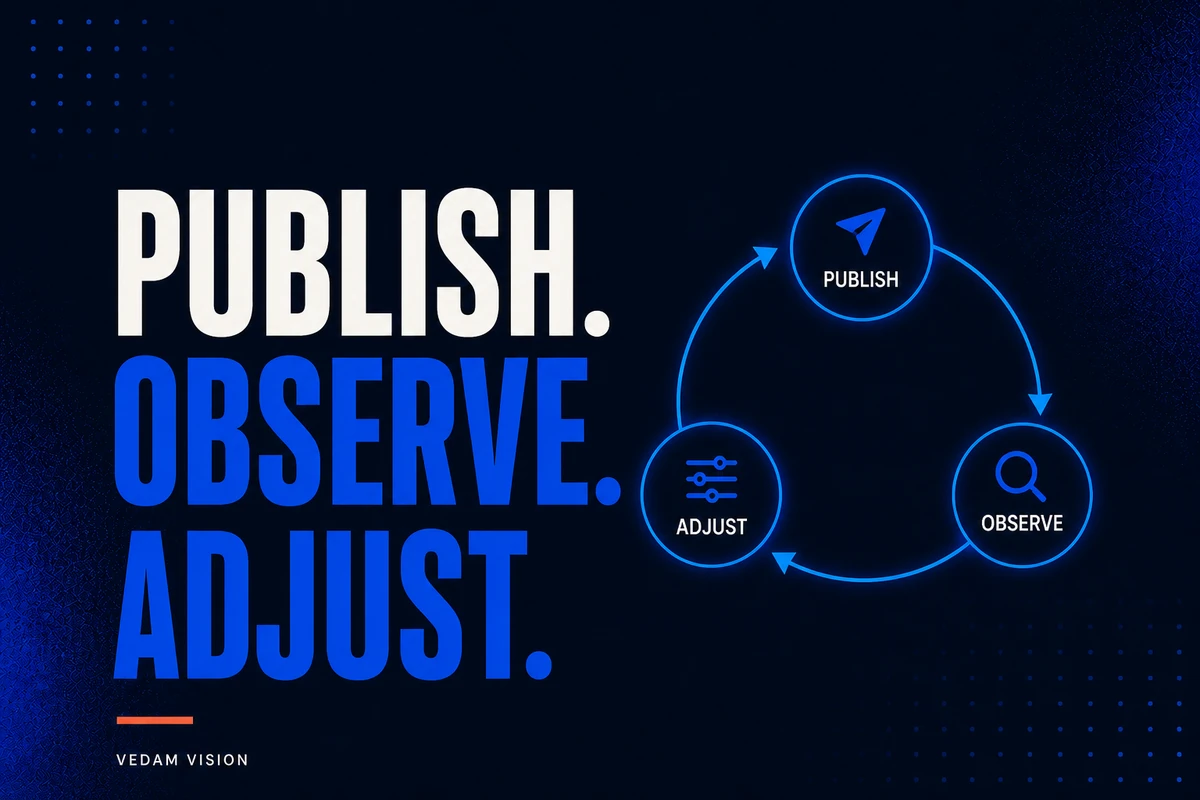
Keep a simple monthly review. Identify which questions generated useful replies, which openings attracted the right readers, and which topics brought visitors to the profile or website. Use those observations to improve the next calendar rather than chasing each week's popular format.
Vedam Vision's brand storytelling guide for Indian founders offers another way to connect a strong opening with a specific insight and a genuine discussion question.
A practical editing checklist for people and AI search
Before publishing, read the post once as a busy professional and once as a retrieval system.
For the human reader, ask:
- Does the first line tell me why this matters?
- Is the post written for a recognisable audience?
- Can I use the example or action today?
- Does the tone sound like a person with a point of view?
- Is the final question worth answering?
For discoverability, ask:
- Does the opening contain the actual subject?
- Is the main question answered directly?
- Are descriptive terms used naturally?
- Can factual claims be checked?
- Is the post connected to the themes on the profile?
- Would a quoted sentence remain accurate without the rest of the post?
Then remove filler. Phrases such as "in today's fast-paced world" delay the answer. Generic transitions, inflated claims, and stacks of buzzwords weaken both readability and meaning.
Common mistakes when optimising LinkedIn posts
Writing a keyword list instead of a post
Keywords help only when they clarify the subject. Repeating a phrase in every paragraph makes the writing awkward and reduces trust.
Hiding the answer until the end
Suspense can work in a story, but educational content should not force a professional reader through several paragraphs to find the point. Give the direction early, then earn attention with depth.
Copying a viral format without the underlying insight
A familiar hook may attract a glance, but the post still needs an original observation, evidence, or useful example. Format is distribution support, not expertise.
Treating AI visibility as guaranteed
Clear writing can improve the chance that content is understood and retrieved. It cannot guarantee citations, rankings, reach, or leads. Platform systems change, and discovery depends on many factors outside one post.
Publishing without participating
The post is the start of the conversation. Reply to substantive comments, ask follow-up questions, and learn which parts of the idea need more explanation. Do not use automated replies that make a thoughtful comment feel ignored.
A 30-minute workflow for a useful LinkedIn post
Spend five minutes choosing one reader question from a real sales call, project review, customer conversation, or industry change. Remove confidential details.
Spend five minutes writing the answer in one sentence. That sentence becomes the direction for the opening.
Use ten minutes to add context, one concrete example, and one action. Check any factual claim against its primary source.
Use five minutes to improve the opening and remove vague phrases. Make sure the topic appears naturally.
Use the final five minutes to read the post aloud, verify links, and write a question that invites experience rather than empty agreement.
AI can assist with research, structure, alternatives, and editing. The point of view, factual responsibility, and final judgment should remain with the author.
Frequently asked questions
What is LinkedIn AI search?
LinkedIn and external AI-enabled search experiences can use content and profile information to help answer professional queries or recommend relevant material. The exact systems and visibility can change, so focus on accurate, useful content rather than trying to reverse-engineer a guarantee.
Should every LinkedIn post include keywords?
Use descriptive topic language when it reads naturally. One clear phrase in the opening and related terms in the explanation are usually more useful than repeating an exact keyword mechanically.
How long should a LinkedIn post be?
LinkedIn's June 2026 guidance suggests 200 to 300 words as a useful range for AI visibility, but the idea should determine the final length. A concise answer is better than a padded post, and a detailed example may need more room.
Do hashtags help AI search visibility?
Hashtags can label a broad topic, but they do not replace a clear opening, direct answer, evidence, and useful structure. Use a small number of relevant hashtags after the content if they help readers navigate the subject.
Can AI write all my LinkedIn content?
AI can help draft and edit, but fully automated content often loses specific experience, judgment, and accountability. Supply real source material, keep claims verifiable, and make the final post reflect the author's actual point of view.
Clarity is the shared advantage
The best adjustment for AI search is also good writing for people.
Name the question. Answer it early. Explain the tradeoff. Give a specific example. Support the facts. Leave the reader with an action or a genuine question.
That approach will not make every post viral, and no honest strategy should promise that. It will make your expertise easier to understand. Over time, that is the foundation of useful recognition.
If your business needs a focused content system that connects strategy, production, community, and measurement, explore Vedam Vision's social media management service.