Quick Answer
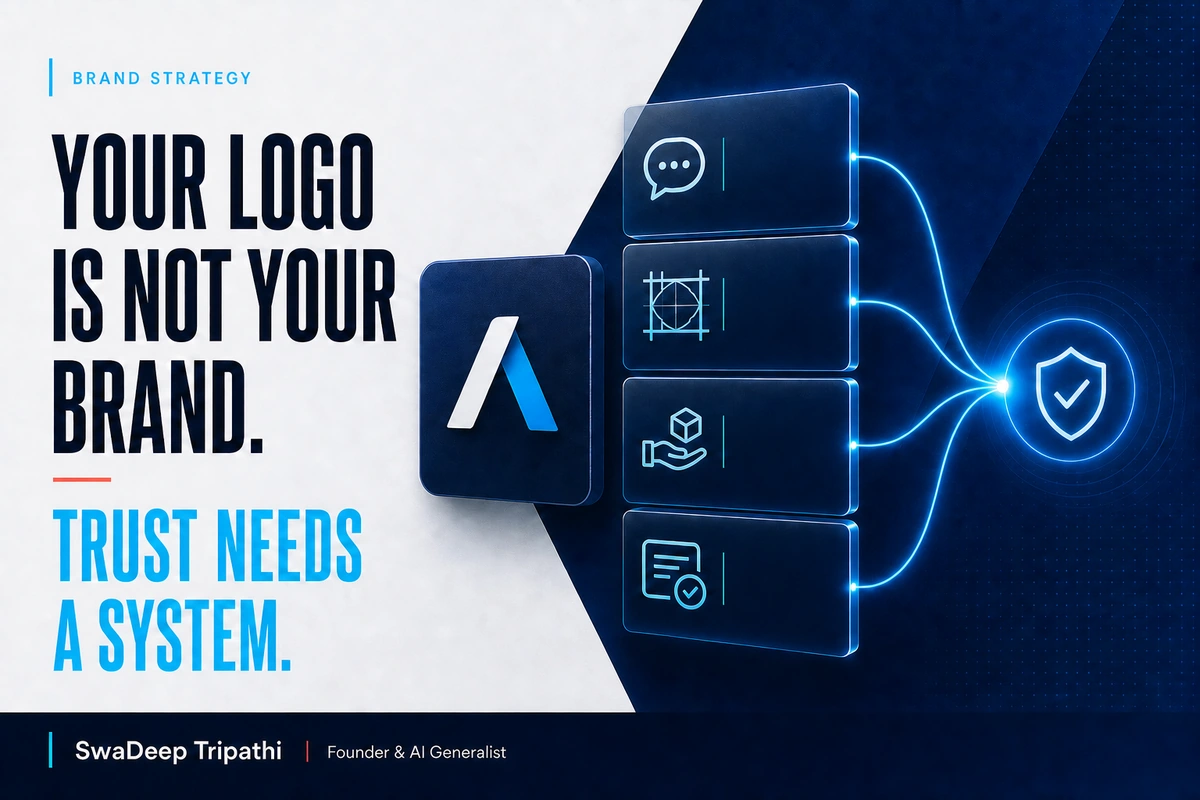
A logo identifies a business. A brand system helps customers know what to expect from it. A useful brand system aligns four layers: the message a company wants to own, the visual cues that make it recognisable, the behaviour customers experience, and the proof that makes the promise believable. When these layers agree, trust becomes easier to build. When they conflict, a new logo cannot fix the gap by itself.
Most business owners understand the value of looking professional. The confusion begins when a logo project is expected to solve a positioning, experience, or credibility problem.
A cleaner symbol can improve recognition. It can make a signboard easier to read, a website feel more current, and a social profile more consistent. Those are worthwhile outcomes. They are not the same as building a brand.
The World Intellectual Property Organization draws a useful distinction. Its trademark guidance for small and medium enterprises explains that a trademark is a sign that identifies and distinguishes products or services, while a brand has a wider meaning. A brand includes the visual, emotional, rational, and cultural image customers associate with a company or product. In plain language, a logo can be an important sign, but the brand also lives in expectations and reputation.
That distinction matters for an Indian SME because customers rarely judge one touchpoint in isolation. They may discover a business through Instagram, verify it on Google, visit its website, message on WhatsApp, speak to a salesperson, and finally experience delivery or support. If each step tells a different story, trust leaks from the journey.
Why a logo redesign often feels disappointing
A logo redesign creates visible change, so it is tempting to make it the starting point. Yet many brand problems are not primarily visual.
The business may be unclear about who it serves. Its website may make a broad promise that salespeople explain differently. Social posts may sound playful while proposals feel stiff. Customer support may be helpful before payment and difficult to reach afterward. Case studies may be missing, outdated, or too vague to verify.
In that situation, a new symbol improves one layer while the rest remain inconsistent.
The disappointment does not mean design is unimportant. It means design has been asked to carry a promise that the message, operation, and evidence do not support.
Think of a coaching institute that adopts a premium identity but still sends confusing fee details in three different formats. Or a real-estate firm with elegant brochures but inconsistent information about possession dates. Or a restaurant with lively social content and an ordering experience that hides delivery limits until the last step. The visual promise sets an expectation. The experience decides whether that expectation survives.
A stronger process begins by defining the expectation the business wants to own, then aligning the system around it.
The four layers of a trustworthy brand system
Layer 1: Message
The message is what the business wants to be known for. It is not a list of every service. It is the clear expectation a relevant customer should carry away.
For a diagnostic clinic, that expectation might be reliable reports with clear communication. For a regional manufacturer, it might be dependable fulfilment for distributors. For a digital agency, it could be practical growth work without confusing jargon or hidden process.
A useful message answers four questions:
- Who is the business for?
- What important problem does it solve?
- What makes its approach meaningfully different?
- Why should the customer believe the claim?
The last question prevents positioning from becoming a slogan exercise. "Best quality" is not a position unless the business can show what quality means, how it is maintained, and why the comparison is fair. "Fast service" is weak unless the response or delivery standard is defined.
The message should guide headlines, proposals, sales conversations, and service descriptions. It can be adapted to the channel, but the central expectation should remain stable.
For an India-focused business, language is part of the message system. The audience may respond better to plain English, Hindi, Hinglish, or a regional language depending on the category and market. Translation alone is not enough. The examples, level of formality, and proof need to feel natural in that context.
Layer 2: Visuals
Visual identity helps people recognise the business and understand its character quickly. The logo belongs here, alongside colour, typography, imagery, iconography, layout, motion, and the rules for using them.
The goal is not to make every asset identical. It is to make them feel related.
Canva's current brand-management guidance describes brand kits as a way to centralise logos, colours, fonts, imagery, graphics, templates, and usage guidance. The practical benefit is consistency across teams and channels. A system reduces the chance that every salesperson, designer, franchise, or agency partner creates a different version of the brand.
A small business does not need a hundred-page manual. It needs enough structure to answer common questions:
- Which logo version should be used on light and dark backgrounds?
- What are the primary and supporting colours?
- Which typefaces are approved and what are the fallbacks?
- What image style fits the brand?
- How should headlines, offers, prices, and calls to action be arranged?
- Which elements must stay consistent across social, web, print, and WhatsApp?
The system should also work in the formats the business actually uses. A mark that looks impressive on a laptop may become unreadable as a WhatsApp profile image. Thin type may disappear on outdoor signage. A colour combination may fail accessibility checks on a website. A premium print finish may not translate to a low-cost invoice or packaging label.
Good visual identity is not decoration. It is a reusable set of decisions.
Vedam Vision's branding and visual identity service reflects this broader scope by connecting logo design with positioning, identity systems, brand guidelines, and marketing collateral for Indian markets.
Layer 3: Behaviour
Behaviour is how the business actually shows up.
It includes response time, sales conduct, delivery quality, billing clarity, complaint handling, tone of support, and what happens when something goes wrong. Customers may forget the exact shade of blue in a logo, but they remember being ignored after payment or receiving a clear solution when a problem appeared.
This layer is where a brand promise becomes operational.
If the message says "simple," the form, proposal, payment, and onboarding should not be confusing. If the message says "reliable," the company needs visible ownership, realistic timelines, and proactive updates. If it says "premium," the detail, service, and follow-through must justify more than a polished surface.
For many Indian SMEs, WhatsApp is part of the customer experience. That means the greeting, catalogue, handoff, payment instruction, and support escalation are brand touchpoints. The same is true of Google Business Profile replies, delivery messages, invoices, call scripts, and follow-up reminders.
Write down the behaviours that support the brand promise. A clinic might commit to confirming appointments and sharing preparation instructions. A B2B supplier might define how quickly it acknowledges an enquiry and how it communicates a delay. A service firm might specify what the client receives each week and who owns the next action.
These standards should be realistic. A promise that the team cannot maintain will weaken trust faster than a modest promise delivered consistently.
Layer 4: Proof
Proof turns a claim into something a customer can evaluate.
It can include case studies, demonstrations, qualifications, process detail, product specifications, verified reviews, before-and-after evidence, live work, guarantees with clear terms, and transparent policies. The right proof depends on the category and the decision the customer is making.
A hospital and a clothing brand should not use the same proof strategy. A hospital may need credentials, facilities, specialities, protocols, and patient guidance. An ecommerce seller may need product details, return terms, delivery estimates, customer reviews, and secure payment options. A marketing firm may need live work, case studies with context, reporting examples, and a clear explanation of process.
Proof should be specific enough to reduce doubt without exaggeration. Do not invent customer quotes, project results, awards, or partner logos. If evidence is not ready, use a clearly marked placeholder internally and remove the unsupported claim from public material.
This layer also protects the business from empty differentiation. Two companies can both say they are responsive. The one that shows a service standard, contact route, and escalation process makes the claim easier to believe.
How the four layers work together
Imagine a local interior-design firm that wants to be known for calm, predictable project delivery.
Its message focuses on clarity in scope, budget, and milestones. Its visuals use an organised layout, warm photography, readable plans, and restrained colour rather than a collage of luxury references. Its behaviour includes written approvals, weekly updates, documented change requests, and a named project owner. Its proof includes completed work, client references, sample timelines, and transparent explanations of what is included.
Every layer supports the same expectation.
Now imagine that the firm uses the same visuals but gives vague estimates, misses updates, and cannot show completed projects. The identity may attract attention, but the experience does not sustain trust.
This is the real work of a brand system: making different parts of the business tell the same believable story.
A practical brand-system audit for an SME
You can test the current system without beginning with a redesign.
Step 1: Write the expectation in one sentence
Complete this statement: "We want the right customer to expect us to be..."
Avoid broad words such as good, innovative, or professional. Choose a useful expectation tied to the buying decision. Examples include easy to work with, reliable under tight deadlines, clear about costs, or specialised in a particular problem.
Step 2: Collect the real touchpoints
Gather the website home page, social profiles, sales deck, quotation, invoice, WhatsApp greeting, onboarding message, packaging, signage, support reply, and review page. Include what customers actually see, not just the brand files stored in a folder.
Step 3: Score each layer
Review message, visuals, behaviour, and proof separately. Ask whether each one supports the chosen expectation, contradicts it, or leaves it unproven.
Bring people from sales, delivery, and support into the review. A design team can see inconsistency in colour or typography. Operations can see the gap between a promise and the process required to deliver it.
Step 4: Fix the highest-trust gap first
Do not automatically start with the most visible problem. Start with the gap that creates the greatest doubt or customer friction.
If service information is unclear, fix the message and page structure. If customers see mismatched materials, create the visual rules and templates. If handoffs are unreliable, repair ownership and communication. If strong work exists but is invisible, build credible case studies and proof.
Step 5: Turn decisions into reusable rules
Document approved messages, logo files, type, colour, image direction, templates, tone examples, service standards, proof requirements, and approval ownership. Keep the system accessible to employees and partners.
The document is useful only if people can apply it. Review it when the offer, audience, channels, or operations change.
What not to do during a rebrand
Do not copy the appearance of a larger competitor without understanding why its system works. Recognition comes from distinctive, repeated choices, not from looking familiar for the wrong reason.
Do not let a mood board replace positioning. Visual references can express a direction, but they cannot decide the customer, value, difference, or proof.
Do not launch a new identity before preparing the high-frequency touchpoints. If the website changes while proposals, profiles, and sales materials remain old, the transition creates more inconsistency.
Do not promise a personality the operation cannot support. Friendly copy cannot compensate for unhelpful support. A premium palette cannot compensate for unclear billing.
Do not judge the system only by whether the founder likes it. Test recognition, readability, comprehension, and usability with the people the business needs to reach.
A brand is an expectation kept repeatedly
The logo matters. It should be distinctive, usable, and appropriate. It deserves professional attention because it will appear across many touchpoints.
But the logo is one part of a larger system.
The message tells people what to expect. The visuals help them recognise the promise. The behaviour delivers or breaks it. The proof gives them a reason to believe it before and after they buy.
When those four layers align, the business becomes easier to understand and easier to trust. When they do not, another logo refresh may only make the inconsistency look newer.
Start with the expectation you want to own. Find the layer that weakens it most. Fix that layer, then make the rest of the system support the same idea. If you want an outside view of your website, message, proof, and customer journey, request a free Vedam Vision audit and use the findings to prioritise the next move.
Frequently Asked Questions
What is the difference between a logo and a brand system?
A logo is a distinctive visual sign used to identify a business, product, or service. A brand system is the wider set of messages, visual rules, behaviours, and proof that shapes what people expect and remember.
Does a small business really need brand guidelines?
Yes, but the guidelines can be compact. An SME needs clear rules for logo use, colour, typography, imagery, tone, common templates, and approval ownership so that employees and partners present the business consistently.
When should a company redesign its logo?
A redesign makes sense when the current mark is hard to use, difficult to read, legally risky, misleading, visually dated for the intended position, or unable to work across required formats. It should follow a clear brand brief rather than personal taste alone.
How can an Indian SME improve brand trust without a full rebrand?
Clarify the offer, standardise high-frequency customer messages, improve response and handoff behaviour, publish credible proof, and fix inconsistent touchpoints. These changes can strengthen trust before a complete visual overhaul.
What should be included in a basic brand system?
A basic system should include positioning, key messages, logo files and usage, colour, type, imagery direction, tone of voice, templates for common channels, service behaviours, proof standards, and a named owner for approvals and updates.