Quick answer
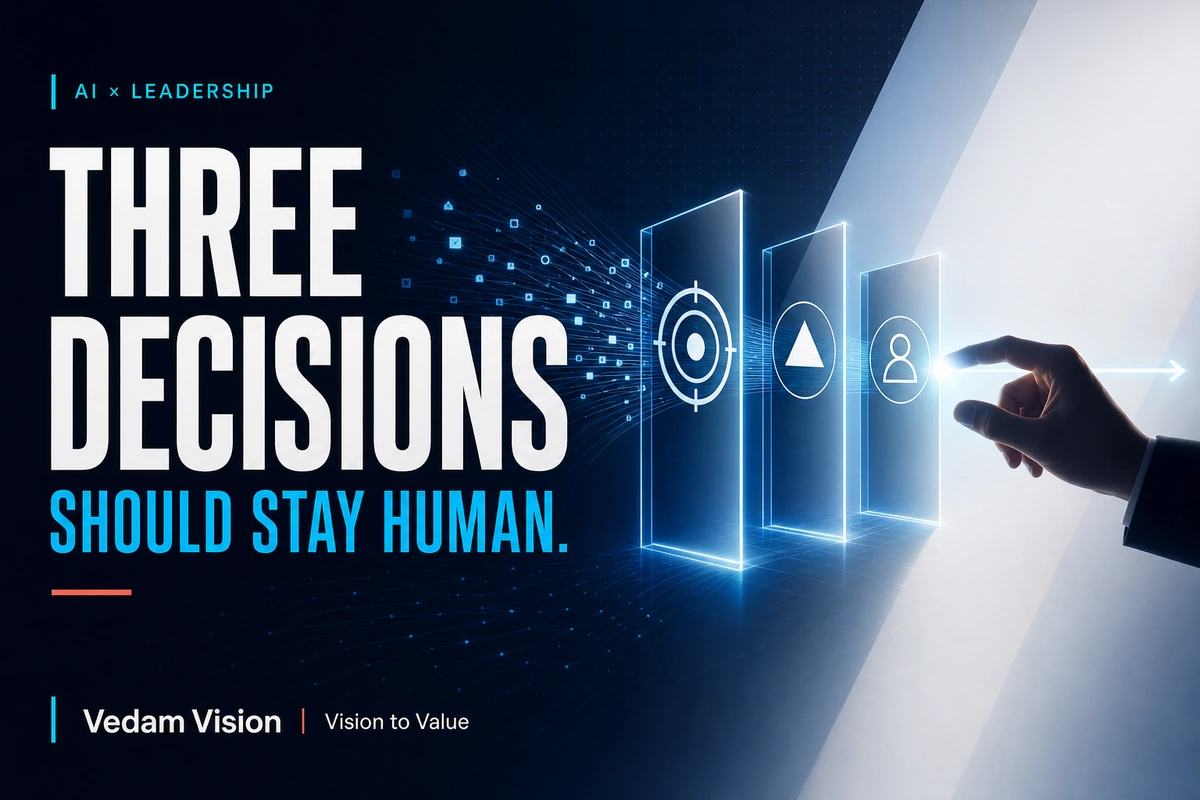
Founder decision making should remain human when the decision defines what the business stands for, requires taste under uncertainty, or creates a consequence someone must own. AI can research the market, compare options, challenge assumptions, and prepare scenarios. It should not quietly become the final authority for positioning, creative taste, or accountability. The practical rule is simple: let AI improve the preparation, but keep a named person responsible for the call and its outcome.
AI can prepare a founder to make a better decision.
It can scan a large set of customer comments, summarise competitor claims, draft positioning options, compare campaign concepts, and list the risks in a plan. That is valuable work, especially for a small team with limited research capacity.
But preparation is not ownership.
Some decisions shape the identity and obligations of the business. They determine what the company will ignore, what it will protect, and what it is willing to promise. Those decisions should not be delegated simply because a model can produce a confident answer.
Microsoft's 2026 Work Trend Index provides useful context. The study surveyed 20,000 knowledge workers who use AI across ten markets, including India. Microsoft reports that 86 percent treat AI output as a starting point rather than a final answer and say they remain responsible for the thinking. Respondents also ranked quality control and critical thinking among the human skills becoming more important as AI handles more work.
The message is not that founders should avoid AI. It is that more execution makes clear intent and judgment more valuable, not less.
Why founder decision making needs a boundary
In a small or growing business, the founder often sits close to several kinds of work at once. Product, sales, hiring, marketing, customer relationships, and cash flow may all pass through the same person.
AI can reduce the burden by organising information and producing first drafts. The risk begins when convenience changes into authority without anyone noticing.
A positioning statement is generated and copied into the website. A visual direction is selected because the model described it as premium. A difficult customer reply is sent because the draft sounded reasonable. Each step looks efficient. Together, they can move the company in a direction nobody explicitly chose.
The answer is not to review every comma forever. It is to define where automation can proceed and where a person must make the call.
Vedam Vision's guide to an Indian SME AI implementation roadmap recommends moving from a bounded pilot to production with documentation and ownership. That principle applies to leadership work too. Before a workflow becomes routine, make the human boundary visible.
Decision one: positioning
Positioning is the choice of who the business is for, what problem it wants to own, why a customer should believe it, and which alternatives it is willing to reject.
AI is useful during positioning research. It can:
- group customer language into themes
- compare competitor home pages
- identify repeated category claims
- generate alternative value propositions
- test whether a statement is clear
- surface questions the team has not answered
These tasks improve the founder's view of the landscape. They do not decide where the company should stand.
Positioning contains a commitment. If a service firm chooses to be known for speed, it must design delivery around that promise. If a D2C brand chooses clinical credibility, it must support claims, packaging, content, and customer support with appropriate evidence. If a manufacturer chooses reliability over the lowest price, its sales process must explain and prove that tradeoff.
A model can write all three options persuasively. It does not bear the cost of choosing the wrong one.
An India-specific positioning test
Indian markets often contain wide differences in price sensitivity, language, distribution, and buying process. A promise that works for a metro-based buyer may not translate cleanly to a tier-two channel partner. A product positioned for online self-service may still depend on WhatsApp guidance or a local distributor.
Ask these questions before accepting an AI-generated position:
- Which exact buyer is this for?
- What real behaviour or capability supports the promise?
- What are we choosing not to compete on?
- Can sales, delivery, and support keep the promise?
- Does the language work in the channels our customers actually use?
AI can help collect the evidence for these answers. The founder and leadership team should approve the commitment.
Decision two: taste
Taste is not simply personal preference. In business, it is the ability to choose what feels appropriate, distinctive, coherent, and worth protecting when several options are technically acceptable.
AI can produce many credible logos, layouts, headlines, images, or campaign concepts. Abundance makes taste more important because the bottleneck moves from making options to selecting the right one.
The fastest option is not always the most suitable. The most familiar option may look safe while making the brand invisible. The most dramatic option may win attention while weakening trust.
Taste asks a more difficult question: what should this business look and sound like, given its audience, ambition, and context?
Where AI helps with creative judgment
Use AI to expand and sharpen the decision:
- generate contrasting directions, not twenty minor variations
- explain the strategic tradeoff in each option
- identify possible accessibility or clarity issues
- simulate how a concept changes across formats
- compare the option with the approved brand system
- prepare a structured review checklist
Then ask a person to decide which direction deserves to represent the business.
Vedam Vision's article on building AI-powered websites in 48 hours makes the same operational distinction. AI can accelerate structure, drafting, and ideation, while brand positioning, conversion logic, visual taste, trust signals, and business nuance still need human control.
A useful taste review for small teams
Do not ask only, "Do we like it?"
Use four review questions:
- Is it clear to the intended customer?
- Is it recognisable without relying on the logo?
- Does it support the promise we are making?
- Can the team use it consistently across the website, social media, proposals, packaging, and sales material?
This moves the conversation beyond subjective reactions without pretending creativity can be reduced to a score.
For an Indian SME, practical details matter. A design may look excellent on a large screen but fail on a low-cost phone. A type choice may not support Devanagari or another required script. A premium packaging concept may be expensive or unreliable to reproduce locally. Taste includes these realities.
Decision three: accountability
Accountability is the decision to own a consequence.
When a recommendation affects a customer, employee, partner, or public claim, someone must be able to explain what was decided, what evidence was used, and what happens if the result is wrong.
AI cannot accept that responsibility. A model does not apologise to a customer, correct a contract, manage a team after a poor hiring choice, or rebuild trust after a misleading campaign. The business does.
This is especially important when the output touches:
- prices, discounts, refunds, or credit
- legal or contractual commitments
- health, safety, or financial information
- employment and performance decisions
- public claims about results
- sensitive customer data
- unusual or emotional customer situations
The level of human review should match the consequence. A low-risk internal summary may need a quick accuracy check. A quotation to a customer, a hiring rejection, or a claim in an advertisement needs a stronger control.
Name the owner before the workflow starts
Every production AI workflow should answer four questions:
- Who approves the rule or prompt?
- Who reviews uncertain or high-impact outputs?
- Who monitors errors and updates the process?
- Who can pause the automation?
If the answer is "the team," ownership is still unclear.
Vedam Vision's AI solutions and automation service focuses on assistants, lead qualification, and workflow automation connected to real business processes. In that kind of work, the escalation path matters as much as the automated step.
Use AI as a challenger, not a hidden decision maker
AI can be particularly useful when it challenges the founder's first answer.
Ask it to identify missing evidence, opposing views, operational constraints, and possible unintended consequences. Ask it to separate facts from assumptions. Give it two strategies and ask what would need to be true for each one to work.
This use of AI makes thinking less comfortable but more complete.
For example, a coaching business may want to launch a low-price online programme. AI can map competitor offers, analyse common student questions, and model support requirements. It can also challenge the assumption that a lower price will improve conversion if trust and proof are the real barriers. The founder still decides because the choice affects positioning, delivery capacity, and cash flow.
A B2B manufacturer may be considering automated quotation replies. AI can prepare a draft from standard product data. It should flag rather than guess when specifications, freight, taxes, production capacity, or payment terms fall outside the approved range. A sales or operations owner remains accountable for the final commercial promise.
The principle is consistent: automate preparation and routine execution, then create an explicit checkpoint where judgment meets consequence.
A simple decision record for founders
Important decisions become easier to review when the reasoning is visible.
Use a one-page decision record with these fields:
- Decision: What are we choosing?
- Objective: What outcome should improve?
- Evidence: Which customer, market, operational, or financial facts matter?
- Options: What serious alternatives were considered?
- AI role: What did the system research, draft, compare, or challenge?
- Human owner: Who makes and owns the final call?
- Risks: What could go wrong, and which signals would expose it?
- Review date: When will we assess the result?
This is not bureaucracy. It prevents the company from treating a fluent output as a settled strategy. It also gives the team a record of why the choice made sense at the time.
For recurring decisions, the record can become a lightweight operating rule. A customer support workflow might document which queries are safe to answer automatically and which must reach a person. A content workflow might require primary sources for claims and human approval for brand-sensitive topics.
Warning signs that too much judgment has been outsourced
Watch for these patterns:
- the team cannot explain why an option was selected
- an AI recommendation is treated as evidence by itself
- the system makes customer promises outside approved rules
- people stop checking because the output usually looks polished
- no one owns error review or process updates
- positioning changes whenever a new trend appears
- creative work becomes consistent but indistinguishable
- a sensitive decision has no escalation path
One warning sign does not mean the business must stop using AI. It means the boundary needs attention.
A weekly operating rhythm for human-led AI
Founders do not need a large governance committee to maintain control. A short weekly review can work for a smaller organisation.
Review one active AI workflow and ask:
- What did the system do well this week?
- Which outputs required meaningful correction?
- Did it make or imply any unapproved promise?
- Which exception occurred more than once?
- Does a rule, source, prompt, or owner need to change?
Record the decisions. Assign the update. Test the revised workflow with real examples.
This turns human oversight into an operating habit rather than a final approval ritual. It also helps the team automate more safely over time because the boundary is based on observed performance.
The article AI tools every Indian SMB should use in 2026 is a useful companion when choosing a practical stack. The better stack is usually the smaller one with clear jobs, owners, and review rules.
Frequently asked questions
Which founder decisions should never be fully automated?
Decisions that define positioning, require creative or strategic taste, or create significant consequences should retain a human owner. AI can support the research and execution, but a person should approve and own the final call.
Can AI make strategic recommendations for a business?
Yes. AI can compare evidence, develop options, surface assumptions, and challenge a plan. A recommendation is an input, not an authority. Leaders should verify the evidence and judge whether the recommendation fits the business context.
How should an Indian SME decide where human review is required?
Match review to risk. Keep people close to financial commitments, legal terms, employment, safety, sensitive data, reputation, and unusual customer situations. Lower-risk internal work can use lighter checks once the process is stable.
Does keeping decisions human reduce the value of automation?
No. AI can still remove substantial preparation, sorting, drafting, and routine execution. The goal is to use human time at the point where context, tradeoffs, and accountability matter most.
What is the simplest way to document accountability?
Name one owner, define what the AI may do, list what requires approval, record the evidence used, and state who can pause the workflow. Review these rules when the business, data, or process changes.
Better tools make better judgment more important
The question is not whether AI should participate in founder decision making. It already can, and often should.
The question is what role it plays.
Use AI to research positioning, not to choose what the business will stand for. Use it to create and compare options, not to replace taste. Use it to execute approved work, not to hide who owns the consequence.
The more capable the tools become, the easier it will be to produce a plausible answer. That makes clarity, judgment, and accountability more valuable.
Let AI improve the thinking. Keep the final responsibility with the person making the call.