Quick answer
AI agents for Indian business should be treated as workflow systems, not smarter chat windows. Google I/O 2026 showed a clear move from tools that answer to agents that can plan, monitor information, use software, and carry work across several steps. The practical opportunity is to automate a narrow, repeated sequence with defined permissions, human checkpoints, and measurable outcomes. Start with one process, keep the agent away from irreversible decisions, and expand only after the handoffs work reliably.
The next useful AI advantage may not be a better paragraph.
It may be a better sequence of actions.
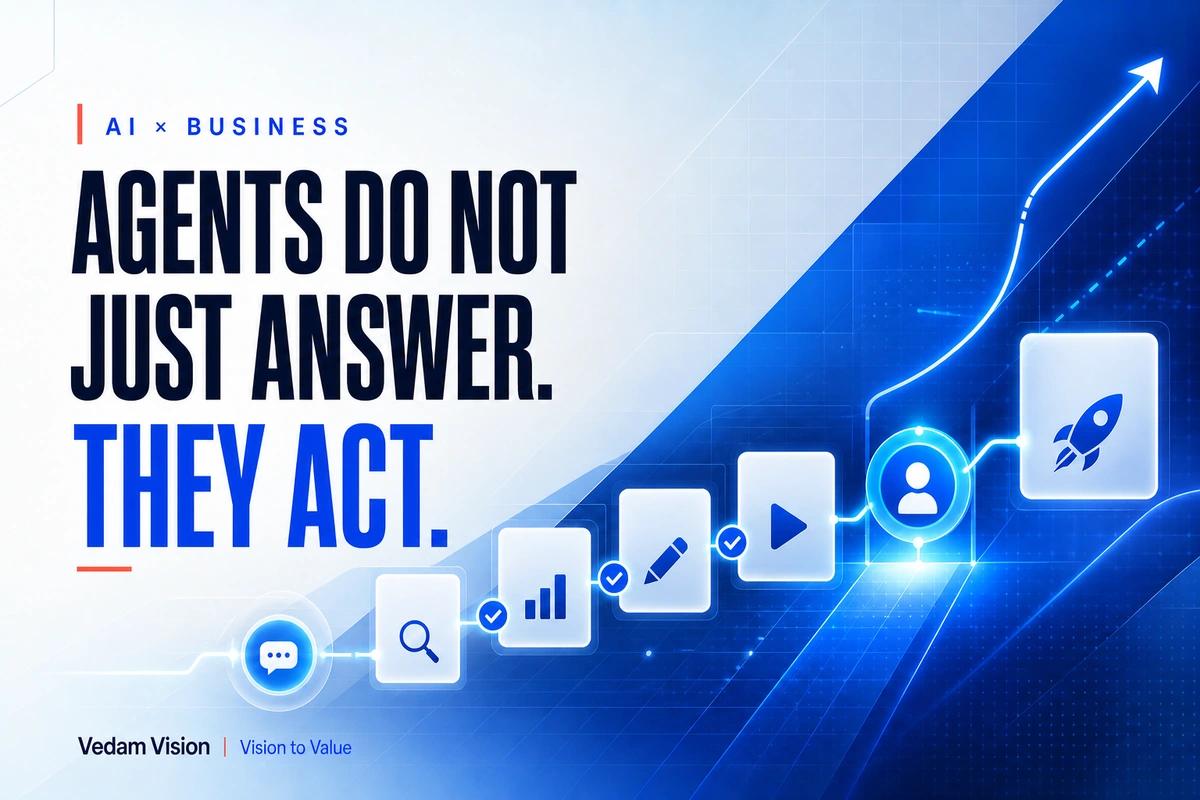
Google's official I/O 2026 announcement collection described an agent-first direction across Search, Gemini, developer tools, shopping, and other products. Google framed the shift as moving beyond tools that help people write toward agents that help people act.
That wording matters for business owners. A chatbot usually responds to a request. An agent is designed to pursue an outcome across steps. It may gather information, call a tool, update a system, wait for an event, and continue.
For an Indian SME, this can be useful. It can also create a larger failure path. One weak instruction can travel through several actions before anyone sees the result.
The companies that benefit will not be the ones with the highest agent count. They will be the ones that design the cleanest boundaries between people, software, and decisions.
What changed at Google I/O 2026
Google I/O included many model and product announcements, but the operational pattern was consistent. Google presented agents and agentic experiences that can work over longer tasks and take action, not only generate content.
Google's Search announcement described information agents in Search that can monitor changing information in the background and send synthesised updates. The I/O collection also highlighted Google Antigravity as an agent-first development platform and described Gemini 3.5 as combining intelligence with action.
Availability, pricing, and product details will continue to change. A business should verify current Google terms before choosing a tool. The durable lesson is broader: the unit of AI value is moving from an answer to a workflow.
That changes the questions leaders should ask.
Instead of asking which model writes the best reply, ask:
- What event starts the workflow?
- Which tools and records may the agent access?
- Which actions may it take without approval?
- Where must a person review the next step?
- How will the company know the outcome improved?
These questions sound operational because agents are operational.
AI agents for Indian business need a real workflow
"Use an agent for sales" is not a workflow.
"When a qualified website enquiry arrives, check whether the required service and city are supported, prepare a CRM record, draft a response from approved information, and ask a salesperson to approve any pricing or delivery promise" is much closer.
The second description names a trigger, information, actions, and a human checkpoint. It also reveals where the agent must stop.
This is important for Indian SMEs because customer journeys often cross several systems. A lead may start on Instagram, move to WhatsApp, receive a catalogue, ask for a GST invoice, and then enter a spreadsheet or CRM. The work is rarely contained in one clean application.
Vedam Vision's guide to AI use cases by function for Indian SMEs can help a team choose a bounded starting point. Pick a process with repeated volume, clear inputs, a visible owner, and a manageable cost when something goes wrong.
Five parts of a dependable agent workflow
1. A precise trigger
The workflow needs an event that can be observed.
Examples include a new enquiry with a phone number, an invoice uploaded to a folder, a support message tagged with a known issue, or a weekly inventory report arriving at a fixed time.
Avoid vague triggers such as "when useful" or "when the customer seems interested." If the team cannot explain when the agent starts, it will be hard to test or audit.
2. Approved context
An agent should not have to guess the rules of the business.
Provide current service areas, prices, stock rules, refund terms, escalation contacts, brand language, approved claims, and examples of acceptable output. For an Indian business, context may also include GST treatment, cash-on-delivery rules, regional language needs, WhatsApp etiquette, or festival-period delivery limits.
Keep this information in an owned source of truth. A long prompt copied six months ago is not reliable operations.
3. Limited permissions
Give the agent the minimum access required for the task.
Reading a CRM record is different from changing it. Drafting a message is different from sending it. Preparing a payment link is different from issuing a refund.
Begin with read-only or draft permissions where possible. Add actions only after the team has observed the workflow with real examples and documented the exceptions.
4. Human checkpoints
Human review should sit close to consequence.
A routine internal classification may need light sampling. A price, contract term, refund, hiring decision, medical statement, credit recommendation, or public performance claim needs a qualified person.
The checkpoint should be usable. Show the reviewer the source information, the proposed action, the reason, and the available alternatives. A button labelled "approve" is not meaningful if the evidence is hidden.
5. A measurable outcome
Do not judge an agent by how busy it looks.
Measure the business result. A lead-handling agent may be assessed on response time, complete CRM records, qualified appointments, corrections, and missed high-intent leads. An invoice agent may be assessed on processing time, exception rate, duplicate detection, and approval accuracy.
Record the current baseline first. Otherwise, a fast new workflow may look impressive without improving anything important.
Three realistic starting points for Indian SMEs
Lead preparation, not automatic selling
An agent can collect a website enquiry, check required fields, identify the requested service, add useful public company information, and prepare a response.
Keep a person responsible for qualification, price, availability, and promises. Indian service sales often depend on context that is not captured in a form, including city, urgency, procurement process, relationship history, and the buyer's preferred channel.
Support triage, not customer entrapment
An agent can classify common questions, retrieve an approved answer, and route unusual cases. It can reduce preparation work while keeping a visible path to a real person.
Do not force every customer through automation. Emotional complaints, safety issues, payment disputes, cancellations, and repeated failures should escalate quickly.
Marketing operations, not unsupervised publishing
An agent can collect source material, create a brief, prepare format variations, resize approved creative, and log publication status. It should not invent results, copy unsupported claims, or publish sensitive content without review.
For teams planning a wider rollout, the Indian SME AI implementation roadmap provides a practical way to move from one pilot into documented production.
The hidden risk is error propagation
A poor chatbot answer is visible in one response. A poor agent decision may influence several systems.
Imagine an agent that misunderstands a product rule, marks a lead as low priority, drafts the wrong quotation, updates the CRM, and schedules a follow-up. Each step looks reasonable because it follows the previous one. By the time a person notices, the mistake has travelled.
Design controls for this chain:
- validate critical fields before action
- require source links or record references
- use confidence or exception flags carefully
- log every tool call and change
- prevent irreversible actions without approval
- set spending, volume, and time limits
- create a simple pause control
These controls are not a rejection of automation. They are what make useful automation possible.
A practical pilot plan
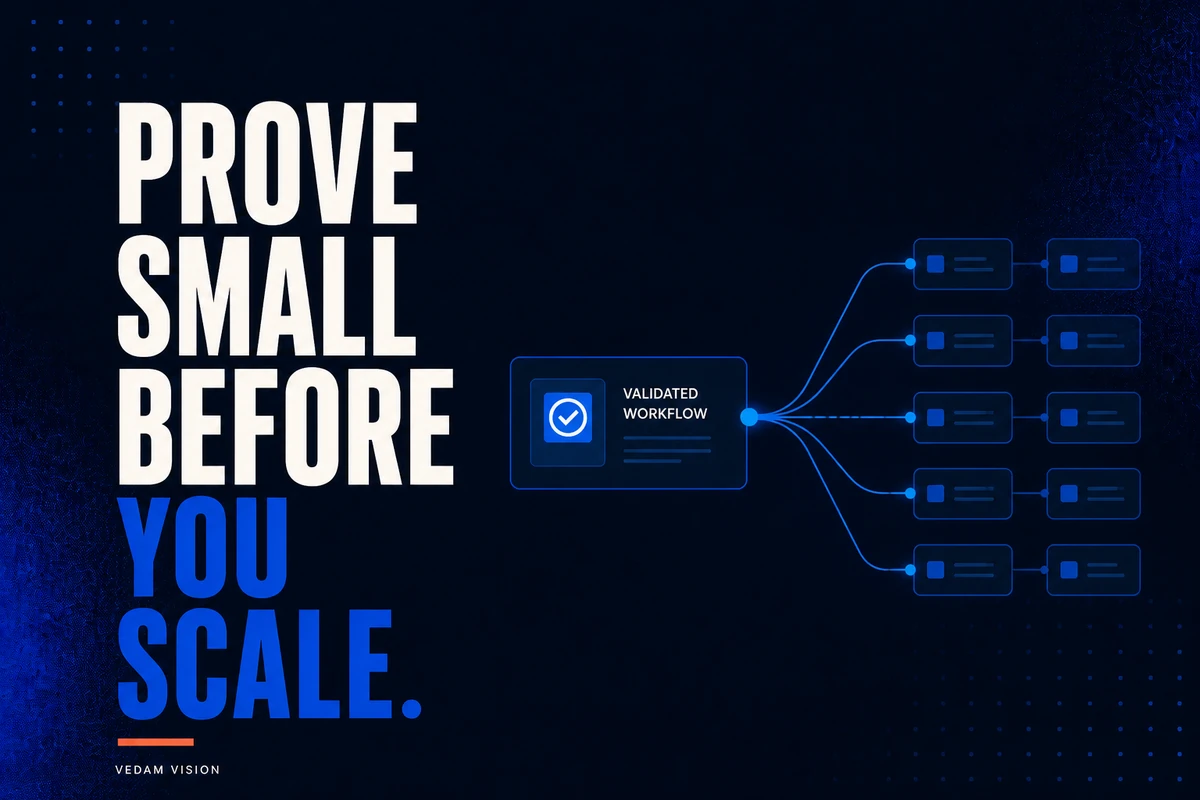
Choose one workflow that occurs often enough to test within two weeks.
First, map the current process from trigger to outcome. Note every tool, handoff, delay, and exception.
Second, decide which preparation step the agent can own. Keep the first version narrow.
Third, create a test set with ordinary cases, incomplete inputs, unusual requests, and cases that must escalate.
Fourth, run the agent in shadow mode. Let it prepare actions while people continue using the existing process. Compare its recommendations with what the team actually did.
Fifth, allow one reversible action after quality is stable. Continue logging corrections and exceptions.
Vedam Vision's AI solutions and automation service focuses on assistants, lead qualification, content systems, and workflow automation around existing business processes. The important design work happens before the automation is switched on.
Questions to ask a vendor
Before buying an agent platform, ask:
- Which data does the system store, and where?
- Which tools can it access, and at what permission level?
- Can actions require approval?
- Are tool calls and changes logged?
- How are failed steps retried?
- Can the team set budget, volume, and time limits?
- How can the workflow be paused immediately?
- What happens when the model or connected software changes?
The answers should be understandable to the process owner, not only the technical team.
Frequently asked questions
What is an AI agent for business?
An AI agent is a system designed to pursue an outcome across multiple steps, often by using tools, retrieving information, making bounded choices, and continuing until it reaches a checkpoint or completion condition.
How is an AI agent different from a chatbot?
A chatbot primarily exchanges messages. An agent may also call software, monitor events, update records, or coordinate actions. The distinction depends on the actual workflow, not the product label.
Which workflow should an Indian SME automate first?
Choose a frequent process with clear inputs, a named owner, measurable delay or inconsistency, and low to moderate risk. Lead preparation, support triage, and internal reporting are often easier to bound than sensitive financial or employment decisions.
Should an AI agent be allowed to contact customers automatically?
Only after the business has approved the content boundaries, tested real cases, created escalation rules, and measured errors. Begin with drafts and human approval when prices, promises, disputes, or sensitive information may appear.
How should a business measure an AI agent pilot?
Use outcome measures such as cycle time, correction rate, exception handling, qualified actions, customer impact, and staff effort. Compare them with a baseline from the existing process.
Build the handoffs before adding the agent
Google I/O 2026 made the direction visible. AI systems are being designed to act across longer sequences, not only answer isolated prompts.
That can create real operating leverage for Indian businesses. It can also move mistakes faster.
Start with the workflow. Define the trigger, context, permissions, checkpoint, and result. Keep a person close to any decision with meaningful consequences. Expand only after the sequence is reliable.
The better agent will matter. The better-designed handoff will matter more.