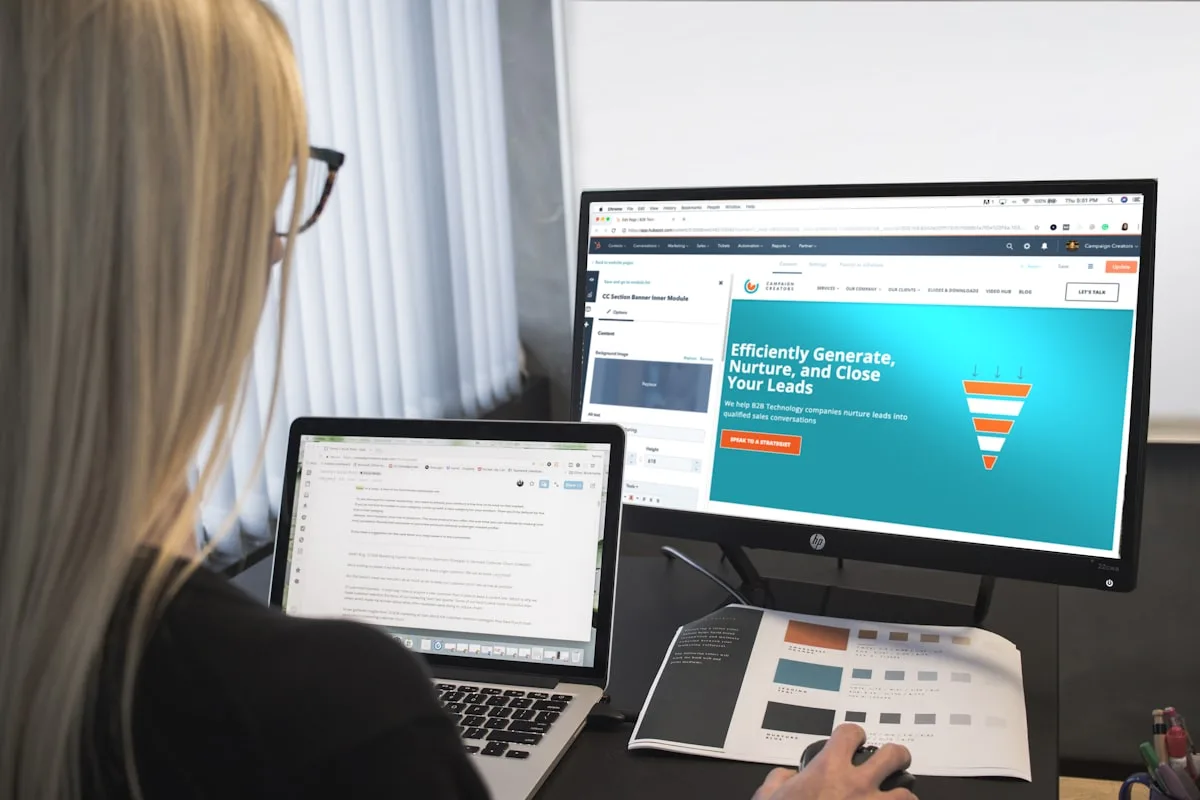
Manufacturing companies are increasingly judged online before a buyer ever requests a quotation. Digital visibility now supports trust, capability perception, and B2B lead generation.
For many businesses, the website is where trust is confirmed. People may discover you through Google, Maps, ads, Instagram, or referrals, but they usually decide whether to enquire based on what they see online. That is especially true in categories where trust, speed, and clarity matter a lot.
Why this matters in 2026

Customers compare faster than ever. If your website feels outdated, confusing, or incomplete, people assume the service experience may be similar. A modern site is not only about visual polish. It is about building trust, explaining services, reducing confusion, and making the next step obvious.
That is why websites now play a bigger role in conversion, brand trust, and lead quality than many teams realize.
Marketing for Manufacturing Companies: Going Digital in 2026
The strongest websites do a few things well: they communicate clearly, guide attention, show proof, answer common questions, and make enquiry easy. In practice, that means structure matters just as much as design.
| Priority | What to improve | Why it matters |
|---|---|---|
| Capability pages | Explain what you make and for whom | Improves relevance |
| Technical content | Shows expertise and process depth | Builds buyer confidence |
| LinkedIn and SEO | Capture research-stage attention | Supports B2B visibility |
| Lead handling | Faster enquiry response | Improves conversion |
Common mistakes to avoid
- Using vague messaging that does not explain the service clearly
- Hiding proof, reviews, or trust-building information
- Making forms too long or hard to find
- Ignoring mobile experience and page speed
- Publishing a site that looks active but does not guide action
How to improve this practically
Start by reviewing the buyer journey. What does the visitor need to understand in the first 10 seconds? What questions usually come up before enquiry? What proof reduces hesitation? Once those answers are clear, the website can be structured around conversion instead of guesswork.
It also helps to connect the website to the larger marketing system. Search visibility, paid campaigns, social proof, and follow-up speed all work better when the landing experience is strong.
How Vedam Vision approaches this
At Vedam Vision, we treat websites as growth systems, not just visual assets. Strong messaging, trust signals, conversion flow, and mobile clarity matter because that is what helps more visitors become enquiries.
FAQ
Do manufacturers need websites built for lead generation?
Yes, especially when buyers research vendors online before contact.
What content works best?
Capability pages, process explainers, use cases, and industry-focused trust content work well.
Is LinkedIn useful for manufacturing brands?
Yes, especially for authority, visibility, and B2B communication.
What is the most common weakness?
Many firms have weak digital presentation despite strong real-world capability.
If your site feels outdated or underperforming, explore our services or request a free audit for a practical improvement roadmap.
Practical next steps
Marketing for Manufacturing Companies: Going Digital in 2026 becomes more useful when the business turns the idea into a repeatable process instead of treating it like a one-time tactic. That usually means documenting the approach, defining what success looks like, and making sure the related website pages, CTAs, proof points, and follow-up steps are aligned properly.
Businesses often lose momentum because they improve one asset but do not connect it to the wider funnel. Stronger results usually come from linking content, discovery channels, trust signals, and conversion steps together so that each improvement supports the next stage of the journey.
What to review over time
After implementation, teams should review whether the change is actually improving clarity, response quality, engagement, or conversion. In some cases, the biggest lift comes from refining structure rather than adding more activity. That is why regular review matters. It helps the business scale what is working instead of guessing.
In the long run, the value comes from consistency. Better marketing systems reduce randomness, make execution easier, and create stronger compounding results over time.
Practical next steps
Marketing for Manufacturing Companies: Going Digital in 2026 becomes more useful when the business turns the idea into a repeatable process instead of treating it like a one-time tactic. That usually means documenting the approach, defining what success looks like, and making sure the related website pages, CTAs, proof points, and follow-up steps are aligned properly.
Businesses often lose momentum because they improve one asset but do not connect it to the wider funnel. Stronger results usually come from linking content, discovery channels, trust signals, and conversion steps together so that each improvement supports the next stage of the journey.
What to review over time
After implementation, teams should review whether the change is actually improving clarity, response quality, engagement, or conversion. In some cases, the biggest lift comes from refining structure rather than adding more activity. That is why regular review matters. It helps the business scale what is working instead of guessing.
In the long run, the value comes from consistency. Better marketing systems reduce randomness, make execution easier, and create stronger compounding results over time.
Practical next steps
Marketing for Manufacturing Companies: Going Digital in 2026 becomes more useful when the business turns the idea into a repeatable process instead of treating it like a one-time tactic. That usually means documenting the approach, defining what success looks like, and making sure the related website pages, CTAs, proof points, and follow-up steps are aligned properly.
Businesses often lose momentum because they improve one asset but do not connect it to the wider funnel. Stronger results usually come from linking content, discovery channels, trust signals, and conversion steps together so that each improvement supports the next stage of the journey.
What to review over time
After implementation, teams should review whether the change is actually improving clarity, response quality, engagement, or conversion. In some cases, the biggest lift comes from refining structure rather than adding more activity. That is why regular review matters. It helps the business scale what is working instead of guessing.
In the long run, the value comes from consistency. Better marketing systems reduce randomness, make execution easier, and create stronger compounding results over time.