Quick answer: Define what each review is deciding, who can approve, who contributes, how feedback is consolidated, what counts as a revision or scope change, when comments are due, how accessibility is supported, and what evidence closes approval.
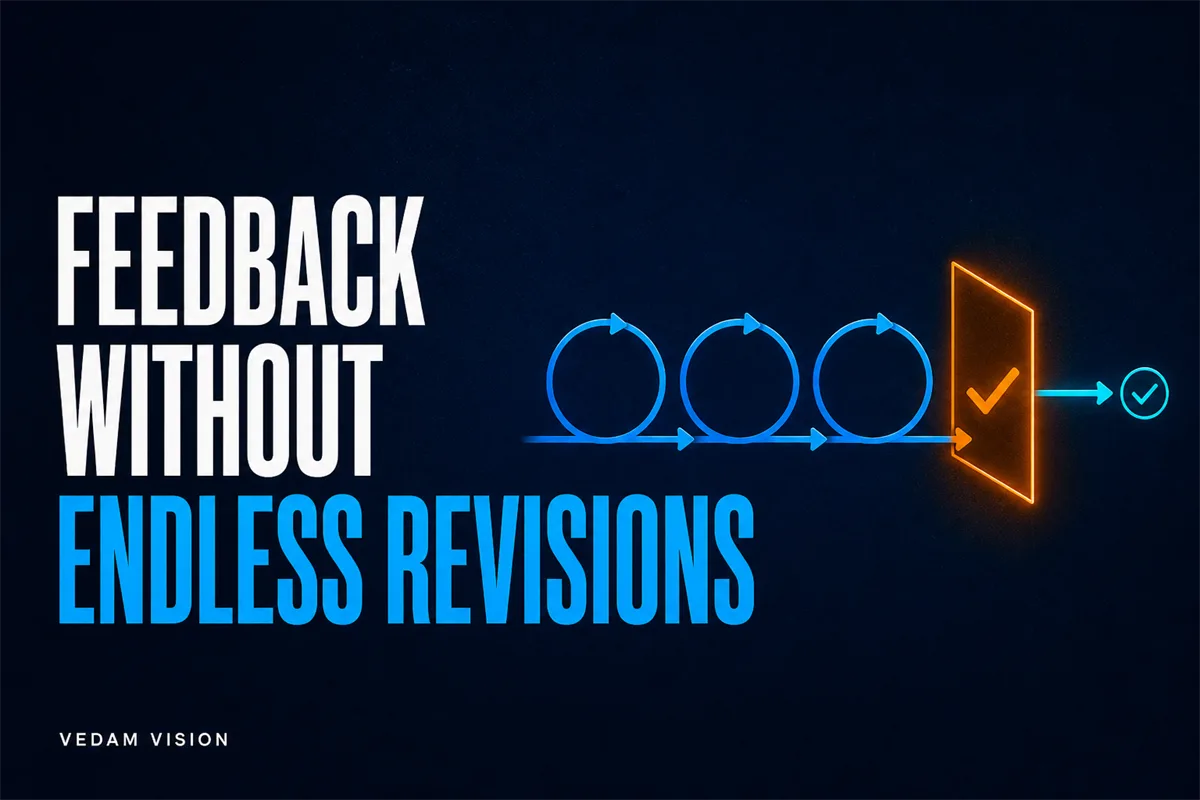
Endless revisions are often a process problem before they are a client problem. Reviewers receive unfinished work without a clear decision, several people comment independently, preferences mix with requirements, and nobody knows when approval is final.
A good feedback process helps clients give more useful input and helps the delivery team interpret it consistently. It protects the relationship by making scope, authority, and decisions visible before tension builds.
Design the review process when scope is agreed, not when the first disagreement appears. The format should match the work, client accessibility needs, and the consequence of the decision.
A practical working model
The model below turns client feedback process into a sequence that business owners can inspect, assign, and improve. Use it as a conversation guide, then adapt the detail to the consequence, volume, and maturity of the work.
1. Define the review purpose
What to do: State whether the client is reviewing direction, completeness, accuracy, compliance, usability, or final approval. Why it matters: Different review purposes require different questions and levels of finish.
Guardrail: Do not request final polish feedback on an early direction review. This boundary keeps the work useful when a normal case changes or a person needs to exercise judgement. Evidence to keep: Review stage, decision, artefact, and due date.
2. Name decision roles
What to do: Identify one client approver, contributors, the delivery owner, and people to inform. Why it matters: A visible approver prevents conflicting comments from becoming equal commands.
Guardrail: Respect internal client governance and document agreed authority. This boundary keeps the work useful when a normal case changes or a person needs to exercise judgement. Evidence to keep: Approver, contributors, delivery owner, and escalation.
3. Provide a guided review
What to do: Ask specific questions tied to objectives, audience, requirements, and known constraints. Why it matters: Guidance moves feedback from personal reaction toward useful evidence.
Guardrail: Leave room for concerns the questions did not anticipate. This boundary keeps the work useful when a normal case changes or a person needs to exercise judgement. Evidence to keep: Question, response, evidence, and decision impact.
4. Consolidate comments
What to do: Use one agreed channel and require the client team to resolve contradictions before handoff where possible. Why it matters: One source reduces duplication and hidden conversations.
Guardrail: Keep original context and identify unresolved conflicts. This boundary keeps the work useful when a normal case changes or a person needs to exercise judgement. Evidence to keep: Comment ID, author, decision, owner, and state.
5. Classify the change
What to do: Label feedback as correction, agreed revision, preference, new requirement, or scope change. Why it matters: Classification protects both quality and commercial clarity.
Guardrail: Do not use scope control to dismiss a legitimate defect. This boundary keeps the work useful when a normal case changes or a person needs to exercise judgement. Evidence to keep: Classification, rationale, effort, decision, and approval.
6. Respond with a decision log
What to do: Show accepted changes, questions, tradeoffs, declined requests with reasons, and next version expectations. Why it matters: Clients gain confidence when they can see how feedback was handled.
Guardrail: Use respectful plain language and avoid defensive debate. This boundary keeps the work useful when a normal case changes or a person needs to exercise judgement. Evidence to keep: Comment, response, owner, version, and status.
7. Close approval explicitly
What to do: Record the approved version, approver, date, remaining limits, and next-stage consequence. Why it matters: Clear closure prevents old comments from returning without context.
Guardrail: Define how later discoveries or changes will be handled. This boundary keeps the work useful when a normal case changes or a person needs to exercise judgement. Evidence to keep: Version, approval, conditions, and next action.
Questions to answer before implementation
Do not rush through these questions. A short written answer creates a shared decision record and reveals where the proposed process still depends on assumptions or personal memory.
- What is the client deciding now? One review should have a small number of explicit decisions. Record the answer, owner, and any evidence that would change it.
- Who can approve the work? Contributors need a voice, while authority remains visible. Record the answer, owner, and any evidence that would change it.
- Where will feedback live? A single source reduces missed and duplicate comments. Record the answer, owner, and any evidence that would change it.
- What is a defect versus a new request? Shared definitions protect quality and scope. Record the answer, owner, and any evidence that would change it.
- How will conflicting feedback be resolved? Do not force the delivery team to guess internal client priorities. Record the answer, owner, and any evidence that would change it.
- What closes the review? An explicit approved version and record prevent ambiguity. Record the answer, owner, and any evidence that would change it.
Run a focused working session
At kickoff, show the client a sample review request and decision log. Agree the channel, approver, contributors, timing, and scope language. This short conversation can prevent many later misunderstandings.
Before sending work, run an internal review against the stated purpose. Do not ask the client to find avoidable errors. After feedback, respond in one consolidated record before producing the next version.
Close the session with three artefacts: the current decision, the named owner, and the date when evidence will be reviewed. If the team leaves with only more ideas, the session has not yet changed the operating system.
Limitations and tradeoffs
Every framework simplifies reality. Apply this one in proportion to the risk and avoid turning a useful control into unnecessary ceremony.
- Some clients require formal legal, regulatory, procurement, or accessibility review with their own process. Review this condition when the process, customer promise, team, tool, or jurisdiction changes.
- Urgent corrections and material risks may need action outside the normal review window. Review this condition when the process, customer promise, team, tool, or jurisdiction changes.
- A fixed number of revisions does not solve unclear requirements by itself. Review this condition when the process, customer promise, team, tool, or jurisdiction changes.
- The process should support clients who cannot use the preferred tool or format. Review this condition when the process, customer promise, team, tool, or jurisdiction changes.
How to judge whether it is working
The process works when clients know what kind of feedback is useful, contradictory comments fall, scope decisions happen early, approved versions are easy to identify, and the relationship remains constructive even when requests are declined.
Review both the intended outcome and the exceptions. A process can look faster while shifting work to another person, creating risk, or making the customer experience less clear. Keep the measures small, definitions visible, and interpretation human.
Turn the framework into an operating habit
A framework becomes valuable when it survives the first workshop. Put the current version where the work happens, name the person who maintains it, and choose a review rhythm that matches the consequence. For business owners, the aim is not to inspect every action. The aim is to notice when assumptions, inputs, ownership, or customer needs have changed enough to require a decision.
Begin with a small live sample and keep a short decision log. Record what the team expected, what actually happened, which exception appeared, and what changed as a result. This creates evidence for improving client feedback process without turning every unusual case into a permanent rule. If a control adds effort but never changes a decision, simplify or remove it.
Share the latest version with everyone affected by the workflow, including the people who receive its output. Their questions often reveal unclear handoffs, missing context, or safeguards that exist on paper but not in daily work. Capture those observations before the next review so improvement is based on evidence rather than memory.
- Review Define the review purpose: confirm that its owner, evidence, boundary, and next action are still current before expanding the system.
- Review Name decision roles: confirm that its owner, evidence, boundary, and next action are still current before expanding the system.
- Review Provide a guided review: confirm that its owner, evidence, boundary, and next action are still current before expanding the system.
- Review Consolidate comments: confirm that its owner, evidence, boundary, and next action are still current before expanding the system.
Useful Vedam Vision resources
Explore our services overview, website design and development, portfolio, and case studies. You can also review the Vedam Vision process, browse the Vedam Vision blog, request a free audit, or use the contact page.
A practical next step
If reviews spread across email, chat, calls, and screenshots, send Vedam Vision the current handoff. We can help design one clear feedback, decision, and approval flow.
Start with one real situation, not a hypothetical transformation. Bring the current artefacts, the people who do the work, and the exceptions that cause the most delay. The first useful change is usually smaller and clearer than the tool list suggests.