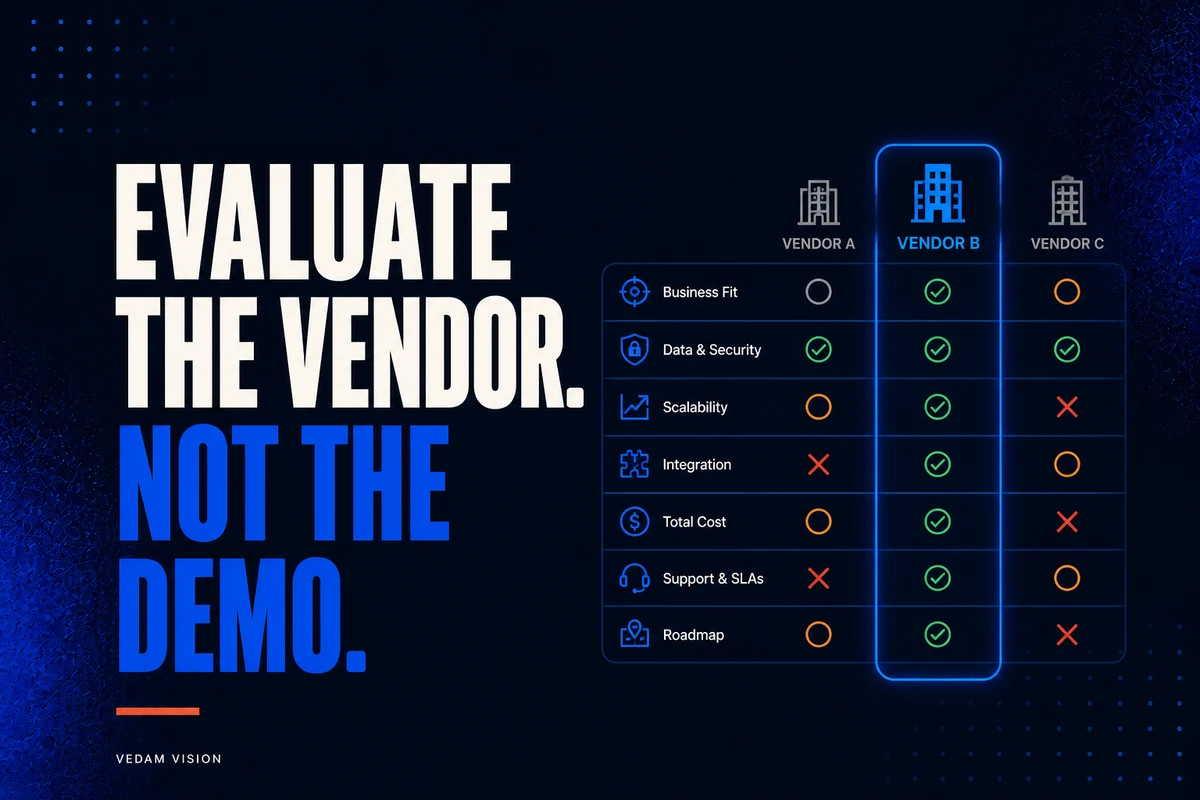
An AI vendor evaluation checklist should help a founder decide whether a product fits a real business problem, the available data, the team's capacity, and the level of risk the business is prepared to manage. Start with the use case and the failure you are trying to avoid. Do not start with a feature list, a polished demo, or a promise that the tool will “transform” the business. If the vendor cannot explain how the product will work in your context, it is too early to buy.
Small businesses often have little room for expensive experiments that create new review work, fragmented data, or a second process nobody owns. A practical decision compares the likely value with the full operating cost: setup, training, data preparation, integrations, review, security controls, change management, and the ability to exit. The right tool may be modest. It may also be no tool until the underlying workflow is clear.
The NIST AI Risk Management Framework Core describes governance, context mapping, measurement, and management as connected functions. It also calls attention to documentation, accountability, third-party software and data, and contingency planning. Those ideas translate well into a purchase conversation: know what you are buying, who depends on it, what could go wrong, and who owns the decision after the contract is signed.
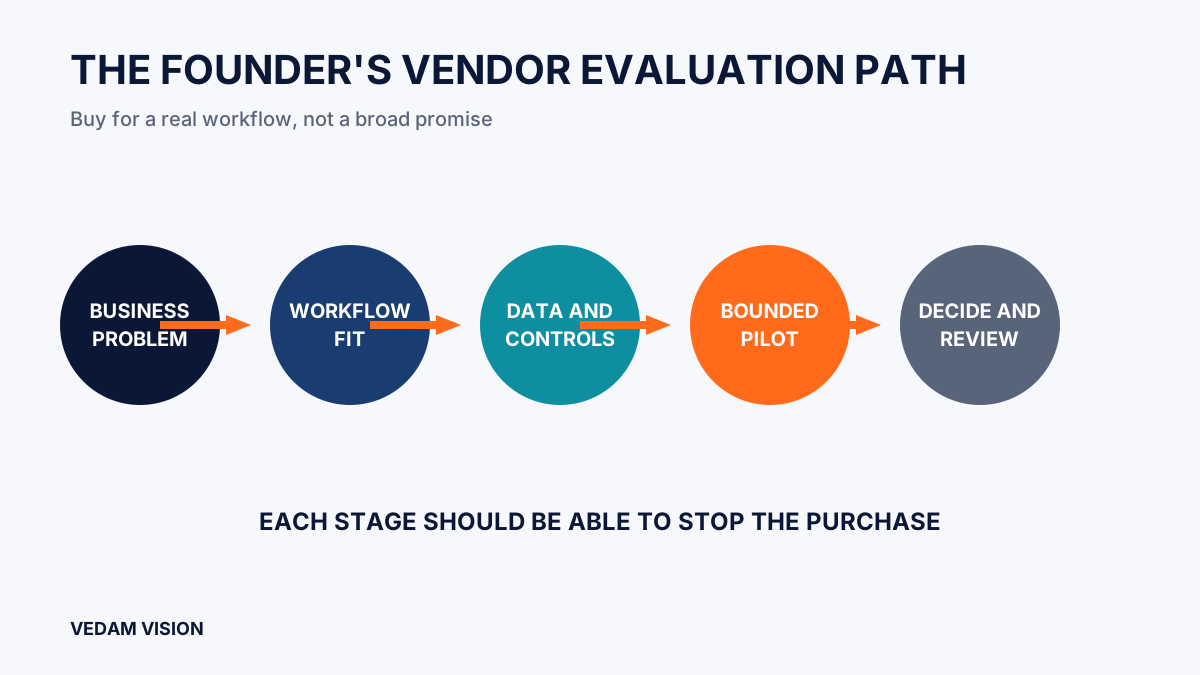
Define the business problem before you compare vendors
Write a problem statement that a person outside the company can understand. “We want AI” is not a problem. “Our team spends too long turning approved service notes into first-draft project updates, and managers still need to check every fact” is a problem. The difference matters because the second statement gives you a baseline workflow, a user group, a desired outcome, and a way to test whether a vendor helps.
Then describe the boundaries. What must the tool never do? Which decisions still require a person? Which data sources are allowed? What needs to remain in the current system? What would make the team stop the pilot? Boundaries make the demo more honest because they prevent a vendor from showing a broad capability that the business cannot safely or practically use.
A useful use-case brief includes
- The task, current workflow, and people affected.
- The recurring pain, delay, error, or opportunity being addressed.
- The desired outcome and the non-negotiable quality bar.
- The approved inputs, sensitive data limits, and system dependencies.
- The human review point, escalation path, and conditions for stopping.
- The pilot scope and the evidence needed to continue, change, or exit.
This brief becomes the scorecard for every conversation. It also protects a founder from buying a tool for a vague future use that never becomes somebody's responsibility.
Evaluate fit with the actual workflow
Ask the vendor to demonstrate the use case using safe, representative material and the constraints in your brief. A generic demonstration can be useful for orientation, but it does not show whether the tool handles your source quality, terminology, review process, edge cases, or delivery channel. If a demonstration cannot use representative data, create a sanitised test set that preserves the shape of the work without exposing confidential information.
Look beyond the generation step. Where does the input come from? Who cleans it? Can the output be checked, edited, approved, and returned to the system without manual copying? What happens when an input is incomplete? Can a colleague trace the output back to its source? Does the tool create a useful draft, or does it merely move the work into a new review queue?
This is where a clear Vedam Vision process helps. Discovery confirms the problem. Planning designs the workflow. Production tests the work. Approval checks whether the output is fit for use. A vendor purchase that skips these stages can leave a business with software but no operational result.
Review data, security, and access controls
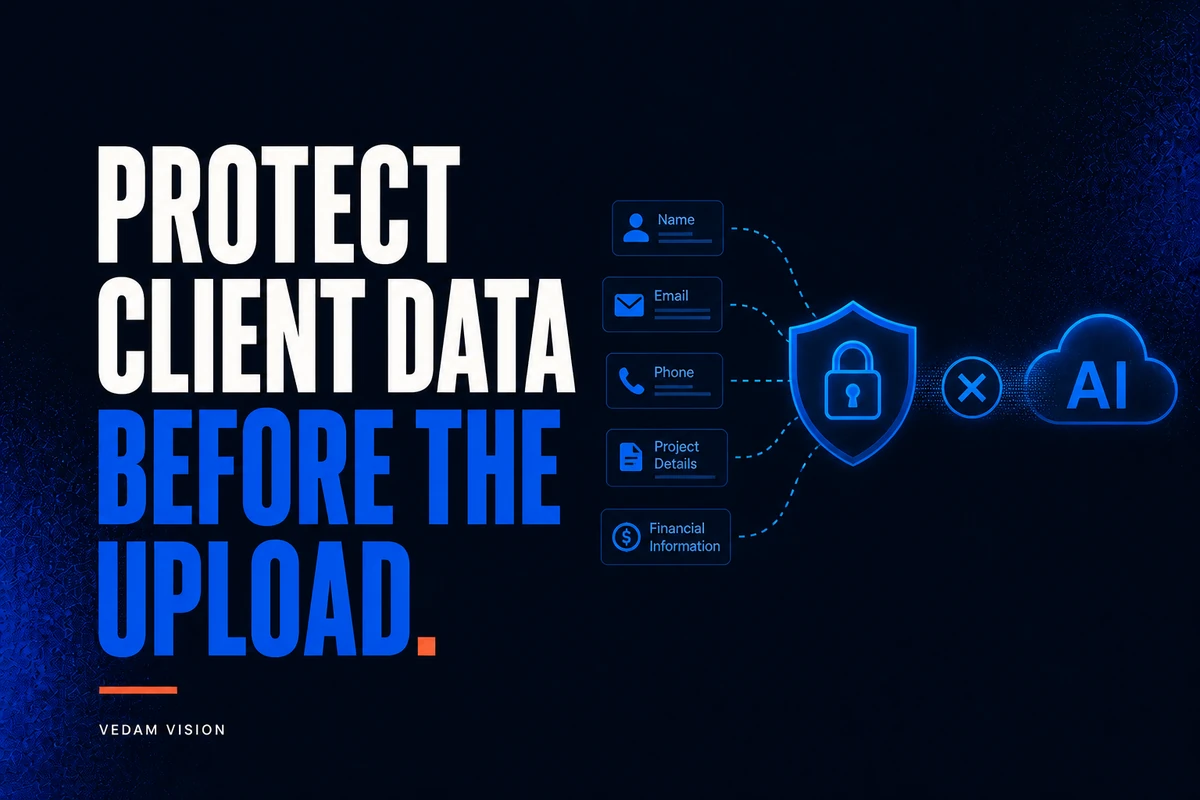
Do not postpone data questions until after the commercial choice is made. Ask what information the product processes, how it is transmitted, where it is stored, who can access it, how workspace permissions work, and which integrations can retrieve or send data. Review the current documentation for the exact plan and configuration you are considering. A claim made in a sales call is not a substitute for a documented control.
Map the information against your AI data privacy checklist. Identify data that must be removed, de-identified, restricted to a particular environment, or kept out of the workflow altogether. Confirm whether the product's user roles, audit records, retention options, export controls, and connected applications are appropriate for the use case.
Ask about the failure path too. If an integration sends the wrong output, if access is misconfigured, if a third-party service is unavailable, or if a tool must be replaced, who notices, who can stop the action, and what can be rolled back? NIST's governance material identifies third-party risks and contingency processes as part of managing AI risk. A founder does not need to build a large control department, but should not buy a workflow with no safe failure mode.
Test quality, limits, and human review honestly
Every AI product has limits. The point of evaluation is to find the limits that matter in your context before they are discovered by a customer. Build a small test set that includes normal cases, incomplete inputs, conflicting sources, unusual formats, and scenarios where the correct answer is to ask a question or decline an action. Give reviewers a defined quality standard rather than asking whether the output “looks good.”
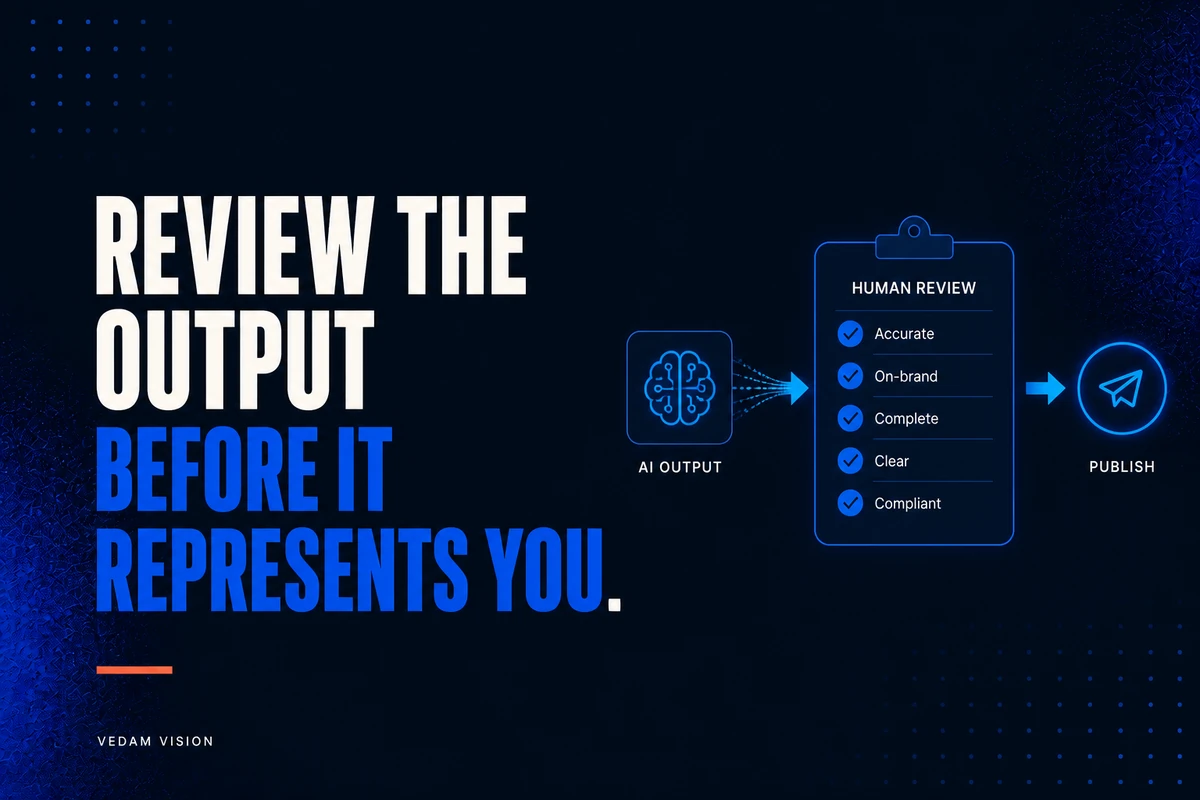
Review factual accuracy, source traceability, consistency, relevant context, accessibility, formatting, confidentiality, and the effect of an error downstream. For a public communication, test whether claims are supported and proportionate. For an operational workflow, test whether records are changed correctly and whether exceptions are visible. For a customer-facing process, test whether the result gives useful help without pretending certainty.
Use the AI output review checklist as a practical review frame. It prevents the team from mistaking fluent language for a safe or correct result. If the product requires a highly skilled person to fix every result, make that cost visible in the purchase decision.
Compare total operating cost, not only subscription price
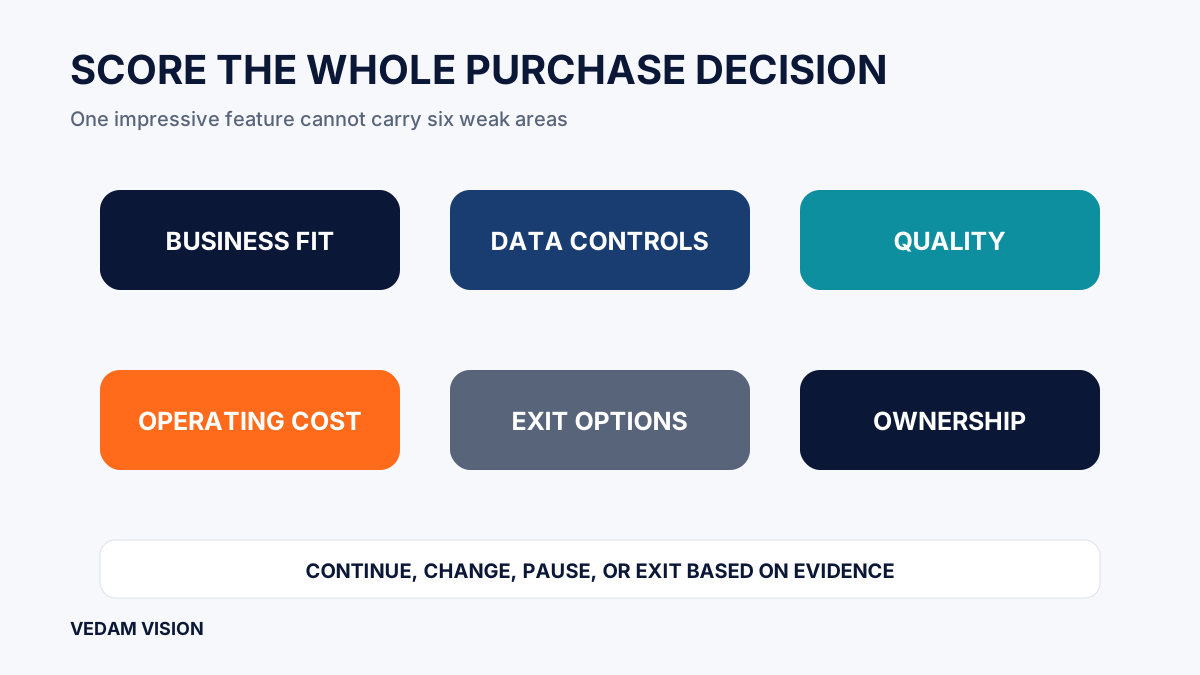
The subscription is one part of the cost. Include implementation time, data cleanup, training, integration work, testing, quality assurance, stakeholder review, ongoing administration, support, and change management. Ask who will own the workflow after the initial excitement fades. If a vendor needs a specialist to configure or supervise the product, confirm whether that skill exists internally or is part of the planned budget.
Also compare the cost of doing nothing, simplifying the workflow first, or using a lighter solution. The AI ROI guide is useful here because generation speed alone does not prove value. A workflow can look fast while review, correction, and handoffs quietly consume the time that was supposed to be saved.
Ask commercial and exit questions before commitment
Founders should understand how a relationship ends before they depend on it. Ask about contract length, renewal terms, price changes, user limits, support boundaries, data export, data deletion, migration assistance, uptime commitments where relevant, and what happens to integrations or custom configurations. Keep a record of answers that materially affect the decision.
Exit planning is not hostility toward a vendor. It is sensible risk management. A business needs to know whether it can keep operating, retrieve its records, and move to another approach if the vendor changes direction, the product stops fitting, or the team decides the pilot did not earn expansion.
Run a bounded pilot with a real decision at the end
A pilot should be narrow enough to supervise and long enough to reveal the work around the tool. Choose one defined group, use case, input set, and review process. Do not connect every data source or automate every action on day one. Set the success measures in advance, including quality, adoption, review effort, safety observations, and whether the business problem was actually reduced.
At the end, make a deliberate decision: continue, change the configuration, expand cautiously, pause, or exit. Record what was learned. A pilot that rolls into a subscription without a review becomes a habit, not a business decision. If you need help designing the controls around the pilot, AI solutions and automation work can help map the task, access, review, and escalation points.
AI vendor evaluation checklist
- The vendor is being assessed against a named business problem and bounded use case.
- The demonstration or pilot uses safe, representative work and real acceptance criteria.
- The team understands data categories, access, integrations, retention, and failure handling.
- Quality, exceptions, source traceability, and human review are tested before expansion.
- Total operating cost includes implementation, review, administration, and change management.
- Commercial terms, support, export, deletion, and exit options are documented.
- A named owner can decide whether to continue, change, pause, or retire the workflow.
A useful AI vendor evaluation checklist does not promise a frictionless purchase. It gives a founder enough evidence to make a proportionate choice. For support translating this checklist into a practical selection or pilot process, explore Vedam Vision services, request a free digital audit, or contact Vedam Vision.