Quick answer: Before importing contacts, decide what the CRM is for, define lifecycle stages and ownership, keep only useful fields, document lawful and respectful communication practices, clean duplicates, control permissions, and test a small sample end to end.
A CRM import can make a messy process look organised for a few days. Then duplicates, unclear stages, unowned leads, unreliable consent records, and conflicting fields begin to spread. The safer order is process first, data second, configuration third, import last.
A small business does not need every feature a CRM offers. It needs a shared view that helps people remember context, follow up appropriately, and understand what should happen next.
Treat the import as a migration. Preserve the original source, document every transformation, and prove the target workflow with a small sample before moving the full set.
A practical working model
The model below turns CRM setup for small business into a sequence that business owners can inspect, assign, and improve. Use it as a conversation guide, then adapt the detail to the consequence, volume, and maturity of the work.
1. Define the CRM purpose
What to do: Write the decisions and actions the CRM must support, such as qualification, follow-up, service handoff, and account history. Why it matters: Purpose determines which records and fields deserve maintenance.
Guardrail: Do not import information merely because it exists. This boundary keeps the work useful when a normal case changes or a person needs to exercise judgement. Evidence to keep: Use case, owner, action, and measure.
2. Design lifecycle stages
What to do: Create stages with clear entry and exit evidence. Why it matters: Shared definitions make pipeline reporting and handoffs comparable.
Guardrail: Avoid stages based only on seller feeling or vague probability. This boundary keeps the work useful when a normal case changes or a person needs to exercise judgement. Evidence to keep: Stage name, entry evidence, exit evidence, and owner.
3. Set record ownership
What to do: Decide who owns a person, company, opportunity, and service relationship. Why it matters: Ownership prevents good enquiries from sitting unseen.
Guardrail: Provide an unassigned queue and reassignment rules. This boundary keeps the work useful when a normal case changes or a person needs to exercise judgement. Evidence to keep: Owner, assignment rule, age, and escalation.
4. Build the minimum field set
What to do: Keep fields that support a decision, action, legal duty, or customer experience. Why it matters: A smaller field set is easier to complete, govern, and trust.
Guardrail: Separate required from useful and remove duplicated meaning. This boundary keeps the work useful when a normal case changes or a person needs to exercise judgement. Evidence to keep: Field purpose, source, allowed values, and steward.
5. Clean before import
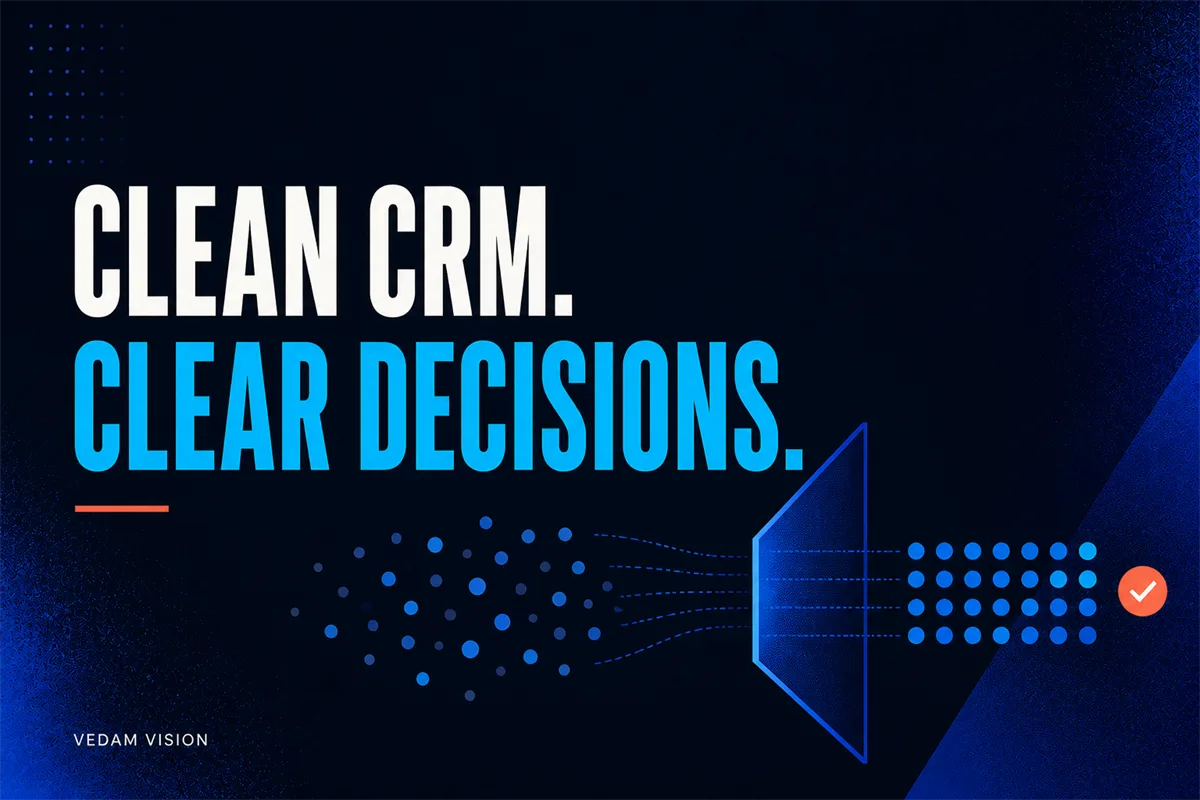
What to do: Standardise formats, identify duplicates, map old values, and quarantine uncertain records. Why it matters: Cleaning in the source is easier to review and reverse.
Guardrail: Never merge people solely because names are similar. This boundary keeps the work useful when a normal case changes or a person needs to exercise judgement. Evidence to keep: Source row, transformation, match confidence, and disposition.
6. Control access and communication
What to do: Use role-based permissions and preserve the basis, preference, and history for contact. Why it matters: CRM data can be commercially and personally sensitive.
Guardrail: Do not treat possession of an email address as permission for every message. This boundary keeps the work useful when a normal case changes or a person needs to exercise judgement. Evidence to keep: Access role, preference, source, and review date.
7. Test the operating loop
What to do: Import a sample and complete capture, assignment, follow-up, reporting, handoff, correction, and deletion scenarios. Why it matters: A successful file import does not prove the CRM process works.
Guardrail: Include negative tests and permission checks. This boundary keeps the work useful when a normal case changes or a person needs to exercise judgement. Evidence to keep: Test case, expected result, actual result, and correction.
Questions to answer before implementation
Do not rush through these questions. A short written answer creates a shared decision record and reveals where the proposed process still depends on assumptions or personal memory.
- What business question will this field answer? Fields without a user become stale decoration. Record the answer, owner, and any evidence that would change it.
- When does ownership change? Explicit handoff points prevent internal disputes and missed follow-up. Record the answer, owner, and any evidence that would change it.
- What creates a new opportunity? Clear rules stop duplicate pipelines and inflated forecasts. Record the answer, owner, and any evidence that would change it.
- How will duplicates be reviewed? Confidence thresholds protect against destructive automatic merges. Record the answer, owner, and any evidence that would change it.
- Who may export or delete data? High-impact permissions require tighter control and accountability. Record the answer, owner, and any evidence that would change it.
- How will incorrect information be fixed? A correction path helps the CRM become more trustworthy over time. Record the answer, owner, and any evidence that would change it.
Run a focused working session
Choose twenty varied records, including a duplicate, an old contact, an active opportunity, an existing client, and an incomplete enquiry. Map each one to the proposed stages, fields, owner, and communication state. Any record that does not fit reveals a design question before migration.
After the sample import, ask a user to perform the real work without assistance from the builder. Observe where labels, views, or required fields cause confusion. Fix the operating experience before adding automation or importing the remaining database.
Close the session with three artefacts: the current decision, the named owner, and the date when evidence will be reviewed. If the team leaves with only more ideas, the session has not yet changed the operating system.
Limitations and tradeoffs
Every framework simplifies reality. Apply this one in proportion to the risk and avoid turning a useful control into unnecessary ceremony.
- Privacy, consent, retention, and communication obligations depend on jurisdiction and context. Obtain appropriate advice. Review this condition when the process, customer promise, team, tool, or jurisdiction changes.
- No deduplication method is perfectly safe; ambiguous matches need human review. Review this condition when the process, customer promise, team, tool, or jurisdiction changes.
- Historical data may not support the new stage definitions, so avoid false precision in old reports. Review this condition when the process, customer promise, team, tool, or jurisdiction changes.
- A CRM will not create follow-up discipline if managers do not review ownership and ageing. Review this condition when the process, customer promise, team, tool, or jurisdiction changes.
How to judge whether it is working
The CRM is ready when users can explain why each field exists, move records consistently, see who owns the next action, correct mistakes safely, and produce a report whose definitions they trust.
Review both the intended outcome and the exceptions. A process can look faster while shifting work to another person, creating risk, or making the customer experience less clear. Keep the measures small, definitions visible, and interpretation human.
Turn the framework into an operating habit
A framework becomes valuable when it survives the first workshop. Put the current version where the work happens, name the person who maintains it, and choose a review rhythm that matches the consequence. For business owners, the aim is not to inspect every action. The aim is to notice when assumptions, inputs, ownership, or customer needs have changed enough to require a decision.
Begin with a small live sample and keep a short decision log. Record what the team expected, what actually happened, which exception appeared, and what changed as a result. This creates evidence for improving CRM setup for small business without turning every unusual case into a permanent rule. If a control adds effort but never changes a decision, simplify or remove it.
Share the latest version with everyone affected by the workflow, including the people who receive its output. Their questions often reveal unclear handoffs, missing context, or safeguards that exist on paper but not in daily work. Capture those observations before the next review so improvement is based on evidence rather than memory.
- Review Define the CRM purpose: confirm that its owner, evidence, boundary, and next action are still current before expanding the system.
- Review Design lifecycle stages: confirm that its owner, evidence, boundary, and next action are still current before expanding the system.
- Review Set record ownership: confirm that its owner, evidence, boundary, and next action are still current before expanding the system.
- Review Build the minimum field set: confirm that its owner, evidence, boundary, and next action are still current before expanding the system.
Useful Vedam Vision resources
Explore our services overview, website design and development, portfolio, and case studies. You can also review the Vedam Vision process, browse the Vedam Vision blog, request a free audit, or use the contact page.
A practical next step
If your CRM decision starts with vendor features or a spreadsheet import, pause and send Vedam Vision the real sales and service flow. We can help define the minimum structure before data becomes harder to repair.
Start with one real situation, not a hypothetical transformation. Bring the current artefacts, the people who do the work, and the exceptions that cause the most delay. The first useful change is usually smaller and clearer than the tool list suggests.