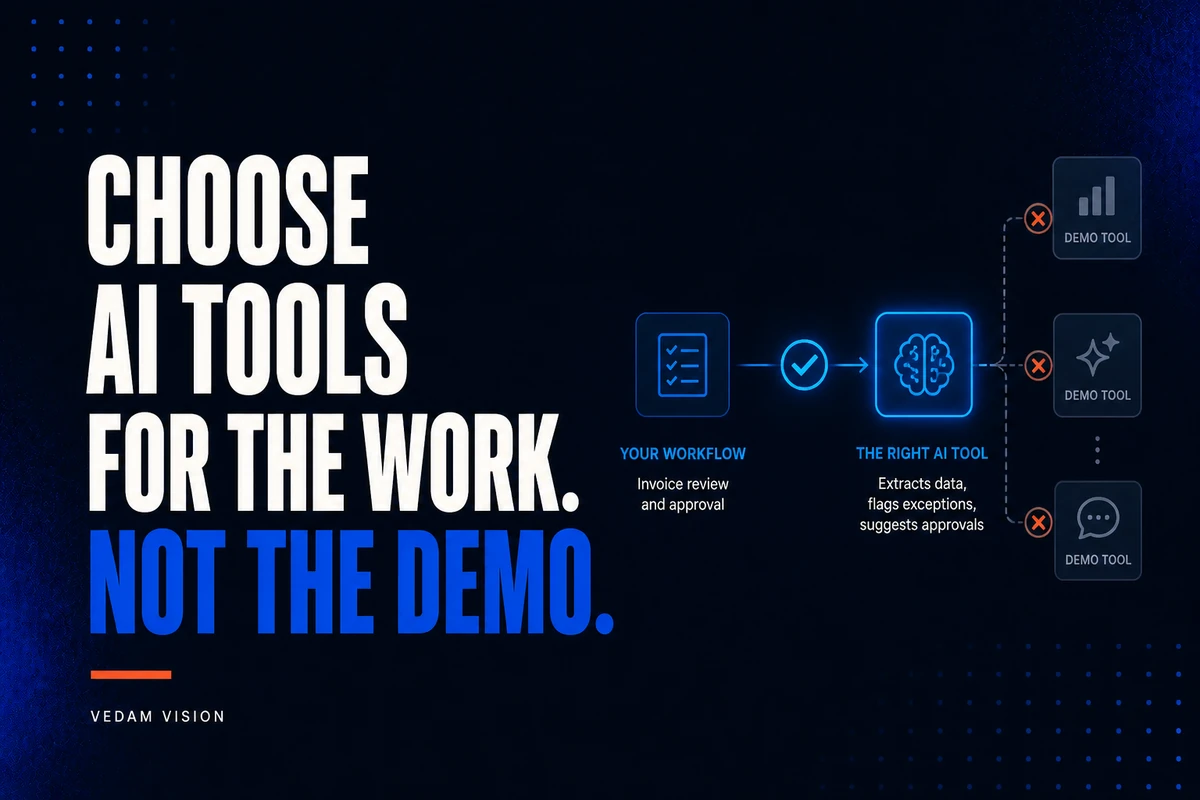
Small businesses should choose AI tools by starting with one recurring business job, defining the result that must improve, and testing a short list against real work. The tool is useful only when it reduces delay, review effort, or avoidable mistakes without creating a larger burden in training, security, or supervision.
That sounds simple, but the buying process often moves in the opposite direction. A polished demonstration creates excitement. Different teams then request separate subscriptions. Three months later, the company owns several tools that overlap, depend on weak data, and still require people to copy information between systems. The problem was not a lack of AI. The problem was that no one defined the operating decision before comparing products.
This guide gives small-business owners a practical way to evaluate AI tools for small business. It focuses on fit, control, cost, and measurable value. It does not assume that every workflow needs automation or that the most capable model is automatically the best business choice.
Begin with the work, not the tool category
Write one sentence that describes the job you want to improve. Keep vendor names and technical terms out of it. A useful sentence might be: “Turn approved meeting notes into a client follow-up within thirty minutes, with a person checking every promise before it is sent.” Another might be: “Classify incoming enquiries so the correct owner receives the message, contact details, and reason for enquiry.”
The sentence should identify the trigger, output, owner, and acceptance rule. These four parts stop a buying conversation from becoming a tour of interesting features. If the team cannot describe what a satisfactory result looks like, it cannot compare tools honestly.
Start with a workflow that happens often enough to observe but is not the most sensitive process in the company. A first test should reveal real operational friction without exposing the business to unacceptable financial, privacy, or reputation risk. Vedam Vision's guide to practical AI governance explains why ownership and review boundaries should be visible before a workflow expands.
Define the business result before creating a shortlist
A business result is not “use AI for content” or “automate customer support.” Those statements describe a direction, not an outcome. A better result includes a baseline and an acceptance condition. For content, the business may want to reduce the time needed to turn an approved brief into a reviewable first draft while keeping factual approval with the subject owner. For support, it may want to route common questions faster while ensuring complaints and payment issues always reach a person.
Use three measures at most during the first test:
- Completion time: How long does the work take from trigger to accepted result?
- Review effort: How much human correction is required before the result can be used?
- Exception rate: How often does the workflow stop because context, permission, or judgment is missing?
These measures work together. A draft produced in seconds is not efficient if a senior employee spends an hour repairing it. An automated response is not useful if customers repeat the same information when the case reaches a person. Measure the complete path, not the impressive step in the middle.
Use a fit matrix to compare AI tools for small business
A shortlist of two or three options is usually enough for a focused workflow. Compare them using the same evidence. Do not let one vendor demonstrate a carefully prepared case while another is judged on an unstructured trial. Give every option the same representative inputs and the same acceptance test.
Give the largest weight to workflow fit and control. Workflow fit asks whether the tool handles your real inputs, language, volume, approval steps, and output format. Control asks whether the team can review, correct, pause, and audit what happens. A product with more features can still be a weaker choice if it hides important decisions or forces the team into an unsuitable process.
Review effort deserves its own score because it is easy to miss during a demonstration. Record the number and type of corrections. A small wording change is different from a factual error, an invented promise, or a missed exception. The goal is not to eliminate people. It is to place their judgment where it protects quality and customer trust.
Check data, access, and security before the trial grows
Ask what information the tool receives, where that information is stored, who can access it, and how it can be removed. Do not upload confidential client material simply because a trial account makes the action easy. Start with approved test data and confirm the vendor's settings, retention terms, user controls, and export options.
The NIST AI Risk Management Framework provides a useful way to think about governance, measurement, and management. A small business does not need to copy an enterprise programme, but it can adopt the core discipline: understand the context, identify risks, measure performance, and keep a named person accountable for action.
The OECD AI Principles also emphasise human-centred values, transparency, robustness, and accountability. In practical buying terms, that means asking whether the team can explain the tool's role, detect weak outputs, protect information, and assign responsibility when something goes wrong.
Security basics still matter. The US Cybersecurity and Infrastructure Security Agency maintains guidance for small and medium businesses covering practical cyber risk. Apply the same care to an AI subscription that you would apply to any system holding customer, employee, financial, or operational information.
Calculate the full operating cost
The subscription price is only one part of cost. Include setup, data preparation, integration, training, review time, administration, and the work needed when the tool changes. Also consider the cost of leaving. Can the team export prompts, records, documents, and workflow history in a usable format? Can another tool or manual process take over without losing important context?
Build a simple monthly estimate:
| Cost area | What to include | Why it matters |
|---|---|---|
| License | Seats, usage limits, add-ons, taxes | Shows the visible recurring cost |
| Setup | Configuration, migration, integration | Prevents a cheap trial from hiding expensive implementation |
| Review | Human checking and correction time | Reveals whether speed is real |
| Administration | Access, billing, policy, monitoring | Captures ongoing ownership |
| Exit | Export, replacement, retraining | Reduces avoidable lock-in |
Then compare that cost with the value of accepted work, not raw output. The article on calculating AI ROI for Indian SMBs provides a deeper method for connecting time, quality, and risk to a business decision.
Run a controlled pilot instead of an open-ended trial
A trial answers whether a feature works. A pilot answers whether the workflow improves. Give the pilot an owner, a start date, a small sample of representative work, and a final keep, change, or stop decision.
During the pilot, keep a short exception log. Record when the tool lacks context, produces an unsafe or inaccurate result, requires unexpected manual work, or cannot connect to the next step. The log becomes more valuable than a general opinion because it shows what needs to change.
Use the Vedam Vision delivery process as a reference for separating discovery, design, implementation, and review. The same sequence works for internal evaluation. It prevents a team from committing to a build before it has agreed on the business problem and acceptance rule.
A practical thirty-day buying process
Week one: map the workflow
Choose one job, observe the current process, and document the trigger, inputs, output, owner, review, and exceptions. Record a modest baseline. If exact operational data is unavailable, use a clearly labelled sample instead of inventing precision.
Week two: shortlist and test
Select two or three options. Give each the same representative work. Score fit, control, review effort, total cost, security, and portability. Remove any option that fails a non-negotiable requirement, even if its demonstration is impressive.
Week three: run the pilot
Use approved data and a limited user group. Keep human approval at consequential points. Track accepted completion time, correction effort, and exceptions. Meet briefly during the pilot to resolve process questions, not to add features.
Week four: decide
Compare the pilot with the baseline. Keep the tool if the improvement is repeatable and the control burden is acceptable. Change the workflow if value exists but the boundary is wrong. Stop if the result depends on constant repair, unsafe access, or a cost the business cannot justify.
Common buying mistakes to avoid
- Buying for a department label: “AI for marketing” is too broad. Buy for a defined job and output.
- Counting generated output: Count accepted work and downstream effect instead.
- Ignoring review time: Faster generation can create slower approval.
- Testing only ideal inputs: Include incomplete, ambiguous, and exception cases.
- Giving access too early: Begin with approved data and minimum permissions.
- Skipping the exit question: Confirm how data and workflow history can be exported.
- Keeping every trial: A tool that did not win the pilot should not remain as an accidental subscription.
When outside support is useful
A team can run this process internally when someone owns the workflow, can assess security and integration, and has time to measure the result. Outside support becomes useful when the process crosses website, marketing, CRM, customer communication, or automation systems and no single person can see the full sequence.
Vedam Vision's AI Solutions and Automation service begins with the workflow and acceptance test rather than a preferred tool. You can also review the broader service portfolio when the problem includes website, brand, content, or marketing work. If you want an initial view of where the current system is losing clarity, the free audit provides a practical starting point.
Choose capability, not a collection
The best AI tool for a small business is not the one with the longest feature list. It is the one that fits a defined workflow, works with approved information, keeps accountability visible, and produces enough measurable value to justify its full operating cost.
Start with one job. Compare a small shortlist using the same evidence. Pilot the complete workflow. Keep only the option that improves accepted work without creating hidden risk or permanent correction effort. That approach turns AI tools for small business from a shopping exercise into a capability the team can understand and improve.