Quick answer: Automate repetitive tasks only after you make the rule and owner visible. Select a stable task, measure the manual baseline, map exceptions, assign technical and business ownership, limit permissions, monitor runs, document recovery, and budget for maintenance.
A repetitive task can look like an easy automation win because the normal path is familiar. The hidden cost appears later when inputs change, a connector expires, an exception waits unseen, or the original builder leaves.
The answer is not to avoid automation. It is to treat every useful flow as a small operating product with an owner, users, controls, logs, and a retirement decision.
Begin with one task whose outcome can be checked. Preserve a manual fallback until the team has evidence that the automated route is reliable in real conditions.
A practical working model
The model below turns automate repetitive tasks at work into a sequence that teams can inspect, assign, and improve. Use it as a conversation guide, then adapt the detail to the consequence, volume, and maturity of the work.
1. Measure the manual baseline
What to do: Record frequency, handling time, common errors, waiting time, and exception volume. Why it matters: A baseline shows whether automation solves a meaningful problem.
Guardrail: Do not use estimates when a short observation period is possible. This boundary keeps the work useful when a normal case changes or a person needs to exercise judgement. Evidence to keep: Sample period, volume, effort, error, and wait.
2. Stabilise the rule
What to do: Write the trigger, inputs, actions, outputs, and completion evidence. Why it matters: Stable rules reduce endless branches and maintenance.
Guardrail: Fix contradictory policies before coding them. This boundary keeps the work useful when a normal case changes or a person needs to exercise judgement. Evidence to keep: Rule version, owner, and tested examples.
3. Classify exceptions
What to do: Group situations that should retry, wait, route to a person, or stop. Why it matters: Different failures need different responses.
Guardrail: Never retry an irreversible action without duplicate protection. This boundary keeps the work useful when a normal case changes or a person needs to exercise judgement. Evidence to keep: Exception class, action, owner, and deadline.
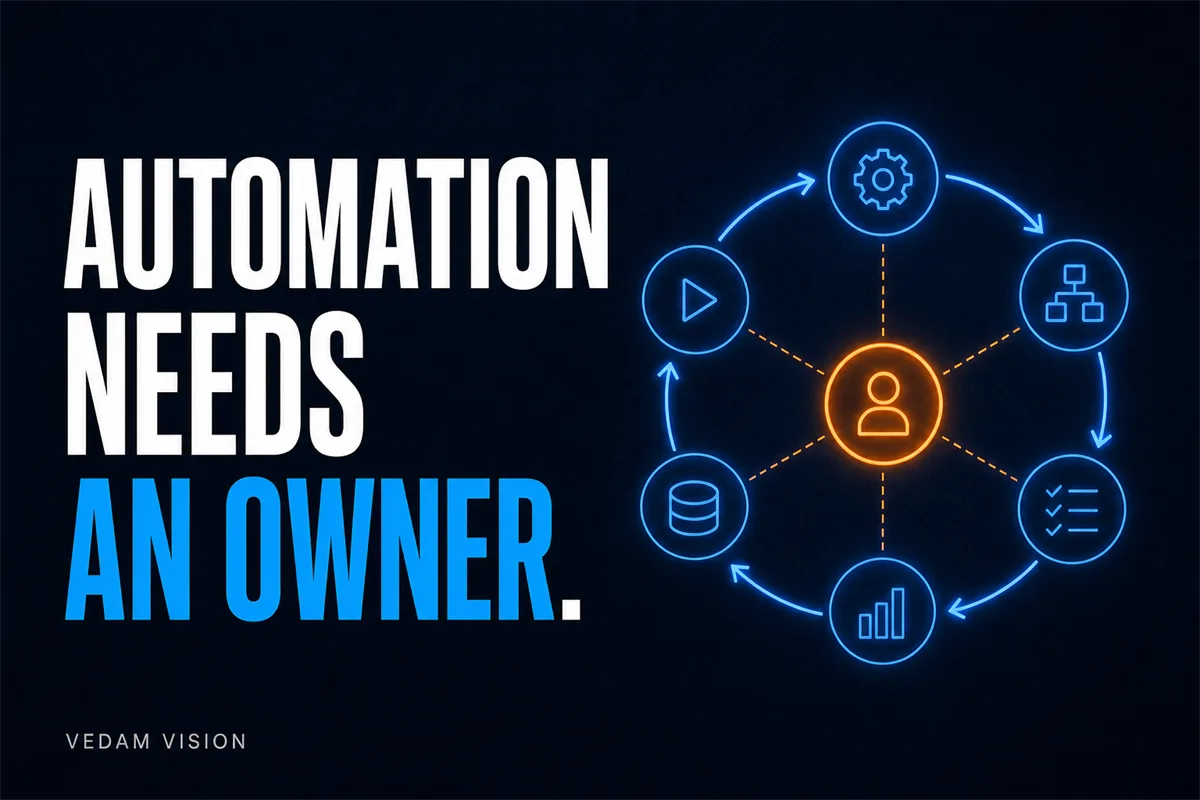
4. Assign two kinds of ownership
What to do: Name the business owner for outcome and the technical owner for operation. Why it matters: One person may hold both roles, but both responsibilities still exist.
Guardrail: Document backup ownership and access. This boundary keeps the work useful when a normal case changes or a person needs to exercise judgement. Evidence to keep: Owner, backup, review date, and escalation.
5. Limit access
What to do: Give the workflow and operators only the data and actions required. Why it matters: Broad permissions increase the impact of mistakes and compromise.
Guardrail: Review connections when staff or systems change. This boundary keeps the work useful when a normal case changes or a person needs to exercise judgement. Evidence to keep: Credential owner, scope, rotation, and last review.
6. Monitor meaningful signals
What to do: Alert on failed runs, unusual volume, growing queues, long duration, and missing completion. Why it matters: A green connector status does not prove the business outcome occurred.
Guardrail: Route alerts to an owned channel with response expectations. This boundary keeps the work useful when a normal case changes or a person needs to exercise judgement. Evidence to keep: Run, outcome, alert, owner, and resolution time.
7. Maintain and retire
What to do: Schedule reviews for rules, connectors, documentation, and continued value. Why it matters: Every automation accumulates dependency and eventually changes.
Guardrail: Remove unused credentials and archive evidence when retiring. This boundary keeps the work useful when a normal case changes or a person needs to exercise judgement. Evidence to keep: Review result, change, version, and retirement record.
Questions to answer before implementation
Do not rush through these questions. A short written answer creates a shared decision record and reveals where the proposed process still depends on assumptions or personal memory.
- Is the task stable enough? Frequent policy changes create expensive automation churn. Record the answer, owner, and any evidence that would change it.
- What is the worst silent failure? Design monitoring around business harm, not only technical errors. Record the answer, owner, and any evidence that would change it.
- Can the action be reversed? Reversible pilots let the team learn more safely. Record the answer, owner, and any evidence that would change it.
- Who responds outside office hours? Response expectations should match the consequence and service promise. Record the answer, owner, and any evidence that would change it.
- What happens if the builder leaves? Documentation, shared credentials, and backup ownership protect continuity. Record the answer, owner, and any evidence that would change it.
- When is manual work cheaper? Low volume or high variation can make careful manual handling the better choice. Record the answer, owner, and any evidence that would change it.
Run a focused working session
Review the exception log every week during the pilot. Ask whether each exception came from bad data, an unclear rule, a system change, or a genuinely unusual case. Change the process only when the classification is understood.
Keep a one-page runbook beside the workflow. It should show purpose, owner, systems, permissions, normal completion, alerts, manual fallback, safe restart, and retirement contact. Test the fallback before it is urgently needed.
Close the session with three artefacts: the current decision, the named owner, and the date when evidence will be reviewed. If the team leaves with only more ideas, the session has not yet changed the operating system.
Limitations and tradeoffs
Every framework simplifies reality. Apply this one in proportion to the risk and avoid turning a useful control into unnecessary ceremony.
- Tool pricing, quotas, APIs, and authentication can change after launch. Review this condition when the process, customer promise, team, tool, or jurisdiction changes.
- Automation may shift work to exception handling rather than remove it. Review this condition when the process, customer promise, team, tool, or jurisdiction changes.
- Some data and actions require stronger privacy, security, legal, or financial controls. Review this condition when the process, customer promise, team, tool, or jurisdiction changes.
- A flow with too many branches may be signalling that the underlying service needs simplification. Review this condition when the process, customer promise, team, tool, or jurisdiction changes.
How to judge whether it is working
The task is truly automated when normal work completes reliably, exceptions become visible, ownership survives staff changes, and the team can recover without guesswork. Fewer clicks alone are not enough.
Review both the intended outcome and the exceptions. A process can look faster while shifting work to another person, creating risk, or making the customer experience less clear. Keep the measures small, definitions visible, and interpretation human.
Turn the framework into an operating habit
A framework becomes valuable when it survives the first workshop. Put the current version where the work happens, name the person who maintains it, and choose a review rhythm that matches the consequence. For teams, the aim is not to inspect every action. The aim is to notice when assumptions, inputs, ownership, or customer needs have changed enough to require a decision.
Begin with a small live sample and keep a short decision log. Record what the team expected, what actually happened, which exception appeared, and what changed as a result. This creates evidence for improving automate repetitive tasks at work without turning every unusual case into a permanent rule. If a control adds effort but never changes a decision, simplify or remove it.
Share the latest version with everyone affected by the workflow, including the people who receive its output. Their questions often reveal unclear handoffs, missing context, or safeguards that exist on paper but not in daily work. Capture those observations before the next review so improvement is based on evidence rather than memory.
- Review Measure the manual baseline: confirm that its owner, evidence, boundary, and next action are still current before expanding the system.
- Review Stabilise the rule: confirm that its owner, evidence, boundary, and next action are still current before expanding the system.
- Review Classify exceptions: confirm that its owner, evidence, boundary, and next action are still current before expanding the system.
- Review Assign two kinds of ownership: confirm that its owner, evidence, boundary, and next action are still current before expanding the system.
Useful Vedam Vision resources
Explore our services overview, website design and development, portfolio, and case studies. You can also review the Vedam Vision process, browse the Vedam Vision blog, request a free audit, or use the contact page.
A practical next step
If a useful automation has become a fragile mystery, send Vedam Vision the trigger, tools, and failure pattern. We can help simplify ownership, monitoring, exceptions, and recovery.
Start with one real situation, not a hypothetical transformation. Bring the current artefacts, the people who do the work, and the exceptions that cause the most delay. The first useful change is usually smaller and clearer than the tool list suggests.