Quick answer: Map the journey by decision, not by channel. Identify the person who feels the problem, the people who shape requirements, the person who can approve the spend, the reviewers who can stop progress, and the evidence each person needs.
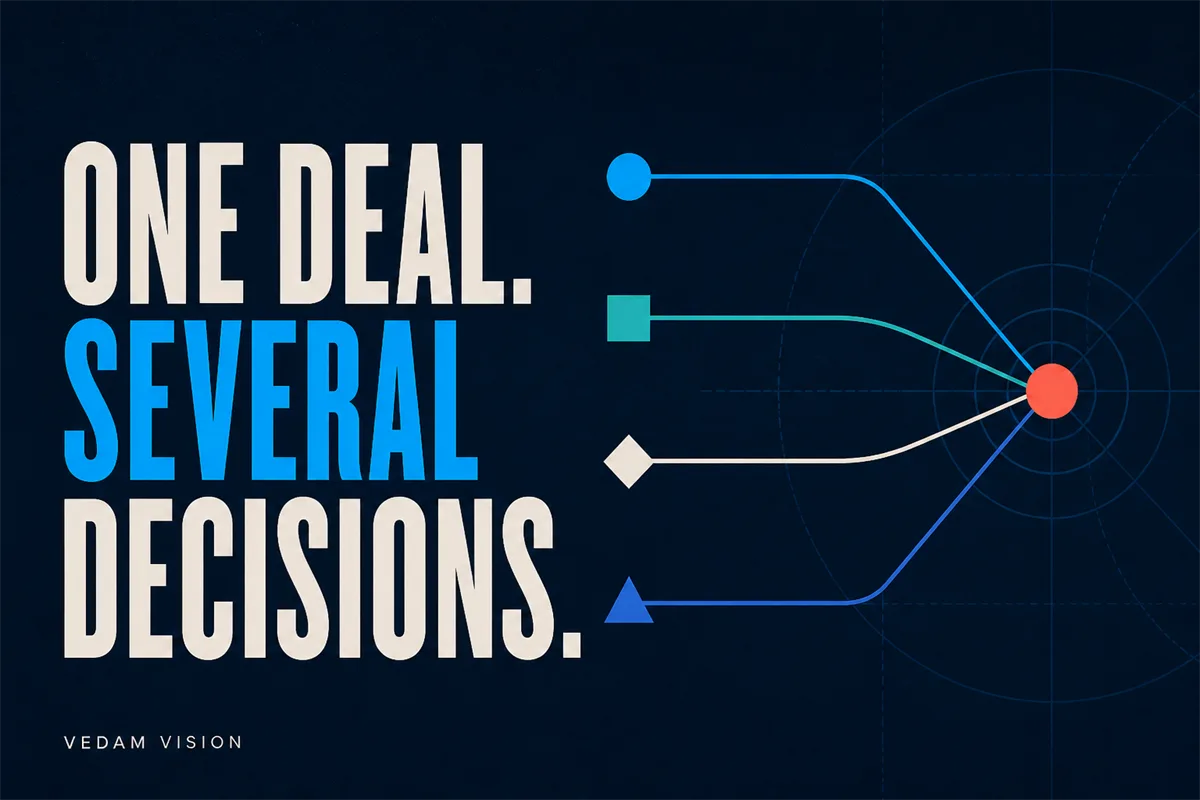
A B2B purchase rarely moves through one neat funnel. The daily user may start the search, a manager may define the requirement, finance may question the cost, information security may examine risk, and an executive may approve the final commitment. A useful journey map makes those different jobs visible instead of pretending that one persona makes every choice.
The map should help a sales leader decide what to learn, what evidence to prepare, who owns the next step, and where an opportunity can stall. It is not a decorative diagram and it is not a list of marketing channels. It is a working view of how a group becomes confident enough to act.
Start with one offer and one realistic buying situation. If you map every customer, product, country, and contract size at once, the result will be too vague to guide a conversation.
A practical working model
The model below turns B2B buyer journey into a sequence that sales leaders can inspect, assign, and improve. Use it as a conversation guide, then adapt the detail to the consequence, volume, and maturity of the work.
1. Define the decision
What to do: Write the exact commitment the customer is considering, including scope, cost, operational change, and expected outcome. Why it matters: Different commitments involve different people and different risk questions.
Guardrail: Do not describe the decision as buying your service. Describe the change the customer must approve. This boundary keeps the work useful when a normal case changes or a person needs to exercise judgement. Evidence to keep: A one-sentence decision statement that every seller uses.
2. List roles before names
What to do: Identify user, initiator, champion, technical reviewer, financial approver, procurement contact, executive sponsor, and possible blocker. Why it matters: Role mapping remains useful when individuals change or several people share one role.
Guardrail: Do not assume job title equals influence. Confirm who can shape, delay, approve, or reject. This boundary keeps the work useful when a normal case changes or a person needs to exercise judgement. Evidence to keep: A role table with influence, concern, and required evidence.
3. Capture each role progress question
What to do: Record what each role must understand before supporting the decision, from practical fit to risk, cost, adoption, and accountability. Why it matters: People move at different speeds because they are solving different uncertainties.
Guardrail: Avoid one generic objection list. A security concern is not the same as a budget concern. This boundary keeps the work useful when a normal case changes or a person needs to exercise judgement. Evidence to keep: A question bank connected to roles and stages.
4. Map evidence to uncertainty
What to do: Match demos, examples, process documents, commercial detail, implementation plans, and references to the question they answer. Why it matters: Evidence is persuasive when it reduces a specific uncertainty instead of merely adding volume.
Guardrail: Never invent proof or offer a case study that does not match the situation. This boundary keeps the work useful when a normal case changes or a person needs to exercise judgement. Evidence to keep: An evidence library with owner, source, and review date.
5. Separate contact stage from decision stage
What to do: Track both the latest interaction and the buying decision that interaction helped advance. Why it matters: A meeting can happen without meaningful progress, while an internal review can advance without a new meeting.
Guardrail: Do not treat activity count as buyer movement. This boundary keeps the work useful when a normal case changes or a person needs to exercise judgement. Evidence to keep: A stage definition with entry evidence and exit evidence.
6. Design multi-threaded next steps
What to do: End important conversations with a named action, owner, date, and the next stakeholder who needs context. Why it matters: The opportunity becomes safer when knowledge is not trapped with one enthusiastic contact.
Guardrail: Respect the champion. Help them navigate internally instead of bypassing them. This boundary keeps the work useful when a normal case changes or a person needs to exercise judgement. Evidence to keep: A mutual action record visible to the selling team.
7. Review stalls without blame
What to do: When progress stops, ask which role, question, evidence, or internal dependency is unresolved. Why it matters: A diagnostic review finds a repairable gap instead of labelling the buyer unresponsive.
Guardrail: Some decisions should pause or stop. Do not manufacture urgency. This boundary keeps the work useful when a normal case changes or a person needs to exercise judgement. Evidence to keep: A stall review note and a clear continue, pause, or close decision.
Questions to answer before implementation
Do not rush through these questions. A short written answer creates a shared decision record and reveals where the proposed process still depends on assumptions or personal memory.
- Who experiences the problem first? This identifies the trigger and the language that feels real to the initial researcher. Record the answer, owner, and any evidence that would change it.
- Who must live with the implementation? This reveals adoption, workflow, training, and support concerns before they become late objections. Record the answer, owner, and any evidence that would change it.
- Who can spend or commit resources? This clarifies commercial authority without assuming the most senior attendee is the approver. Record the answer, owner, and any evidence that would change it.
- Who can stop the decision? This brings legal, procurement, security, and policy checks into the journey early enough to prepare. Record the answer, owner, and any evidence that would change it.
- What proof is acceptable to each role? This prevents one generic deck from carrying every conversation. Record the answer, owner, and any evidence that would change it.
- What would make no decision rational? This helps the team understand genuine constraints and qualify without pressure. Record the answer, owner, and any evidence that would change it.
Run a focused working session
Run a 60-minute mapping session with sales, delivery, and one person who hears customer concerns after the sale. Put one recent, anonymised buying situation on the wall. Ask what actually happened, not what the CRM stage suggests happened. Mark assumptions in a different colour so the team knows what still needs verification.
Finish by choosing the three highest-risk gaps. One might be missing implementation evidence, another might be late procurement involvement, and a third might be inconsistent qualification. Assign an owner and a date to each gap. The map becomes useful only when it changes preparation, content, or follow-up.
Close the session with three artefacts: the current decision, the named owner, and the date when evidence will be reviewed. If the team leaves with only more ideas, the session has not yet changed the operating system.
Limitations and tradeoffs
Every framework simplifies reality. Apply this one in proportion to the risk and avoid turning a useful control into unnecessary ceremony.
- Small and low-risk purchases may not need a detailed committee map. Use the lightest version that changes a decision. Review this condition when the process, customer promise, team, tool, or jurisdiction changes.
- Buyer roles can combine in one person, especially in smaller companies. Preserve the questions even when roles collapse. Review this condition when the process, customer promise, team, tool, or jurisdiction changes.
- A map based only on sales opinion can repeat internal bias. Validate it through customer interviews, call notes, win reviews, and loss reviews. Review this condition when the process, customer promise, team, tool, or jurisdiction changes.
- The journey is not always linear. Allow roles and questions to reappear when scope, price, or implementation changes. Review this condition when the process, customer promise, team, tool, or jurisdiction changes.
How to judge whether it is working
A good B2B buyer journey map gives the team fewer surprises. Sellers know which role is missing, marketing knows which uncertainty needs content, delivery sees implementation expectations earlier, and leaders can distinguish healthy progress from busy activity.
Review both the intended outcome and the exceptions. A process can look faster while shifting work to another person, creating risk, or making the customer experience less clear. Keep the measures small, definitions visible, and interpretation human.
Turn the framework into an operating habit
A framework becomes valuable when it survives the first workshop. Put the current version where the work happens, name the person who maintains it, and choose a review rhythm that matches the consequence. For sales leaders, the aim is not to inspect every action. The aim is to notice when assumptions, inputs, ownership, or customer needs have changed enough to require a decision.
Begin with a small live sample and keep a short decision log. Record what the team expected, what actually happened, which exception appeared, and what changed as a result. This creates evidence for improving B2B buyer journey without turning every unusual case into a permanent rule. If a control adds effort but never changes a decision, simplify or remove it.
Share the latest version with everyone affected by the workflow, including the people who receive its output. Their questions often reveal unclear handoffs, missing context, or safeguards that exist on paper but not in daily work. Capture those observations before the next review so improvement is based on evidence rather than memory.
- Review Define the decision: confirm that its owner, evidence, boundary, and next action are still current before expanding the system.
- Review List roles before names: confirm that its owner, evidence, boundary, and next action are still current before expanding the system.
- Review Capture each role progress question: confirm that its owner, evidence, boundary, and next action are still current before expanding the system.
- Review Map evidence to uncertainty: confirm that its owner, evidence, boundary, and next action are still current before expanding the system.
Useful Vedam Vision resources
Explore our services overview, website design and development, portfolio, and case studies. You can also review the Vedam Vision process, browse the Vedam Vision blog, request a free audit, or use the contact page.
A practical next step
If your B2B journey is hidden inside scattered call notes and personal memory, Vedam Vision can help turn it into a practical message, evidence, content, and website system. Send us the offer and the point where decisions usually stall, and we can help you identify the first gap worth fixing.
Start with one real situation, not a hypothetical transformation. Bring the current artefacts, the people who do the work, and the exceptions that cause the most delay. The first useful change is usually smaller and clearer than the tool list suggests.