A B2B marketing strategy for a small business does not require a large sales team. It requires a clear choice of buyer, a useful explanation of the problem the business solves, a dependable route to proof, and a follow-up process that people can actually maintain. The aim is to make fewer, better conversations easier to start and easier to qualify.
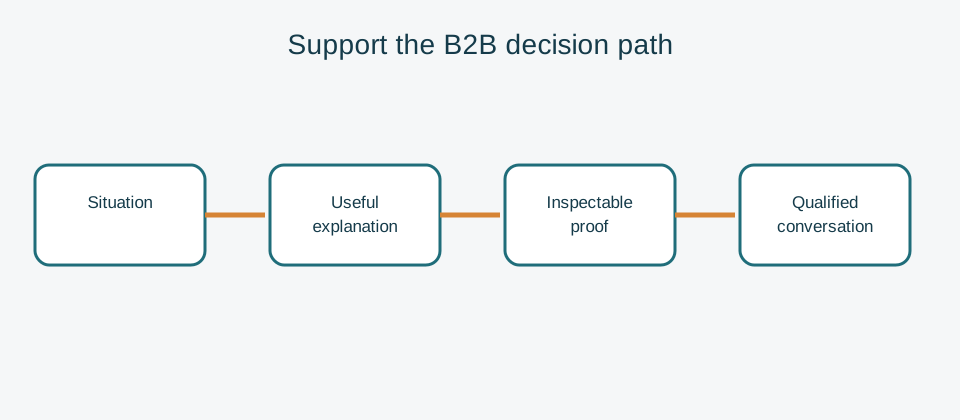
Many B2B owners try to compensate for a small team with more activity. They publish in many places, send broad messages, and add software before deciding what a prospect needs to understand. That creates volume without a reliable path. Start with the buyer's decision instead. What situation brings them to look for help, what evidence reduces their uncertainty, and what is the smallest sensible next step?
Decide which buyer deserves the first version of the strategy
B2B markets can look deceptively broad. A business may serve several sectors, roles, or company sizes, but a small team cannot explain every offer with equal depth. Pick a priority segment based on the problems the business can describe honestly, deliver consistently, and support with relevant evidence. This is a decision about focus, not a declaration that other buyers are unwelcome.
Describe the buyer in a way that changes the work. Include the role involved in the decision, the operating situation, the urgency, and the likely concern. “Operations manager at a growing service company dealing with manual handoffs” is more useful than “businesses that want efficiency.” It suggests what a page, conversation, or diagnostic should address.
Map the buying group without pretending it is simple
In B2B, the person who feels the problem, the person who evaluates solutions, and the person who approves the spend may differ. A small company does not need an elaborate account map for every prospect. It should know the likely questions each role raises. The user may ask whether the work will fit their process. The decision maker may ask about scope, risk, and timing. A finance or procurement contact may need a clear commercial explanation.
Build the message around a recognisable situation
A useful B2B message begins with the situation the buyer recognises, then explains the defined work and the conditions for progress. Avoid broad promises such as “transform your business.” A prospect cannot evaluate them. Instead, explain the practical issue, the work involved, what the team will review, and what the client needs to contribute.
The Vedam Vision process demonstrates why a visible process can be persuasive without inflated claims. It gives a buyer a way to understand the stages of work. Pair that with a clear route through the services so a reader can choose relevant detail rather than navigate a list of unrelated capabilities.
Keep the promise bounded
State what the business will do, not an outcome nobody can guarantee. A practical offer might include a discovery session, an audit, a strategy document, a website improvement plan, or implementation support. State the boundary too: access, approvals, subject expertise, data quality, or client participation may affect the work. Boundaries make the message more credible because they help a buyer assess fit before a call.
Create a small set of assets that answer real pre-sale questions
A small sales team benefits from assets that can do useful work between conversations. These are not generic downloads built to collect contact details. They are concise explanations that answer a repeated question and let a prospect continue their evaluation without waiting for an email. Examples include a service page, a process overview, a comparison of options, an implementation checklist, or an article that explains a decision.
Use only proof a prospect can inspect. An authorised project example in the portfolio, a relevant item in the case study library, or a clear account of the working method is more useful than unsupported superlatives. Remove evidence that is old, vague, or no longer representative of the work.
Choose two manageable routes to market
Most small teams should begin with fewer routes than they think. One route may be existing relationships, referrals, partnerships, or former clients. Another may be search-led content, a focused LinkedIn presence, a targeted email, or a carefully selected event. The decision should reflect where the priority buyer already looks for help and how much follow-up the team can sustain.
Do not treat a channel as a strategy. A post, advertisement, or outreach list only has value when it connects to the message and next step. For example, an article that helps a buyer compare approaches can link naturally to a free digital audit. The audit should deepen the article's question, not act as a generic demand for contact information.
Make outreach specific and respectful
When a team uses direct outreach, research should be enough to explain why the message is relevant. Name a public business context, a likely decision, or a useful resource. Do not claim knowledge that has not been verified. A short note that offers a practical perspective can start a conversation. A message that assumes a problem, invents urgency, or pushes for a meeting will usually weaken trust.
Put qualification before persuasion
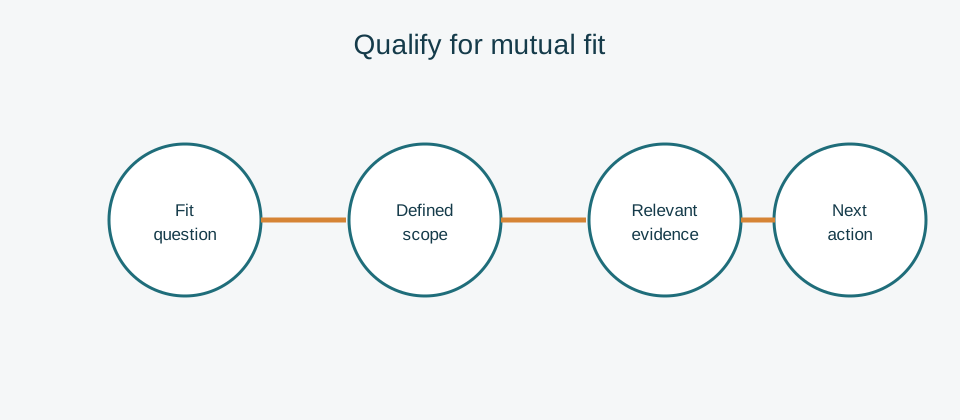
A small sales team is protected by good qualification. It is better to understand fit early than to spend weeks preparing a proposal for work the business cannot deliver well. Create a small set of questions that uncover the buyer's objective, current process, people involved, constraints, decision timing, and what would make the work worthwhile. Keep the questions conversational and relevant to the service.
Qualification is not a way to make a buyer prove they deserve attention. It is a mutual fit check. The business should also say when it is not the right partner, when more discovery is required, or when a smaller first step makes more sense. The contact route can invite that kind of focused discussion without promising a scope before the facts are clear.
Give follow-up a real owner and a simple cadence
Leads do not become opportunities because a system labels them that way. Someone needs to own the next action. For each active conversation, record the buyer, their situation, the agreed next step, the date it is due, and the material that would help them decide. This can begin in a simple shared system. Consistent use matters more than complex automation.
Follow up with a reason. Share the agreed information, clarify a question, or ask whether a decision has changed. Avoid repetitive “just checking in” messages. If the buyer has gone quiet, give them an easy way to close the loop. This protects time and keeps the business respectful of the buyer's attention.
Measure decisions, not vanity signals
Track enough information to learn which routes create qualified conversations and where the path breaks. Useful observations can include the source of an enquiry, the buyer segment, the question raised, the stage reached, the reason for disqualification, and the next action. A raw count of impressions or site visits may be interesting, but it rarely tells a small team what to improve.
Review patterns monthly. If many prospects misunderstand the offer, revise the service page. If one referral source produces good fit, invest more care in that relationship. If proposals regularly stall because requirements are unclear, improve discovery before adding more reach. The U.S. Small Business Administration's marketing and sales guidance is a sound general reference for treating marketing as part of the broader sales activity rather than a separate popularity contest.
Limitations to keep visible
A B2B strategy cannot eliminate a long sales cycle, internal buyer politics, budget freezes, or delivery constraints. It also cannot manufacture trust where there is no relevant proof or clear offer. A small company should resist copying enterprise practices that create administrative work without improving a buyer's decision. The best system is one the team can maintain while delivering well.
There is also a practical capacity limit. If delivery is already stretched, the correct marketing decision may be to improve qualification, response expectations, or onboarding before seeking more enquiries. More demand is not automatically useful demand. Make capacity visible in the weekly review so the team can adjust its route to market before the customer experience suffers.
That choice can feel slower in the moment, but it protects the reputation on which future B2B demand depends.
Review the strategy when the offer, market, or capacity changes. Keep what helps the right conversation happen. Remove activity that cannot be tied to a buyer question or a real decision.
Conclusion: a small team needs a clearer path, not a louder machine
A B2B marketing strategy for a small business should focus on a priority buyer, a bounded offer, inspectable proof, manageable routes to market, and owned follow-up. That combination helps a business make better use of limited time. It also gives prospects a calmer, more credible way to decide whether a conversation is worthwhile.