A brand messaging framework gives a business a shared way to explain what it does, who it helps, why the work matters, and what a buyer should do next. It is not a collection of slogans. It is a practical set of decisions that keeps the website, sales conversations, proposals, and content from describing the business in different ways.
For founders, the aim is clarity. A buyer should not need to decode broad language such as “end-to-end solutions” or “transformative outcomes” before they can work out whether the offer is relevant. Start with the buyer's situation, then use plain language to show the problem, the work, the evidence, the boundaries, and the next sensible step.
Why a framework matters before more copy is written
Copy problems often begin as decision problems. A team has not agreed which buyer gets priority, which problem the business is best placed to solve, or what the offer includes. The website then tries to include every capability and every audience. The result may be technically accurate, but it leaves a buyer with too much interpretation to do.
A framework creates a shared source of truth. It does not remove nuance from a service business. It gives people a stable starting point, so a campaign, landing page, sales deck, and conversation can adapt to context without losing the central point. It also makes it easier to notice when new copy makes a stronger promise than delivery can support.
Begin with a single useful sentence
Write one sentence before building the rest: “We help [specific buyer] address [recognisable situation] through [defined work], so they can [reasonable change or decision].” Add a boundary if the work depends on a particular condition. This is not necessarily the headline. It is the internal sentence that tests whether the team has made a real choice.
If it could describe most competitors, it is too broad. If it contains an outcome nobody can control, it is too strong. If it needs specialist language before the buyer understands the problem, simplify it.
The seven parts of a practical messaging framework
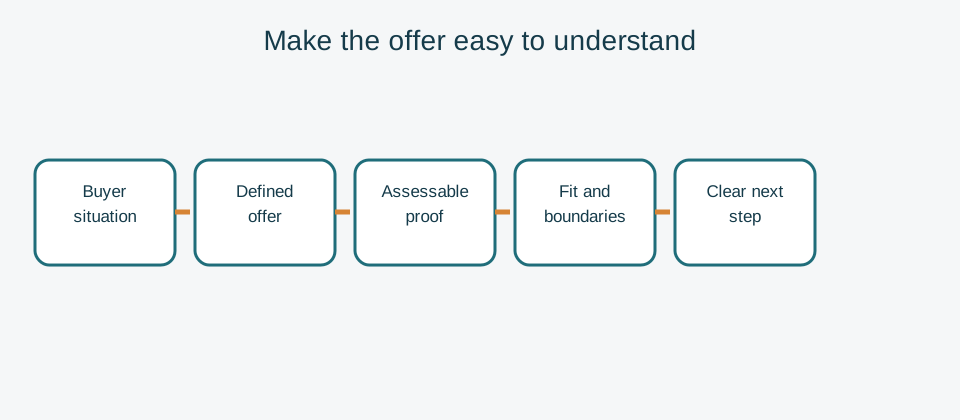
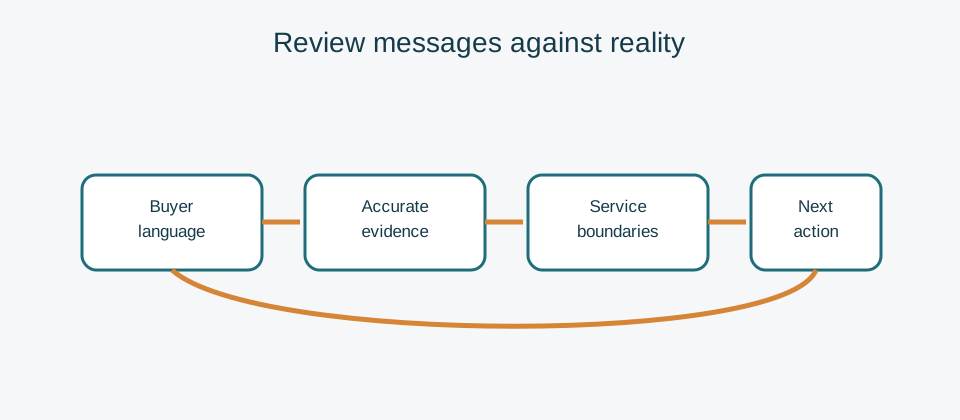
Use the following parts as connected decisions. They are most useful when written in the buyer's words and reviewed against real questions from enquiries, calls, and proposals.
1. Priority buyer
Name the first audience, the role involved in the decision, and the business context. “Small businesses” may be a useful market category, but it is rarely enough for a message. A more useful description might be a service business with a growing enquiry flow that still handles qualification through informal conversations. The specificity should guide the message, not pretend every buyer is identical.
2. Triggering situation
Describe the moment when the buyer begins to look for help. It may be a stalled process, a website that no longer explains the offer, a handoff that creates rework, or a new service that needs a credible launch. The situation is more useful than a generic pain point because it gives the reader a way to recognise themselves.
3. Consequence of doing nothing
State the practical cost without exaggeration. The cost could be slower decisions, inconsistent follow-up, uncertainty for prospects, or a team spending time on the same manual step. Avoid declaring a financial result unless it can be verified for that buyer. The purpose is to show why the situation deserves attention now.
4. Defined offer and method
Explain what the business will actually do. A clear offer states the starting point, the work, the decisions or deliverables, and the way the team works. The Vedam Vision process is a useful pattern for making the working approach visible. A process helps a buyer understand what participation, review, and progress might look like.
5. Proof a buyer can assess
Proof can be an authorised work sample, a clear explanation of the process, an accurate credential, or a case study with permission to share. It is not a pile of vague superlatives. The portfolio and case study library are places where a visitor can assess work in context. Use only examples that are current, accurate, and appropriate to publish.
6. Boundaries and fit
Good messaging says what the offer is not. If discovery is needed before a fixed scope, say that. If a client must provide approvals, access, or subject expertise, say so. If the business is not a fit for a particular scale or timeline, state the condition tactfully. Boundaries reduce bad-fit enquiries and make a reasonable promise more credible.
7. Next step
Choose one action appropriate to the reader's confidence. The free digital audit can help an early-stage buyer start with a focused question. The contact route can serve a buyer ready to discuss the work. The action should make sense after the message. It should not demand more commitment than the page has earned.
How to turn the framework into a homepage message
A homepage has limited attention. It should help a visitor answer three questions quickly: is this for someone like me, is the problem familiar, and what can I do next? Lead with the priority buyer and situation. Follow with the defined work and a modest explanation of the benefit. Then make the route to proof and contact visible.
Do not try to place every framework field in the first paragraph. The headline and opening should establish relevance. Supporting sections can explain the method, show accurate proof, answer common uncertainties, and state boundaries. The broader Vedam Vision services page and the specific AI solutions and automation work show why a reader needs both a clear overview and a route to more relevant detail.
Use a message hierarchy
- Headline: buyer plus situation or desired decision.
- Supporting line: defined work and a careful benefit.
- Proof route: process, work examples, or evidence the buyer can inspect.
- Fit guidance: conditions, scope, or who should not choose the offer.
- Call to action: one relevant next step.
This hierarchy prevents the common mistake of adding more claims whenever a page feels weak. Often the missing piece is not a stronger claim. It is a clearer connection between the buyer situation and the work being offered.
Test messaging in real conversations
Messaging is a working hypothesis. Test it in discovery calls, proposal reviews, enquiry forms, sales emails, and conversations with people who decide not to proceed. Notice which words buyers repeat back, where they ask for clarification, and whether they describe the problem in a different way. Keep a simple note of these observations.
Separate evidence from preference. A founder may prefer a phrase because it sounds polished, while a buyer may respond more clearly to a plain explanation. The buyer's understanding matters more. At the same time, do not change the message after one unusual conversation. Look for a repeated signal, then make a small revision that can be assessed.
Questions for the review meeting
- Can a buyer say who the offer is for without reading the entire page?
- Does the message name a situation that prompts a real conversation?
- Are the benefits framed as reasonable changes rather than guarantees?
- Does the proof show something a buyer can examine?
- Do the service boundaries prevent the most common mismatch?
- Does the next step match the buyer's likely confidence?
Keep the framework consistent across the business
A framework only works if it travels. Put the core version where marketing, sales, delivery, and external partners can find it. Give each part a short note on what must remain true and what can be tailored. For example, the priority buyer, offer boundaries, and proof rules should be stable. The example used in a social post or a proposal can change with context.
Check new pages and campaign briefs against the framework before they are approved. This is not a rigid brand-policing exercise. It is a way to protect clarity. If a new audience or offer is strategically important, update the framework deliberately instead of quietly introducing a different promise in one asset.
Limitations worth keeping in view
A messaging framework cannot make an unclear business model clear by itself. It cannot replace customer research, service design, delivery quality, or a commercially viable offer. It can also become too polished if it stops reflecting how buyers actually speak. Treat it as an operating tool, not a final declaration.
There is a balance to hold. A message needs enough focus to be useful, but it should not narrow the business into a promise it cannot keep. The right level of specificity comes from honest evidence, practical boundaries, and a willingness to learn from the market.
Conclusion: clarity is the useful brand asset
A brand messaging framework helps buyers understand an offer faster when it begins with their situation and follows through with defined work, assessable proof, honest boundaries, and a sensible next step. For founders, that clarity is more valuable than a louder claim. It makes marketing easier to execute and sales conversations easier to begin.