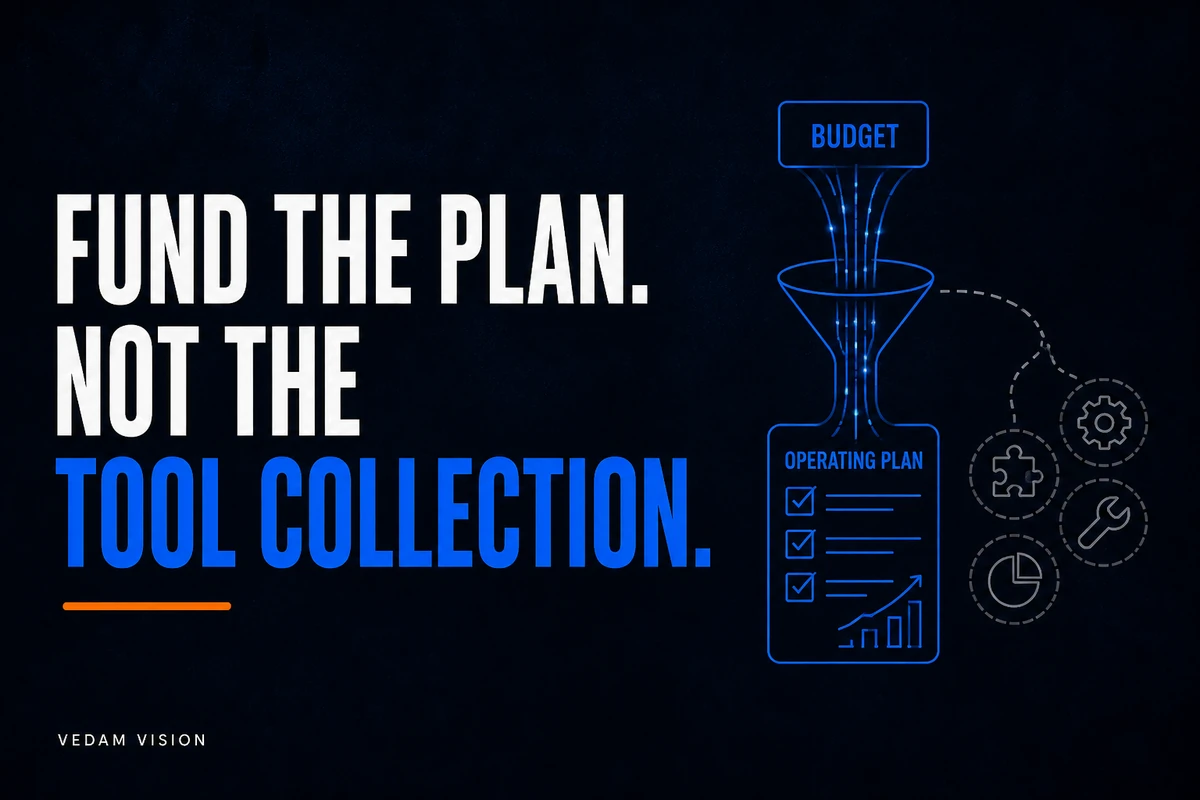
Marketing budget allocation for a small business should begin with a short list of business decisions, not a shopping list of channels and subscriptions. Protect the work that helps a potential customer understand the offer, reach the business, and take a next step. Then fund a small test, review what happened, and only add a tool when it removes a real bottleneck.
Small teams often feel pressure to look active everywhere. That pressure can produce a scattered budget: a new design tool, an advertising experiment, a subscription nobody owns, and a campaign without a clear destination. A tighter approach is less dramatic, but usually more useful. Decide what the business needs to learn or improve, put a clear limit around the spend, and make one person responsible for the review.
Start with the commercial question, not the channel
Before allocating money, write the question the budget is meant to answer. It might be: do the right buyers understand our service page, can we turn existing interest into better qualified enquiries, or is there a dependable way to follow up after an introduction? This keeps the conversation close to the business rather than the novelty of a platform.
The U.S. Small Business Administration describes marketing and sales as connected business activities. That is a helpful reminder for a small team. A marketing budget is not simply a communications expense. It is money set aside to help a buyer move from uncertainty to a more informed decision. The Vedam Vision process is a useful example of making the work and its stages visible before asking for commitment.
Choose one priority audience and one priority action
Define the audience narrowly enough to make choices. “Everyone who needs marketing” is not an audience. A more workable description is a local service owner whose website receives enquiries but does not explain the next step clearly. Then name the action that matters: request an audit, book a conversation, download a guide, or ask for a proposal. A budget cannot be judged well if the desired action is vague.
Build a simple allocation before choosing amounts
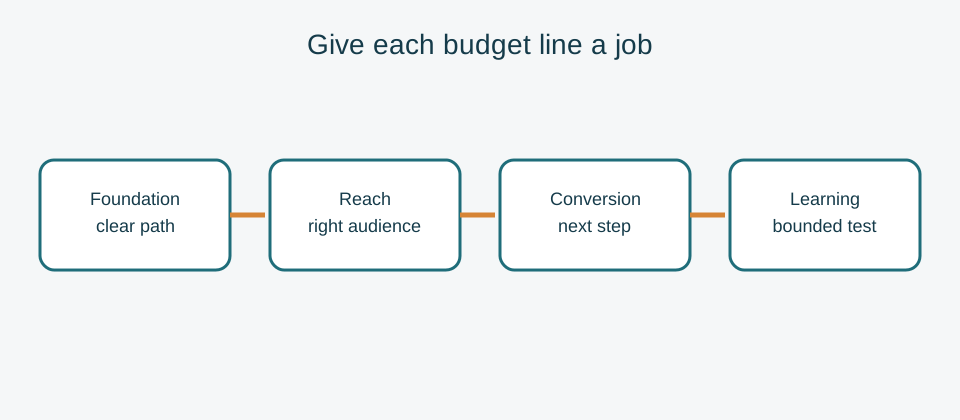
Do not begin by copying a percentage from another company. The right amount depends on cash flow, sales cycle, delivery capacity, and how much evidence the team already has. Instead, sort potential spend into four jobs. The jobs show where money is being asked to work and make it easier to pause something that is not useful.
- Foundation: the pages, offer explanation, contact route, and basic measurement that let a buyer act.
- Reach: activity that puts a useful message in front of a defined audience.
- Conversion: follow-up, landing pages, enquiry handling, and sales material that reduce uncertainty.
- Learning: small, time-bound tests that answer a specific question before larger spend.
Foundation is easy to overlook because it is less visible than a campaign. Yet paying for reach before the offer, page, and response process are ready creates waste. A visitor who cannot understand what is offered may leave regardless of how well targeted the traffic was. Review the Vedam Vision services and relevant service detail before funding an activity that assumes every visitor needs the same explanation.
Protect the essentials first
For a small team, essential work often includes a clear website route, accurate service information, a working enquiry form, a response owner, and a basic way to record where conversations started. None of these needs an elaborate system. They need to be dependable. If an enquiry is lost because nobody knows who responds, additional advertising will make the underlying problem more expensive.
Use the portfolio and case study library as examples of the kind of proof route a buyer should be able to inspect. Only publish proof that is authorised, current, and specific enough to be understood. A small budget is better spent making existing evidence easy to find than creating a louder claim that delivery cannot support.
A practical essential-work check
- Can a visitor say who the offer is for and what problem it addresses?
- Can they find one credible example, process explanation, or relevant service page?
- Is there one sensible next step, with a named owner for the response?
- Can the team tell whether an enquiry came from a referral, search, social activity, or a campaign?
If the answer is no to several of these questions, spend there first. This is not glamorous work. It makes later activity easier to assess.
Spend on reach only when the destination is ready
Reach can include a local partnership, a useful article, a focused email, a small paid test, an event, or a social post. The choice should follow the audience and the question, not a general belief that a particular channel always works. Ask where a potential buyer already seeks help or evaluates a provider. Then make sure the message links to a page or conversation that continues the same thought.
For example, a small service business could use a practical article to answer a repeated pre-sale question, then link to its free digital audit for a reader who needs a focused review. The article should be useful without the audit. The audit should be a relevant next step, not a distraction added because a budget line exists.
Google's guidance on helpful, reliable, people-first content supports this discipline: publish to help the intended reader rather than to fill a calendar or chase a system. That principle is valuable even when the spend is modest. A useful asset can remain available for future conversations. A generic post may add activity without helping a buyer decide.
Use small tests with a clear stopping rule
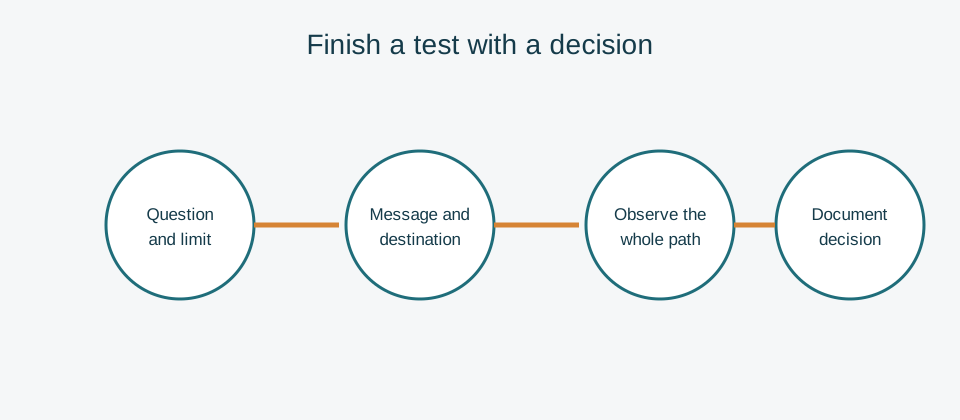
A test is not a commitment to keep spending. It is a bounded way to learn. Set the audience, message, destination, spend limit, start and end date, and the observation that will shape the next decision. Avoid treating every click or reaction as success. The useful signal depends on the original question. For one team it may be qualified enquiries. For another, it may be whether prospects understand a new offer well enough to ask informed questions.
Write a stopping rule before the test begins. A rule could be: stop after the agreed amount, stop when delivery capacity is full, or stop when the data is too thin to support a decision. A stopping rule protects a small budget from the habit of extending a test simply because it has not yet produced a comfortable answer.
Review the whole path, not only the campaign
When a test underperforms, do not automatically increase the budget. Review the message, targeting, landing page, response speed, fit of the offer, and the quality of the follow-up. A weak result can be a signal that the path needs work. It is not proof that the business needs more tools or that the audience does not exist.
Be cautious with subscriptions and agencies
A tool earns its cost when it removes a recurring constraint in a process the team already understands. It does not earn its cost because it promises a collection of features. Before buying, name the manual task, the person affected, the expected use frequency, the data or access needed, and the review date. If nobody can own the tool or explain what would make it no longer useful, delay the purchase.
The same caution applies to outside help. A specialist can be valuable when the brief is clear and the business is ready to act on the output. If the offer, audience, or internal response process is still uncertain, start with a defined diagnostic or planning task. The contact route is an appropriate way to frame a focused conversation rather than assuming a large ongoing commitment is the only option.
Keep the review simple and regular
Schedule a short monthly review with the person who owns the budget and the person closest to enquiries or delivery. Look at what was spent, what business question each activity addressed, what the team observed, and what should change next. Keep notes in plain language. The goal is not a complicated reporting ritual. It is a record that stops the team from repeating the same uncertain experiment without learning from it.
Separate observations from conclusions. “Several prospects asked how implementation works” is an observation. “We should improve the process section before increasing reach” is a decision. That distinction makes the next budget discussion clearer and less influenced by a memorable but isolated response.
Limitations worth remembering
There is no universal allocation that guarantees growth. A small business with a long sales cycle, a seasonal offer, or limited delivery capacity will make different choices from a business with repeat online purchases. Marketing activity also cannot repair a service that lacks a clear offer, an unavailable team, or a poor customer experience. The budget should support a viable business decision, not conceal a deeper operating issue.
Keep room for judgment. A referral opportunity, a major product change, or a genuine customer insight may justify changing the plan. The point of a budget is not to make the team rigid. It is to make tradeoffs visible before money disappears into activity that cannot be explained.
Conclusion: fund clarity before complexity
Marketing budget allocation for a small business works best when it starts with a business question, protects the foundations that help a buyer act, uses limited tests to learn, and reviews subscriptions with discipline. Before buying another tool, make the current path clearer. A modest budget used with that level of care can create better decisions even when it does not create instant certainty.