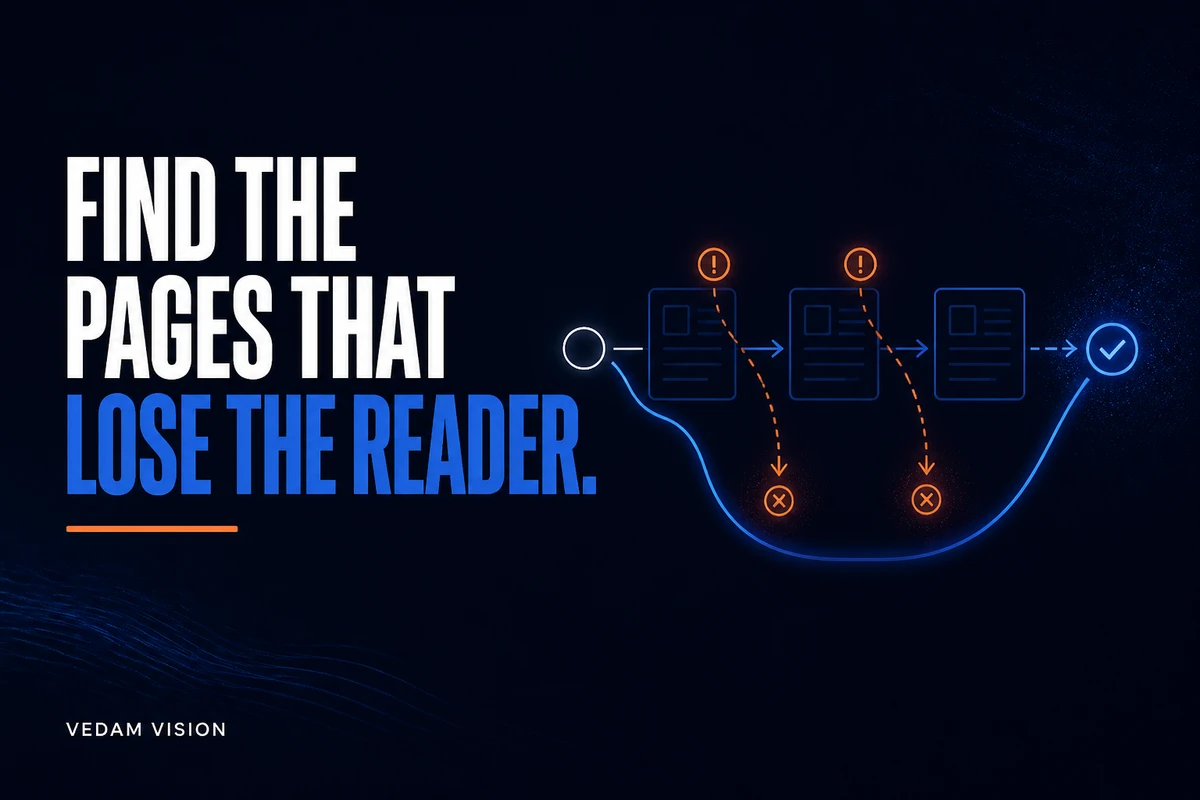
A content audit checklist should help a marketing team find the pages that leave a buyer uncertain about the problem, the offer, the proof, or the next action. Begin with the pages that matter to an active customer journey, read them against the reader's likely question, check the factual support and links, then decide whether to improve, combine, redirect, or retire the page. The goal is clarity, not a bigger spreadsheet.
Teams often approach an audit as a count of URLs, word totals, or traffic reports. Those numbers can help with prioritisation, but they cannot tell you whether a page answers the question that brought a person there. A useful audit combines evidence with a reader-level review. It asks where uncertainty appears and what the business can honestly clarify.
Set the purpose before collecting pages
Choose a practical outcome. A service business might need to make enquiry pages easier to understand, remove duplicate explanations, prepare a site for a redesign, or identify content that needs a source review. Write down the decision the audit will support. Without it, a team can spend days labelling pages without knowing which changes matter.
Define the audience as well. A first-time visitor needs a different path from an existing customer seeking implementation detail. The Vedam Vision services pages illustrate why this matters: a service page needs to explain a relevant problem, the work offered, and a route forward. An audit should test whether its own pages make those elements easier or harder to find.
Start with the pages closest to a decision
Prioritise home pages, service pages, high-intent articles, contact routes, and pages that sales or delivery teams regularly explain by hand. These are likely to affect a reader's ability to move forward. A low-value archive page may still need attention, but it should not take time away from a current buyer path simply because it is easier to edit.
Make a small inventory with the URL, page type, intended reader, main question, owner, last factual review, and likely next action. Keep the inventory useful enough that someone can act on it. A long description of every heading is less valuable than a clear note that says “the page explains the service but never states what a buyer should prepare.”
Read the opening as a new visitor would
For each priority page, look at the first screen and the first two paragraphs. Can a visitor tell what the page is about, who it is for, and why it is relevant? If the opening starts with broad claims about quality, innovation, or transformation, the reader may still be waiting for a useful answer. Replace abstract language with the situation the page is designed to help.
Then check alignment between title, search snippet, heading, and body. A page that promises a checklist should provide a checklist. A page that attracts a question about scope should not become a general brand story. Google's helpful content guidance supports the same basic discipline: create for a real audience and make the purpose of the page clear.
Check the page against the reader's decision
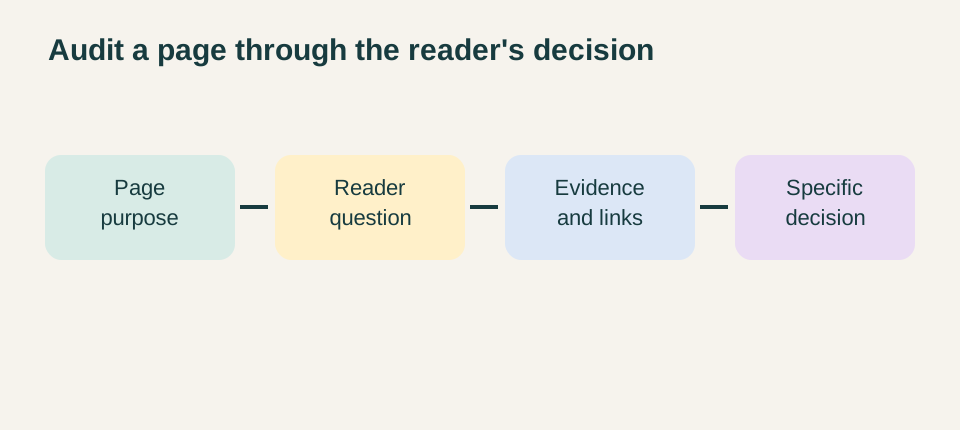
A clear page helps someone decide something. It may help them recognise a problem, compare approaches, prepare information, understand a process, or contact the right team. Write that decision in the audit record. If it is hard to name, the page is probably trying to do too many jobs or has no defined job at all.
Look for the information needed to make the decision: definitions, scope, examples that are clearly labelled, process details, constraints, and next steps. Not every page needs all of them. A short contact page should not become a guide. But a service page that only has a slogan and a button creates a different kind of uncertainty. It asks for commitment before giving the reader a basis for it.
Mark ambiguous language precisely
“Tailored solutions,” “end-to-end support,” and “results-driven” may be true in a broad sense, but they do not explain what happens. Mark these phrases in the audit and ask what a reader would need to know instead. Can the page describe the decisions involved, the inputs required, the limits of the work, or the stages of a project? Specific explanation is usually more credible than a larger promise.
Do not replace vague wording with invented proof. If there is no approved client example, explain the method or the decision framework. If an outcome depends on factors outside the business's control, say that. This protects both the reader and the organisation from an audit that improves the language while weakening factual accuracy.
Verify facts, sources, and links
Flag any statement that refers to a changing feature, regulation, standard, price, statistic, or external requirement. It needs a current primary source or careful removal. Record the URL and date checked. An audit is a good time to separate stable explanations from time-sensitive claims so future editors know what must be reviewed before reuse.
Check internal links too. A link should lead to a page that exists and delivers what its anchor text promises. Readers interested in approach can visit the Vedam Vision process; those assessing prior work can inspect the portfolio or case study library. If these destinations change, the article linking to them needs a corresponding review.
Look for duplicated paths and competing messages
Duplication is not only two pages using the same keyword. It can be two pages making slightly different promises about the same service, two articles answering the same question at different quality levels, or a service page that conflicts with the process it links to. Group related pages by reader problem and compare their purpose, evidence, and next action. Keep the stronger route and give the weaker page a defined treatment.
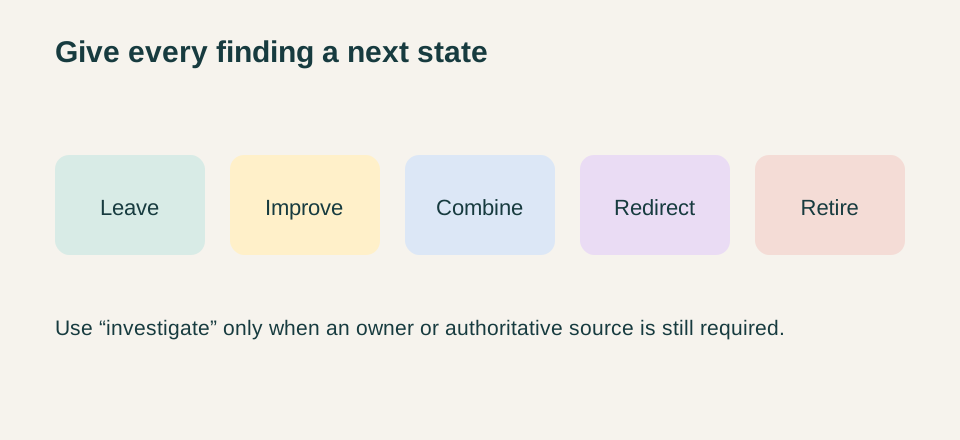
Sometimes the right answer is to combine pages. Sometimes it is to redirect an outdated URL to a current explanation. Sometimes a page needs a factual rewrite before it can remain visible. Do not assume that every old page should be expanded. The U.S. Small Business Administration's marketing and sales guidance offers broad context for connecting marketing information to the customer journey, rather than treating every page as an isolated asset.
Use a simple decision for every finding
Give each audited page one next state: leave unchanged, improve, combine, redirect, retire, or investigate. “Improve” needs a concise description of the missing answer or unsupported claim. “Investigate” should identify the owner or source needed. This prevents an audit from becoming a list of opinions that no one can turn into work.
For each treatment, write the smallest safe next action. An improvement might be a rewritten opening and a source check; a combine decision might first require agreement on the destination page and redirect plan. Add an owner and a review point, but do not invent a deadline simply to make the inventory look complete. A visible decision with an honest dependency is more useful than a confident status that cannot yet be acted on.
Rank actions by reader impact, business relevance, risk, and effort. A page with inaccurate information near a contact decision may be urgent even if it receives little traffic. A page with a clear problem but no available subject expert may need to wait. A good audit acknowledges this tradeoff instead of demanding that every issue be fixed at once.
Connect findings to service and conversion paths carefully
Content should help a reader continue, not force them through a funnel. Where a page identifies a need that matches a genuine offering, link to the relevant service. Where a reader needs a broader conversation, the contact route or free digital audit may be appropriate. The invitation should follow the explanation, and it should not imply that contacting a business is the only way to understand a basic issue.
Review the destination page as part of the audit. A thoughtful article cannot compensate for a contact experience that is unclear or a service page that gives no useful context. This is where the audit becomes a journey review rather than a set of isolated copy edits.
Review the checklist with the people who use the content
Marketing can identify patterns, but sales, delivery, support, and subject specialists may know where readers become confused. Ask for examples of repeated questions and explanations that regularly need correction. Keep the review focused on the page's job, rather than asking each team for a general wishlist. This produces better evidence and avoids turning the audit into a negotiation about every sentence.
Set a review date for pages with changing claims and revisit completed changes after they have been live long enough to receive real reader use. The audit is not a one-time clean-up. It is a method for noticing where a business's public explanation has fallen behind its actual work.
Keep the audit record readable after the meeting. A short owner, action, evidence note, and review date is enough to preserve accountability. If a finding cannot yet be acted on, say what information is missing instead of presenting a guess as a completed recommendation.
Conclusion: audit for clarity, evidence, and a next decision
A content audit checklist is most valuable when it finds the practical reasons a page confuses a reader: an unclear purpose, missing answer, vague promise, unsupported claim, broken route, or competing message. Start with pages closest to a decision, make a specific treatment choice for each one, and preserve honest limits as you improve the path. That produces fewer unresolved notes and more useful pages.