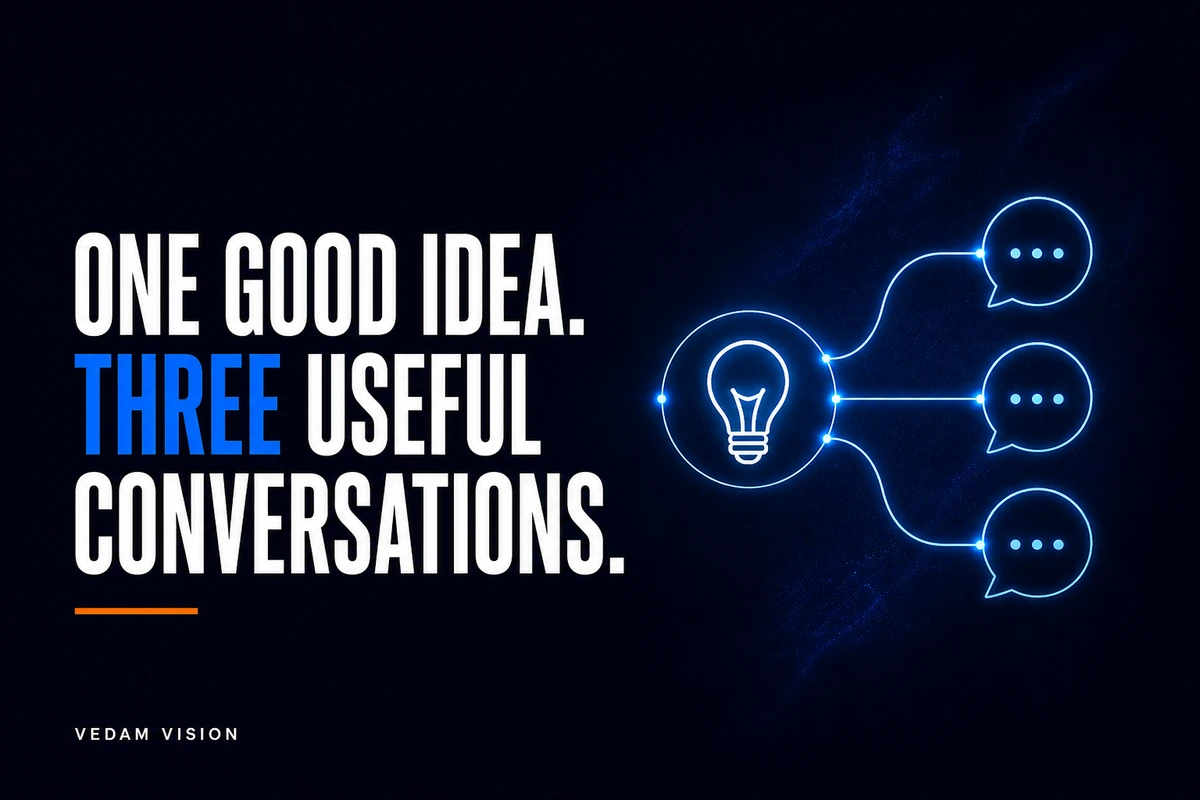
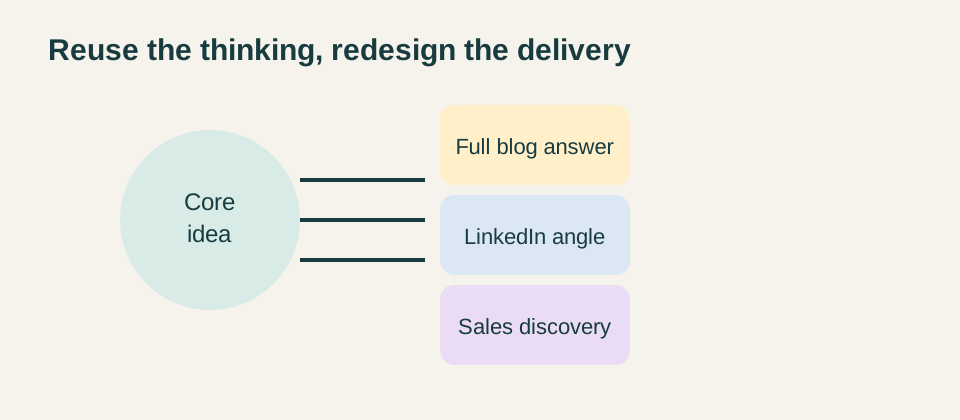
To repurpose content for LinkedIn and blog work, keep the underlying business question and change the format, depth, evidence, and next action for each setting. Start with one idea that can stand on its own, build the detailed blog article as the reference, create a focused LinkedIn perspective from one useful part of it, and prepare a short sales explanation that helps a buyer apply the idea to their situation. Reuse is not copying the same paragraph into three places.
Small teams often make content harder than it needs to be by treating every channel as a separate blank page. The opposite mistake is publishing identical text everywhere. Neither approach respects the audience. A better system preserves the core thinking while recognising that a reader on LinkedIn, a visitor searching for an answer, and a buyer in a conversation each need a different level of context.
Choose an idea with a real business job
Not every topic deserves three formats. Begin with a question that helps a prospective customer make a decision. It might be how to prepare for a website project, when to review a manual process before automating it, or what evidence belongs on a service page. The idea needs enough substance to explain, enough relevance to the offer, and clear limits. A slogan, a trend reaction, or a generic list of tips usually cannot carry that weight.
Write the core idea in a sentence without mentioning a channel: “Before buying a new tool, map the decision and handoffs it is expected to improve.” This becomes the anchor. It can be explored in a blog article, framed as an observation on LinkedIn, and used as a discussion prompt in a sales conversation. The words may change, but the reasoning should not.
Separate the durable idea from the changing detail
A durable idea can be reused for months if it reflects a steady business principle. A platform feature, a product price, an industry rule, or a statistic needs more care because it can change. Keep these details in the blog only when a primary source can support them and a review date is recorded. Do not turn a time-sensitive claim into a social post just because it performed well once.
This distinction makes repurposing safer. The core decision remains useful even when a tool interface changes. The example can be replaced, and the channels do not inherit an outdated statement by accident. It also gives an owner a clear reason to revisit the original article before creating new derivatives.
Build the blog as the complete reference
The blog article is where the reader can inspect the full answer. It should state the question early, explain the decision process, offer practical steps, name limitations, and link to relevant pages. For a reader evaluating automation work, the AI solutions and automation work page may be a useful next route. For a reader who wants to understand how an engagement is approached, the Vedam Vision process is more appropriate.
Depth does not mean padding. A useful reference article gives the reader enough detail to act or prepare. It can explain what information to gather, which questions to ask, and where a general framework stops being sufficient. Google's people-first content guidance is a useful editorial reference here: create material for the people who need it, not a page whose main purpose is to create a search footprint.
Turn one angle into a LinkedIn post
LinkedIn is better suited to one clear observation than a complete guide. Take a single tension from the article, such as activity versus useful progress, and write a concise post around it. Explain the situation, offer a grounded point of view, and leave room for the reader to consider their own context. The post should not pretend to be a complete solution, and it should not use a dramatic hook that the body cannot support.
A practical post could say that a content calendar becomes more reliable when it records a source and reviewer, not only a deadline. That is one useful part of a broader planning article. The post can invite readers to consider their own approval bottleneck, then point to the article if they need the full process. It should not copy every section or list every link from the blog.
Write for the feed without inventing authority
Do not create an artificial founder story, client outcome, or performance figure to make the post sound personal. A clear point of view can be based on a business decision without claiming an experience that is not documented. Use plain language. If the post says a process “always works,” rewrite it. If it makes a claim about a current LinkedIn feature, check the official source or leave the claim out.
LinkedIn content also needs a different invitation. The reader may respond with a question, save the idea, or follow the link later. A brief contextual invitation is enough. The deeper explanation belongs at the canonical blog URL, not in a crowded thread of comments.
Prepare a sales version that starts with discovery
A sales conversation is not a blog post spoken aloud. The useful reuse is a diagnostic prompt. Instead of teaching every part of the framework, ask which part reflects the buyer's current situation: What decision is delayed? Where does a handoff create uncertainty? What has already been tried? This changes the content from an announcement into a conversation about the buyer's work.
Keep the explanation short until the buyer asks for more depth. A service team may use the article to clarify terms or provide a follow-up resource after the call. The services pages can help a buyer see the available areas of work, while the contact route gives a clear way to continue. Do not treat a content asset as proof that a particular engagement will have a particular result.
Before sending a follow-up, agree on the exact next step and the material that would genuinely help. It may be the reference article, a short comparison, or no additional content until the buyer has supplied missing context. Record the question that prompted the follow-up so the team can improve the original explanation later. This keeps content useful to the conversation without turning a helpful resource into a sequence of automatic pitches.
Use a source record instead of relying on memory
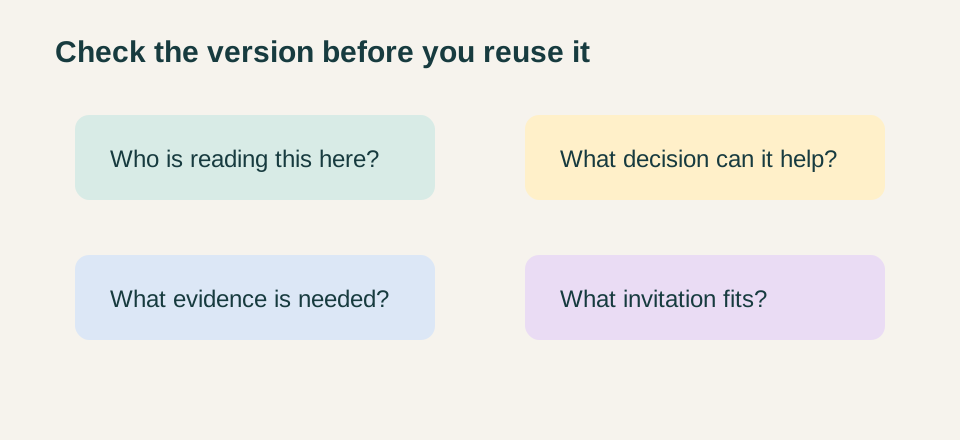
Maintain a compact source record for each core idea. It should include the original question, the durable point, approved examples, source URLs for any changing claims, links to the full article, and dates for review. This stops a useful idea from slowly changing each time it is reused. It also helps a colleague understand why a sentence is framed cautiously.
For general small-business marketing context, the U.S. Small Business Administration marketing and sales guidance is a public source worth reading directly. Use sources to support factual context, not to make ordinary advice sound more certain than it is. An editorial choice such as using one idea across formats remains a recommendation, and it should be presented as one.
Decide when not to repurpose
Some material should stay in one setting. A detailed article about a complex policy may be unsafe as a short social post because its qualifications will be lost. A sales conversation involving confidential information should not become content at all. A post based on a rapidly changing external announcement may be better paused until the primary source is clear. Reuse is valuable only when the meaning survives the change of context.
Also stop when the destination is weak. Sending people to an outdated service page creates friction, even if the social post is thoughtful. Check the supporting material first. A reader who wants examples can inspect the portfolio or case study library, but only if those pages actually relate to the topic being discussed.
Measure learning, not channel volume
A repurposing system should reduce repeated effort, not create a demand to appear everywhere. Review whether the blog answers the search question, whether the LinkedIn angle starts useful discussions, and whether a sales version helps a buyer articulate a need. Qualitative signals matter: clearer questions, fewer repeated explanations, or a better handoff between marketing and sales. Avoid treating a high count of posts as proof that the underlying idea was valuable.
When a version does not work, return to the core idea. It may be too broad, too technical, poorly timed, or linked to the wrong next step. Improve the reference before generating more variations. That is slower than pushing out duplicates, but it protects the quality of the message.
Keep the working materials together. A short record of the original article, approved facts, review date, and channel versions makes it easier to revise an idea without losing the reasoning behind it. It also gives a small team a sensible handoff when the writer, marketer, and sales lead are not the same person. The system remains light because it records decisions, not every draft fragment.
Conclusion: preserve the idea and redesign the delivery
Repurpose content for LinkedIn and blog work by keeping one useful business idea intact while shaping the depth and invitation for each setting. Let the blog provide the full answer, let LinkedIn surface one relevant perspective, and let a sales conversation begin with the buyer's context. The result is a connected content system, not three copies of the same message.