A thought leadership content strategy earns credibility when it repeatedly helps a defined reader make a better decision, using ideas the founder can genuinely explain and stand behind. Start with the questions customers ask before they are ready to buy, choose a narrow point of view for each one, publish the useful explanation in an appropriate format, and review it for accuracy before repeating it. The goal is not to fill a feed. It is to make the business easier to understand and trust.
Founders are often told to post more, speak more boldly, or comment on every current topic. That can create activity without building a reliable body of work. Credibility usually comes from a slower pattern: the audience sees useful thinking, clear limits, and a consistent connection between what is said publicly and how the business actually works. This guide focuses on that pattern rather than on reach promises or personal-brand performance claims.
Define the credibility you are trying to earn
Begin with a practical question: what should the right reader be able to understand after encountering your content? A founder of a service business may want buyers to understand how projects are scoped, why a common shortcut creates risk, or what preparation makes an engagement more productive. These are more useful targets than trying to become known for a broad industry label.
Write a short credibility statement in plain language. For example: “We help owners make clearer decisions about their website and digital operations before they commit budget.” That statement is not a slogan. It is a filter for content. A proposed post should be rejected if it cannot help the intended reader understand a decision related to that promise. The Vedam Vision services pages are a relevant reference point because a public explanation should not imply work that the business does not offer.
Credibility is not the same as certainty. You can explain a method and still say that the right answer depends on business goals, existing systems, customer needs, or available evidence. Naming those dependencies makes an article more useful than a forceful statement that has no room for the reader's real situation.
Choose questions from actual customer decisions
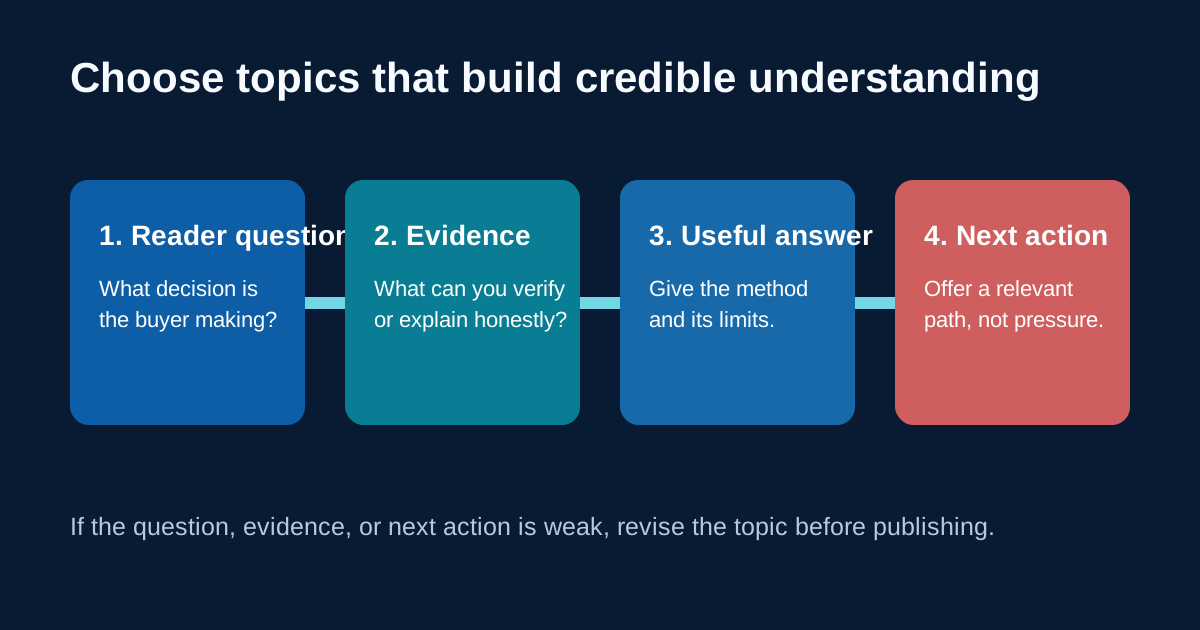
The strongest topic source is a decision a prospective customer already needs to make. Listen for questions that recur during discovery, project planning, delivery, or follow-up. They might ask what information to prepare, how to compare two approaches, why a process has stalled, or what a proposed service can and cannot resolve. Capture the question without names, confidential details, or invented outcomes.
Separate a useful question from a content prompt. “Five trends every founder must know” is a prompt. “What should a business owner check before approving a website redesign?” is a question with a decision behind it. The second gives you a way to describe tradeoffs, evidence, and next steps. The first often leads to unverified claims and generic advice.
Create a small topic record with the reader, question, decision, evidence required, appropriate format, and a review owner. This makes it easier to revisit an idea without relying on memory. It also prevents a founder from reusing a fast-changing product update after the source has gone stale. Google’s people-first content guidance supports the same reader-first discipline: make content for an audience that will find it useful, not primarily to attract attention from a system.
Build a point of view from work you can explain
A point of view is not a dramatic opinion. It is a reasoned explanation of how you approach a recurring business decision. It can describe the sequence you use, the evidence you seek, the conditions that change your recommendation, and the limits of a general answer. Someone should be able to ask “why?” and receive a useful response rather than a bigger claim.
For example, a founder might argue that a business should map customer questions before adding website features. The point is not that features never help. It is that a team should first understand the job a feature is expected to do, the information it needs, and how the customer will use it. That is a useful position because it helps a reader evaluate an option without pretending every company has the same constraints.
Do not borrow authority through unsupported statistics, anonymous client stories, or quotations you cannot verify. If a concrete example is unavailable, use a clearly labelled hypothetical situation or explain the decision framework instead. The Vedam Vision process can provide a transparent route for readers who want to understand how work is approached, but it should not be used as proof of an outcome the business has not documented.
Use formats for the job they can do
A complete article is useful when the reader needs a detailed answer, definitions, limitations, and links to supporting material. A LinkedIn post is better for one observation, one question, or one part of the explanation. A short video or visual may clarify a sequence, but it should not replace the written context required for a complex decision. Choose the format after you know the reader’s job, not because a calendar needs another asset.
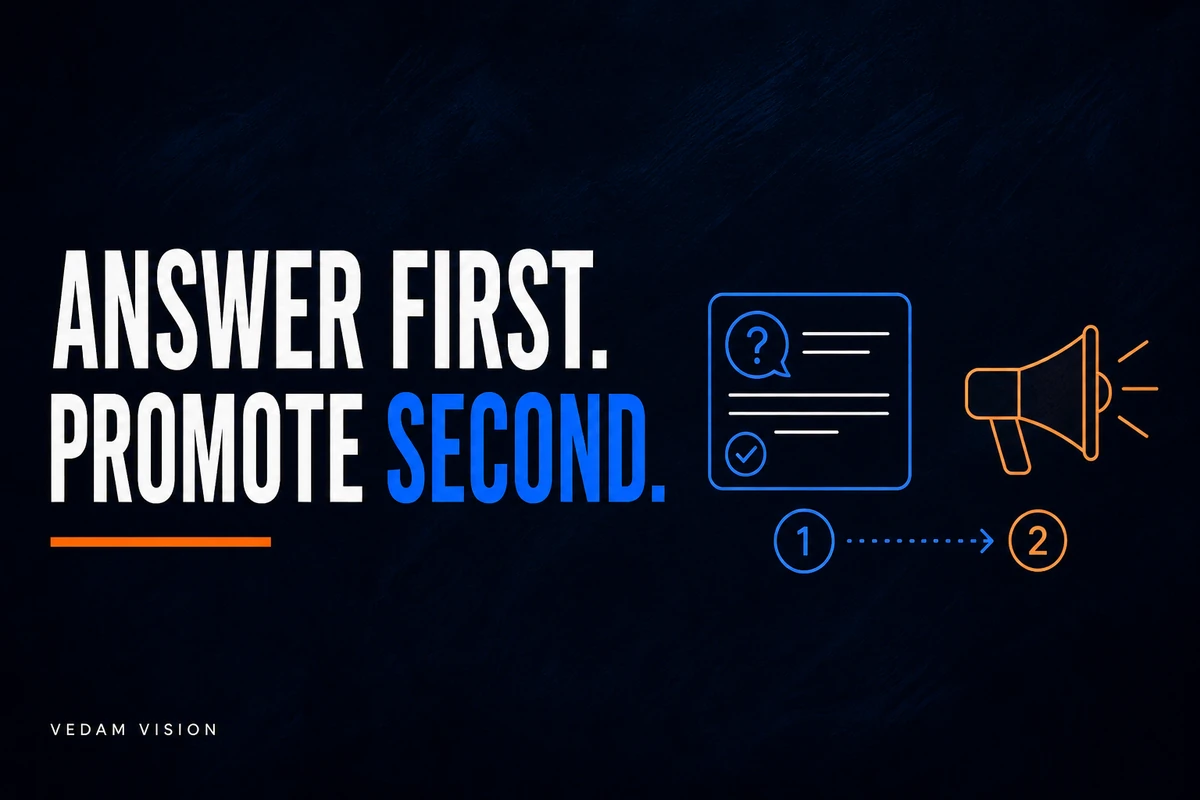
Make the substantive article the source of truth. It should answer the question early, show a practical method, explain what it cannot decide for the reader, and point to relevant next paths. A person considering a broader digital discussion can use the free digital audit route; a person who needs a direct conversation can use the contact route. Neither invitation should appear before the reader has received enough information to judge whether it is relevant.
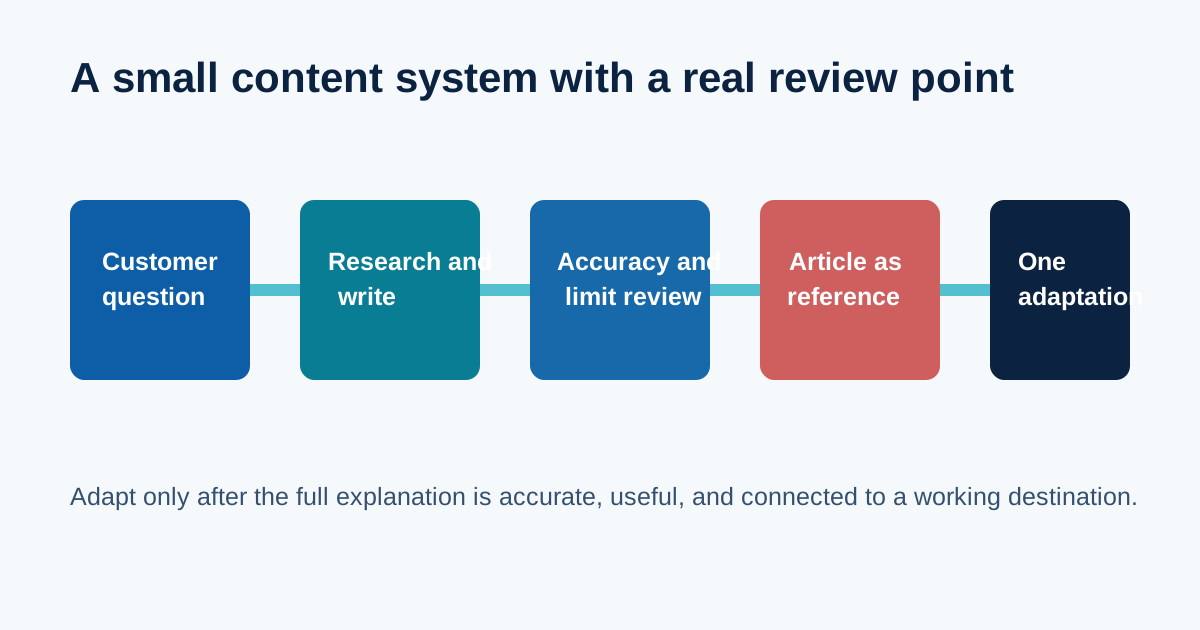
When adapting an article into a post, choose one useful angle rather than compressing the whole guide into a list. Link to the full explanation only when the destination delivers on the promise. This keeps the content connected without treating every channel as an identical copy.
Set a sustainable editorial rhythm
A founder does not need to publish daily to be credible. A sustainable system may begin with one researched article every few weeks, then extract several smaller observations that each preserve the original meaning. The rhythm should match the time available for thinking, checking, and responding. Publishing faster than you can verify is a reliability problem, not a growth tactic.
Use a simple editorial sequence: collect the question, identify the claim, gather the source or internal expertise needed, write the answer, check it for clarity and limits, then decide whether it deserves a shorter adaptation. Keep records of source URLs and review dates for changing facts. The U.S. Small Business Administration’s marketing and sales guidance is useful general context for keeping marketing connected to customer needs rather than treating it as isolated promotion.
Review claims, invitations, and internal paths
Before publishing, check every claim that refers to a current tool, policy, statistic, market condition, or external standard. Find the authoritative source, state the claim carefully, and record when it was checked. If the source is unavailable, remove the claim or make the limitation clear. General advice can be useful without pretending to be a verified fact.
Also inspect the links around the content. An article that discusses website clarity might reasonably lead to the portfolio or case study library if those destinations help a reader assess examples. The link text should say what the reader will find, and the destination must remain live. A broken or mismatched path weakens trust even when the article itself is sound.
Keep invitations contextual and modest. Ask the reader to consider a question, inspect a related service, or start a conversation if the topic genuinely matches their situation. Avoid presenting a comment, download, or contact form as the only acceptable next action. Good thought leadership leaves the reader more capable whether or not they engage further.
Measure whether the work improves understanding
Do not judge a credibility strategy only by views or follower counts. Those measures may be useful signals, but they do not prove that the right people understood the work. Look for qualitative evidence: better questions in enquiries, fewer repeated explanations during sales conversations, feedback that an article clarified a choice, or subject specialists using the material because it accurately represents the method.
Review the topic record after a reasonable period. Did the content answer the intended question? Did it create a new ambiguity? Is an example now outdated? Does the business still stand behind the point of view? Update or retire material that no longer meets that standard. This keeps a public library honest rather than allowing old content to become a hidden liability.
Conclusion: make useful expertise easy to inspect
A thought leadership content strategy for founders should turn real customer questions into careful, useful explanations. Define the credibility you want to earn, choose decisions you can genuinely illuminate, explain your reasoning and its limits, and publish at a pace that supports review. When the work helps a reader think more clearly before it asks for attention, credibility becomes a consequence of usefulness rather than a performance.