
A content calendar for service business should make it easier to publish answers that help a buyer choose, prepare, or evaluate a service. Start with the questions already present in sales and delivery, assign each topic a purpose and owner, then leave enough room to revise or pause work when the facts or business priorities change. A calendar is a decision tool, not a demand for a fixed number of posts.
Generic filler appears when the calendar is built around empty dates. The team sees a gap, picks a broad topic, and writes something that could have been published by any business. A stronger approach begins with real reader needs and evidence the business can check. The date comes after the topic earns a place.
Start with the buyer journey and service realities
A service buyer normally needs more than inspiration. They need to understand the situation that makes a service relevant, the work involved, the information they should prepare, and the constraints that may affect the scope. List the moments when those questions arise. They may occur when a prospect first identifies a problem, compares options, asks for a proposal, prepares to begin, or reviews whether the work is delivering what was agreed.
Collect these questions from call notes, proposal feedback, project kick-offs, support requests, and internal delivery discussions. Keep the original language where possible. “What should we prepare before rebuilding our website?” is more useful than “website trends.” It gives the author a clear reader, a practical answer, and a natural next step.
Separate lasting questions from short-lived updates
Some questions remain useful for months or years, such as how to define a service scope or how to assess a workflow before automating it. Others depend on changing rules, products, pricing, search guidance, or platform features. Mark the difference in the calendar. Lasting questions can be developed as foundational articles. Changing topics need an authoritative source, an access date, and a future review date. Do not publish a time-sensitive claim just because a slot is available.
The Vedam Vision process gives readers a useful reference for the stages of work. The services pages can help a calendar editor check whether a planned topic actually connects to a defined service rather than a vague ambition.
Give every calendar entry a job
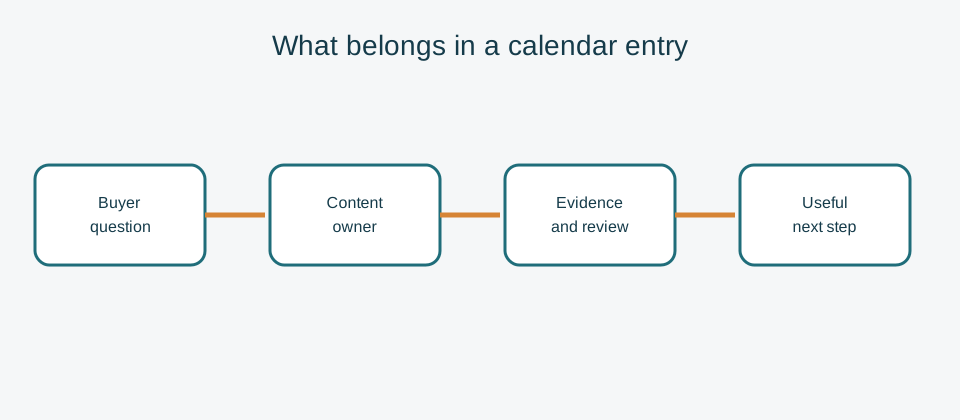
A calendar entry needs more than a working title. Record the reader, the exact question, the decision it should help them make, the pillar it supports, the source of expertise, the person responsible for review, and the relevant destination page. This makes a gap visible early. If no one can verify the topic, if the answer does not lead to a useful decision, or if the service page is outdated, the entry should be revised before it is drafted.
One entry might help a founder decide whether a marketing problem is actually a message problem. Another may help a manager prepare information for an operations review. A third could compare two bounded approaches to website content. The jobs are different, even if all three support the same broader offer. That distinction keeps the calendar from producing the same article in new wording.
Plan with pillars, but do not rotate mechanically
Content pillars provide a useful way to balance the calendar. A service business may have themes around clarifying an offer, improving digital customer journeys, strengthening internal systems, and planning practical marketing work. Each theme can generate several questions. However, a rigid weekly rotation can ignore the reader's needs. If two related questions need to be answered together, publish them in a helpful order. If a subject is not ready, move it rather than filling the date with a weak substitute.
Look for sequences that make sense. An article about choosing content pillars can be followed by one about turning pillars into a calendar. A piece about mapping a manual process can lead to one about assessing automation readiness. A decision guide can link to a more detailed planning resource. The relationship should be visible to the reader, not only to the editor's spreadsheet.
Balance depth, format, and effort
Not every idea needs a long article. Some deserve a detailed guide because the decision has several stages. Others work better as a short explanation, a checklist, a diagram, or an update to an existing page. Record the expected effort and approval needs. A complex technical topic may need research, a specialist review, and careful visual explanation. A simple clarification may only need a short interview with the person who performs the work.
Mixing formats can protect quality. It allows the team to keep a dependable cadence without stretching a small subject into a long article. It also creates a sensible route for reuse: a well-supported article can provide a focused social post, an email answer, or a service-page link. The underlying idea must still be rewritten for its context rather than copied without thought.
Reserve capacity for source checks and approvals
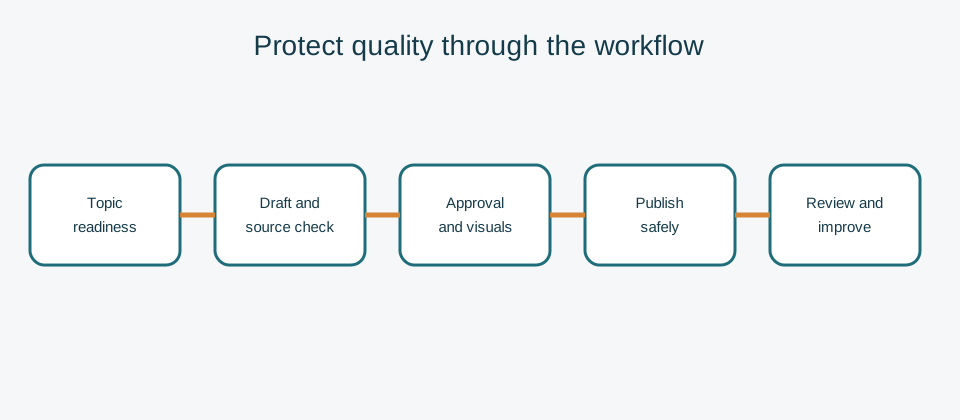
A calendar that contains only writing dates is incomplete. Add time for finding authoritative sources, checking live internal links, obtaining approval, creating accessible visuals, and reviewing a draft against the current offer. These tasks are part of publication, not optional polish. The person who knows a topic best may not be the person who can write or approve it, so make the handoffs explicit.
For claims that can change, record the source URL and access date alongside the entry. If an article mentions a platform feature, regulation, or current guidance, the source should directly support the claim. When an answer depends on a customer's confidential context, write about the decision framework instead of describing the customer. This avoids accidental disclosure and keeps the article useful beyond one situation.
Google's guidance on helpful, reliable, people-first content supports a calendar that begins with audience needs and verifiable expertise. It should not be used as a rule for producing more pages. The safer editorial choice is to postpone an entry when the source material or reviewer is unavailable.
Use internal links as routes for a real reader
Internal links work when they help a reader continue the decision they started. An article about operational handoffs can point to AI solutions and automation work when that service gives relevant detail. An article that explains how work is approached can lead to the process. A reader looking for inspectable work can review the authorised portfolio or the case study library.
Plan the link when the calendar entry is created, then verify it before publication. Remove a link when the destination is no longer current or the anchor text implies more than the page provides. Five relevant links are more useful than a crowded list of unrelated pages. The same principle applies to external sources: include the source because it helps the reader check an important claim, not because a template requires a citation.
Keep a backlog of qualified ideas
A backlog should not be a collection of vague headlines. Store only ideas that have passed the first qualification questions: who needs this, what decision does it help, what knowledge supports it, what makes it distinct, and what could make it unsafe or out of date? Tag each idea with a pillar, expected format, source needs, and review owner. This gives the editor a reserve of work that is more useful than scrambling for a topic after a delay.
Review the backlog monthly. Promote ideas that match current business capacity and audience need. Combine duplicates. Retire items that no longer fit the offer. Add ideas from new questions rather than searching for fashionable subjects. The U.S. Small Business Administration's marketing and sales guidance provides general context for connecting marketing activity to the wider customer process, which is exactly what a service calendar should do.
Review performance without chasing vanity metrics
The point of a calendar is not to prove that it was filled. Look at whether published work helped the intended reader. Useful signs may include a better question arriving through the contact form, a prospect sharing the article during a conversation, an internal team using it to explain a scope, or repeated confusion that suggests the page needs improvement. Record qualitative feedback as well as simple traffic information.
If a piece did not help, investigate the reason. It may have answered the wrong question, lacked a clear next step, used language that readers do not use, or appeared before the service page was ready. Do not immediately publish more on the same theme. Improve the destination, revise the article, or choose a different question. A calendar remains useful when it allows this learning to change future choices.
Limitations to keep visible
A content calendar cannot compensate for an unclear offer, weak delivery, or a lack of subject knowledge. It also cannot protect a team from overcommitment if there is no owner for approvals and follow-up. A service business should prefer fewer well-supported entries over a full calendar that repeatedly asks people to invent something at the last minute.
Current events and platform changes can disrupt a schedule. That is normal. Leave capacity to update, postpone, or remove a topic. The calendar should help the team make those decisions calmly, not turn dates into a source of pressure.
Conclusion: plan questions, owners, and evidence before dates
A content calendar for service business becomes valuable when every entry begins with a real buyer question, a clear editorial job, a credible source of knowledge, and a maintained next step. Use pillars to organise ideas, reserve time for review, and treat the calendar as a living decision tool. That prevents generic filler while making the publishing rhythm easier to sustain.